
One on One Meeting Template (2026): Free Agenda and 50+ Questions
Free one on one meeting template to copy and paste: a 1 on 1 agenda for weekly, first and quarterly 1:1s, 50+ one on one meeting questions, and notes.
Updated October 7, 2026
A one on one meeting template is a short agenda that a manager and one direct report fill in before each 1:1: how they're doing, last meeting's action items, the employee's topics, the manager's topics, feedback both ways, and new action items with an owner and a due date. Copy the short version below for a 30-minute weekly 1:1, or the fuller version if you meet every other week or for longer.
Every template on this page is plain text or a table you can paste straight into Google Docs, Word, Notion or your team's wiki, or print, with no download or sign-up. There are versions for a weekly 1:1, a monthly or every-other-week 1:1, a quarterly 1:1, a first 1:1, and an employee's 1:1 with their manager. After the templates: more than 50 one on one meeting questions grouped by topic, how often and how long to meet, how to run the meeting, and how to keep notes and action items from one 1:1 to the next.
We make Scribbl, an AI note taker for Google Meet, Zoom and Microsoft Teams. Everything here works with a shared doc and a pen, and when your 1:1s are on a video call, Scribbl writes the notes and action items for you, so you can listen to the person instead of typing.
One on one meeting template (short version)
For a 30-minute weekly 1:1. Paste it at the top of a doc you share with the other person, fill in the date, and both add topics during the week. For the next meeting, paste a fresh copy above the last one.
ONE ON ONE: [Employee name] and [Manager name]
Date: [date]          Length: 30 minutes

1. HOW ARE YOU DOING? (3 min)
   [anything on their mind, work or not]

2. LAST TIME'S ACTION ITEMS (2 min)
   [ ] [owner]: [action], due [date]     Done / Not yet / Dropped
   [ ] [owner]: [action], due [date]     Done / Not yet / Dropped

3. EMPLOYEE'S TOPICS (10 to 15 min)
   [added by the employee before the meeting]
   -
   -

4. MANAGER'S TOPICS (5 to 10 min)
   [added by the manager before the meeting]
   -
   -

5. FEEDBACK, BOTH WAYS (3 to 5 min)
   One thing that went well:
   One thing to change or try:
   One thing the manager could do better:

6. NEW ACTION ITEMS (2 min)
   [owner]: [action], due [date]
   [owner]: [action], due [date]

Next 1:1: [date]
Why this order: the employee's topics come before the manager's, so the meeting doesn't turn into a status update for the manager. Manager Tools' weekly 1:1 format also puts the employee's time first. Action items sit at both ends, so every promise from last week gets checked and every new one gets an owner.
1 on 1 meeting template as a table
If you'd rather fill in a table, copy this one. It has the same sections as the short version.
| Section | Time | Who adds it | What goes here |
|---|---|---|---|
| How are you doing? | 3 min | Employee | Anything on their mind, work or not |
| Last time's action items | 2 min | Both | Each one marked done, not yet, or dropped |
| Employee's topics | 10 to 15 min | Employee, before the meeting | Their questions, problems and ideas |
| Manager's topics | 5 to 10 min | Manager, before the meeting | Context, priorities, decisions that affect them |
| Feedback, both ways | 3 to 5 min | Both | One thing that went well, one to change, one for the manager |
| New action items | 2 min | Both | Owner, action, due date |
| Next 1:1 | Manager | Date |
Which one on one meeting template to use
Every template in this table is on this page. Pick by how often you meet and what the meeting is for.
| Template | Use it for | Length |
|---|---|---|
| Short version or table | A weekly 1:1 with a direct report | 30 minutes |
| Fuller version | A 1:1 every other week or once a month | 45 to 60 minutes |
| Quarterly | Goals and career, once a quarter, in place of one regular 1:1 | 45 to 60 minutes |
| First 1:1 | A new report, or a team you just took over | 45 to 60 minutes |
| Employee's version | Preparing for a 1:1 with your own manager | Fits any length |
| Skip-level questions | A 1:1 with your manager's manager | 30 minutes |
Keep performance reviews, pay and promotion talks out of all of them. Those need their own meeting (more on that below).
Fuller one on one meeting template (every other week or monthly)
For a 45 to 60-minute 1:1 every other week, or a longer monthly one when you also talk most days. It adds wins, what they learned, priorities, blockers and a few minutes on growth.
ONE ON ONE: [Employee name] and [Manager name]
Date: [date]          Length: [45 or 60] minutes
Last 1:1: [date]

CHECK-IN (5 min)
   How are you doing, really?
   Anything outside work you'd like me to know? (only if they want to share)

LAST TIME'S ACTION ITEMS (5 min)
   Owner     Action                              Due       Status
   [name]    [action]                            [date]    Done / Not yet / Dropped
   [name]    [action]                            [date]    Done / Not yet / Dropped

WINS SINCE LAST TIME (5 min)
   -
   Something you learned:

PRIORITIES UNTIL THE NEXT 1:1 (5 to 10 min)
   1.
   2.
   3.

BLOCKERS, AND WHAT YOU NEED FROM ME (5 to 10 min)
   -

EMPLOYEE'S TOPICS (10 to 15 min)
   -

MANAGER'S TOPICS (5 to 10 min)
   -

FEEDBACK (5 min)
   For the employee: one thing to keep doing, one thing to change
   For the manager:  one thing to keep doing, one thing to change

GROWTH (5 min)
   Goal or skill we're working on:
   Progress since last time:
   Next step:

NEW ACTION ITEMS
   Owner     Action                              Due
   [name]    [action]                            [date]
   [name]    [action]                            [date]

Next 1:1: [date]
What to cover each week vs each quarter
A weekly 1:1 that tries to cover everything ends up covering this week's work and nothing else. Spread the bigger topics out instead.
| How often | What to cover | Why |
|---|---|---|
| Every week | How they're doing, last week's action items, their topics, priorities and blockers, quick feedback, new action items | Small problems come up while they're still small |
| About once a month | Workload and pace, how the team is working together, feedback on you as a manager, progress on the skill they're building | These change slowly and get crowded out by weekly work |
| Every quarter | Last quarter's goals and how they went, goals for next quarter, career goals, what they want more or less of in their job | Ties weekly work to where they want to go, so the performance review holds no surprises |
| In a separate meeting | Performance reviews, pay and promotions, formal warnings | These need preparation and paperwork, and would crowd out the employee's own topics |
For the quarterly 1:1, use this in place of the usual agenda:
QUARTERLY ONE ON ONE: [Employee name] and [Manager name]
Quarter: [quarter and year]          Length: 45 to 60 minutes

LOOKING BACK
   Last quarter's goals, and how each one went:
   1. [goal]: [done / partly / not done], [what happened]
   2. [goal]: [done / partly / not done], [what happened]
   Work you're proudest of this quarter:
   What got in the way:

LOOKING AHEAD
   Goals for next quarter (each one specific, with a date):
   1.
   2.
   3.
   What you'd like more of in your job:
   What you'd like less of:

CAREER
   Where you'd like to be in one to two years:
   A skill to build this quarter, and how:
   What I'll do to help:

FEEDBACK
   For the employee:
   For the manager:

ACTION ITEMS
   Owner     Action                              Due
   [name]    [action]                            [date]
First one on one meeting template
Use this the first time you meet a new report, or when you take over a team that already exists. Spend most of the meeting listening.
Send a short invite first, so the first 1:1 doesn't feel like a performance talk:
Subject: Our 1:1s, starting [day]

Hi [name],

I'd like to start a weekly 30-minute 1:1 with you, [day] at [time].
It's your time: what's on your mind, what's in your way, and where
you want to grow. It isn't a performance review.

The first one will run about 45 minutes, so I can ask how you like
to work and get feedback. I've started a shared doc for our notes:
[link]. Add anything you want to talk about.

[Your name]
FIRST ONE ON ONE: [Employee name] and [Manager name]
Date: [date]          Length: 45 to 60 minutes

GETTING TO KNOW EACH OTHER
   Your background, and what brought you here:
   What you enjoy most in your work:
   Something outside work you like talking about:

HOW YOU LIKE TO WORK
   How you like to get feedback (right away, in our 1:1s, in writing):
   How you like to be recognized for good work (in public, in private, in writing):
   How and when you like to be reached, and when not to:
   Something the best manager you've had did well:
   Something you'd never want a manager to do:

YOUR WORK RIGHT NOW
   What you're working on:
   What's going well, and what's in the way:

HOW OUR 1:1s WILL WORK
   When we'll meet, and for how long:
   Where the notes live: [link to the shared doc]
   This is your meeting: add your topics before each one.

ACTION ITEMS
   Owner     Action                              Due
   [name]    [action]                            [date]
Ask the recognition question early. Gallup and Workhuman found that only 10% of employees are asked how they like to be recognized and appreciated (Source: Gallup, as of October 2026).
One on one meeting template for employees
If you're the employee, your manager may not bring a template. Bring your own. Fill this in the day before a 1:1 with your manager and paste it into the shared doc, or keep it for yourself.
MY 1:1 WITH [Manager name]
Date: [date]

WHAT I GOT DONE SINCE LAST TIME
   -

MY ACTION ITEMS FROM LAST TIME
   [ ] [action]     Done / Not yet / Dropped

WHAT I WANT TO TALK ABOUT (most important first)
   1.
   2.

WHERE I'M STUCK, AND WHAT I NEED FROM YOU
   -

A QUESTION ABOUT MY GROWTH (at least once a month)
   -

FEEDBACK I'D LIKE
   On:

NEW ACTION ITEMS
   Me:   [action], due [date]
   You:  [action], due [date]
For questions to bring, see questions to ask your manager below.
What is a one on one meeting?
A one on one meeting (also written 1:1 or 1 on 1) is a regular, private meeting between two people at work, most often a manager and one direct report. It's the employee's time to raise what's on their mind, get feedback and talk about growth. A one on one meeting template is the agenda you both fill in for it.
Other kinds of 1:1 use the same template with different questions: a skip-level 1:1 between an employee and their manager's manager, a 1:1 between two peers, and a mentoring 1:1.
| One on one | Team meeting | Performance review | |
|---|---|---|---|
| How often | Weekly or every other week | Often weekly | Often once or twice a year |
| Who sets the agenda | Mostly the employee | The team lead | The manager and HR |
| What it's for | The employee's topics, blockers, feedback both ways, growth | Shared work and updates | A formal rating, often tied to pay and promotion |
| What it isn't | A status update | A place for one person's problems | The first time the employee hears the feedback |
One on one meeting questions by topic
Pick two or three for a meeting. Don't work through a list. Questions that start with "what" or "how" get longer answers than yes-or-no ones. At the end are questions for an employee to ask their manager, and for a skip-level 1:1.
Check-in
- What's on your mind this week?
- On a scale of 1 to 10, how's work going right now? What would make it one point higher?
- What was the best part of your week? The hardest?
- How's your energy compared with last month?
- Is anything outside work making this week harder? (Only if they want to share.)
Priorities and workload
- What are your top three priorities until we meet again?
- Is there anything on your plate that shouldn't be?
- What are you spending time on that isn't moving anything forward?
- If you could only finish one thing this week, what would it be?
- Is your workload too much, too little, or about right?
- Where are you waiting on someone else?
Blockers and support
- What's slowing you down right now?
- What do you need from me this week?
- Is there a decision you're waiting on?
- Who else could help with this, and have you asked them?
- What would you do if I weren't around to ask?
Feedback for the employee
- What are you most proud of from the last two weeks?
- What would you do differently on [project] if you started again?
- Can I share something I noticed in [meeting]? (Then be specific.)
- How do you think [project] looks from the outside?
- Where would you like more feedback from me?
Feedback for the manager
- What's one thing I could do differently to help you more?
- Is there anything I do that gets in your way?
- Do you get enough context from me on why we're doing things?
- Are these 1:1s useful? What should we change about them?
- Is there feedback you've held back because it felt awkward to say?
Career and growth
- What would you like to be doing in two years?
- What skill would you most like to get better at this quarter?
- What part of your job would you like more of? Less of?
- Is there someone here whose work you'd like to learn from?
- What project would stretch you without overwhelming you?
- What would make you want to stay here for a long time?
Team and company
- How are things with the rest of the team?
- Is there anyone you find hard to work with? What's going on?
- What would you change about how the team works?
- Is anything happening in the company you'd like more context on?
- Who on the team deserves recognition they're not getting?
Well-being
- Are you able to switch off after work?
- Is your schedule working for you?
- Is anything making you feel stressed or stuck?
- When are you next taking time off? Do you need some?
Questions to ask your manager in a one on one
- What should I focus on most until we meet again?
- How do you think I'm doing? What's one thing I should change?
- What does doing well in my role look like to you over the next six months?
- What are you and your own manager most worried about right now?
- Is there a project coming up that I could help with?
- What would you need to see from me to be ready for [next role]?
Skip-level one on one questions
For a 1:1 between an employee and their manager's manager.
- What's going well on your team that I might not hear about?
- What's one thing we could fix that would make your work easier?
- Do you know why we're putting [company goal] first this year?
- How can I help your manager help you?
How often and how long should one on ones be?
Weekly for 30 minutes is a good default, and two well-known sources back it. Manager Tools' one-on-ones are scheduled, weekly and 30 minutes long, with the employee's topics first (Source: Manager Tools, The Effective Manager: One-On-Ones, 2025). Gallup's research on manager conversations found that 15 to 30-minute conversations do more than 30 to 60-minute ones when they happen regularly, and that managers who don't give feedback every week need longer conversations to catch up (Source: Gallup, A Great Manager's Most Important Habit, updated February 16, 2026).
The same Gallup article found that 80% of employees who say they received meaningful feedback in the past week are fully engaged, yet only 16% of nearly 15,000 employees called their last conversation with their manager extremely meaningful. A short weekly 1:1 is the simplest way to make that feedback happen every week.
| How often | How long | Fits when |
|---|---|---|
| Every week | 30 minutes | Most direct reports, new hires, and anyone going through a change in their work |
| Every other week | 45 to 60 minutes | Experienced people on steady work, or a manager with many reports |
| Once a month | 60 minutes | Mentoring and skip-level 1:1s. On its own, too far apart for most direct reports |
| Every quarter | 45 to 60 minutes | The goals and career 1:1, in place of one regular 1:1 |
If something comes up, move the 1:1 instead of canceling it. Manager Tools says one-on-ones should be "rarely missed," and rescheduled when there's a conflict.
How to run a one on one meeting
- 1
The day before
Both of you add topics to the shared doc. The manager rereads the last two meetings' notes and checks their own action items.
- 2
Start with them
Ask how they're doing and listen to the answer. Then go through last meeting's action items: done, not yet, or dropped.
- 3
Their topics, then yours
Let them lead. Keep your own topics for after. Anything that's only a status update can go in email or chat instead.
- 4
Feedback both ways
Name one specific thing that went well and one thing to change. Then ask what you could do better.
- 5
Close with action items
Read back each new action item with one owner and one due date, so you both leave with the same list.
- 6
The same day
Tidy the notes in the shared doc and start on your own action items first.
Gallup lists what makes a manager's conversation meaningful, in order: recognition or appreciation for recent work, collaboration and relationships, and current goals and priorities, followed by the length of the conversation and the employee's strengths (Source: Gallup). The templates above cover each one. Recognition is the easiest to skip when the week was busy, so make it the first line of the feedback section.
The 10/10/10 format
If you don't want sections at all, Manager Tools splits a 30-minute weekly 1:1 into three parts: 10 minutes for whatever the employee wants to talk about, 10 minutes for the manager's topics, and 10 minutes on the future, meaning coaching and career planning (Source: Manager Tools). It works with the short template above: the employee's topics are their 10 minutes, and the feedback section covers the last 10.
One on ones on Google Meet, Zoom or Teams
- Use the same recurring link every week, so nobody hunts for it at the start.
- Turn cameras on if you both can. It's easier to tell how someone is really doing.
- Keep the shared doc open and type the action items where you can both see them.
- Close email and chat for the 30 minutes.
- If you want notes without typing, ask whether you can record, and let Scribbl write the notes and action items.
Common one on one meeting mistakes
- Canceling when things get busy. It tells the other person they're the first thing to go. Move it instead.
- Turning it into a status update. Status can go in chat. Keep 1:1 time for things that need a conversation.
- The manager talks most of the time. If you're talking more than half the meeting, ask more questions.
- No notes. The same topics come back every week and nothing moves.
- Action items with no owner or no date, or the manager's own items quietly dropped.
- Only talking about problems. Recognition for recent work is the top item on Gallup's list.
- Saving feedback for the annual review. By then it's too late to act on.
How to keep one on one notes and action items between meetings
Most 1:1s go wrong between meetings, not in them: an action item nobody wrote down, a career goal mentioned once and never again. A few habits fix most of it.
- One doc per person, shared with them. Newest meeting at the top, so the last one is always in view when you open it.
- Carry action items forward. When you paste a fresh copy of the template, move every item marked "not yet" into it. Nothing drops off the list without someone deciding to drop it.
- Write each action item as owner, action, due date. "Priya: send the draft on-call rotation to the team, by Tuesday, October 13." Not "follow up on on-call."
- Track the manager's action items too, and do them first. Nothing costs a manager more trust than forgetting what they promised.
- Keep a short list at the top of the doc for the quarter: goals, career goals, and things to bring up at review time. Add to it as things come up, so you're not trying to remember three months of 1:1s before a review.
- Write notes you'd be comfortable with the employee reading. Facts and agreements, not judgments.
- Agree on sensitive topics. For things like health or a complaint about a coworker, agree with the employee what goes in the shared doc, and follow your HR team's process for anything that has to be reported.
For a stand-alone action item list you can paste anywhere, use this:
| Owner | Action (start with a verb) | Due | Status | From the 1:1 on |
|---|---|---|---|---|
| [name] | [action] | [date] | Not started / In progress / Done / Dropped | [date] |
| [name] | [action] | [date] | Not started / In progress / Done / Dropped | [date] |
There are more formats in the meeting action items template post.
Example: a filled-in weekly one on one
A 30-minute weekly 1:1 between an engineer, Priya, and her manager, Dana, written in the short template.
ONE ON ONE: Priya Shah and Dana Lee
Date: Tuesday, October 6, 2026          Length: 30 minutes

1. HOW ARE YOU DOING?
   Tired after the release weekend. Taking Friday off.

2. LAST TIME'S ACTION ITEMS
   [x] Priya: write the rollback steps for the release, due Oct 2    Done
   [ ] Dana: ask Finance about the training budget, due Oct 2       Not yet, moved below

3. EMPLOYEE'S TOPICS
   - On-call keeps landing on the same two people. Wants a rotation.
   - Would like to lead the next customer pilot.

4. MANAGER'S TOPICS
   - What the Q4 priorities from the all-hands mean for our team.

5. FEEDBACK, BOTH WAYS
   Went well: the release notes were clear. Support had no questions.
   To try: raise risks in the team channel earlier, not the day before.
   For Dana: send the Q4 priorities in writing before the all-hands.

6. NEW ACTION ITEMS
   Priya: send the draft on-call rotation to the team, due Oct 13
   Dana: ask Finance about the training budget, due Oct 9
   Dana: add Priya to the pilot kickoff meeting, due Oct 9

Next 1:1: Tuesday, October 13
What to notice: Dana's late item from last week is still on the list, with a new date, instead of disappearing. Every new item has one person and one date. The feedback went both ways.
Where to keep 1:1 notes
| Where | Good for | Watch out for |
|---|---|---|
| Scribbl (our pick for 1:1s on video calls) | The video, a transcript with speaker names, AI notes and action items from Google Meet, Zoom and Teams in one place, free for 10 meetings a month. Smart Collections keep each person's 1:1s together | Tell the other person you're recording, every time |
| A shared doc (Google Docs, Word, Notion) | Free. Both people can add topics, and it's easy to search | Someone has to type during the meeting |
| Your company's HR or performance software, if it has a 1:1 feature | Notes sit next to goals and reviews | Only works if both people actually open it |
| Your meeting app's own AI notes | Google Meet's "Take notes for me," Zoom's meeting summary with AI Companion, and Teams intelligent recap write notes for you | Paid plans only, and each one covers only its own app |
On the built-in options: Google Meet's "Take notes for me" needs an eligible Google Workspace edition or Google AI plan (Source: Google Meet Help, as of October 2026). Zoom's meeting summary needs a paid Zoom Workplace license, Pro or higher (Source: Zoom Support, as of October 2026). Teams intelligent recap, which also works on 1:1 calls, needs a Teams Premium or Microsoft Copilot license (Source: Microsoft Learn, as of October 2026).
Should you record a one on one meeting?
Only if the other person is comfortable with it. Ask before the first one and say why: so you can listen instead of typing, and so you both have the same record of what was agreed. Then tell them at the start of every meeting that you're recording, and offer to pause for anything personal. In some places everyone on a call has to agree before it's recorded; see do you have to tell people you're recording and is it legal to record a meeting.
Not everyone wants this, and that's fine. Manager Tools, for example, asks managers to take 1:1 notes by hand. If your report would talk less with a recording running, take notes yourself.
Take one on one notes without typing: Scribbl
We make Scribbl, and it's built for exactly this: a manager who wants to listen in a 1:1, not type.
Scribbl is an AI note taker for Google Meet, Zoom and Microsoft Teams. Nothing joins the call: Google Meet works from a Chrome extension, and Zoom and Teams from Scribbl Desktop for Mac (Apple silicon) and Windows. After each 1:1 you get the video recording, a transcript with speaker names, AI notes and action items, so you can give the person your full attention and still leave with every action item, owner and date.
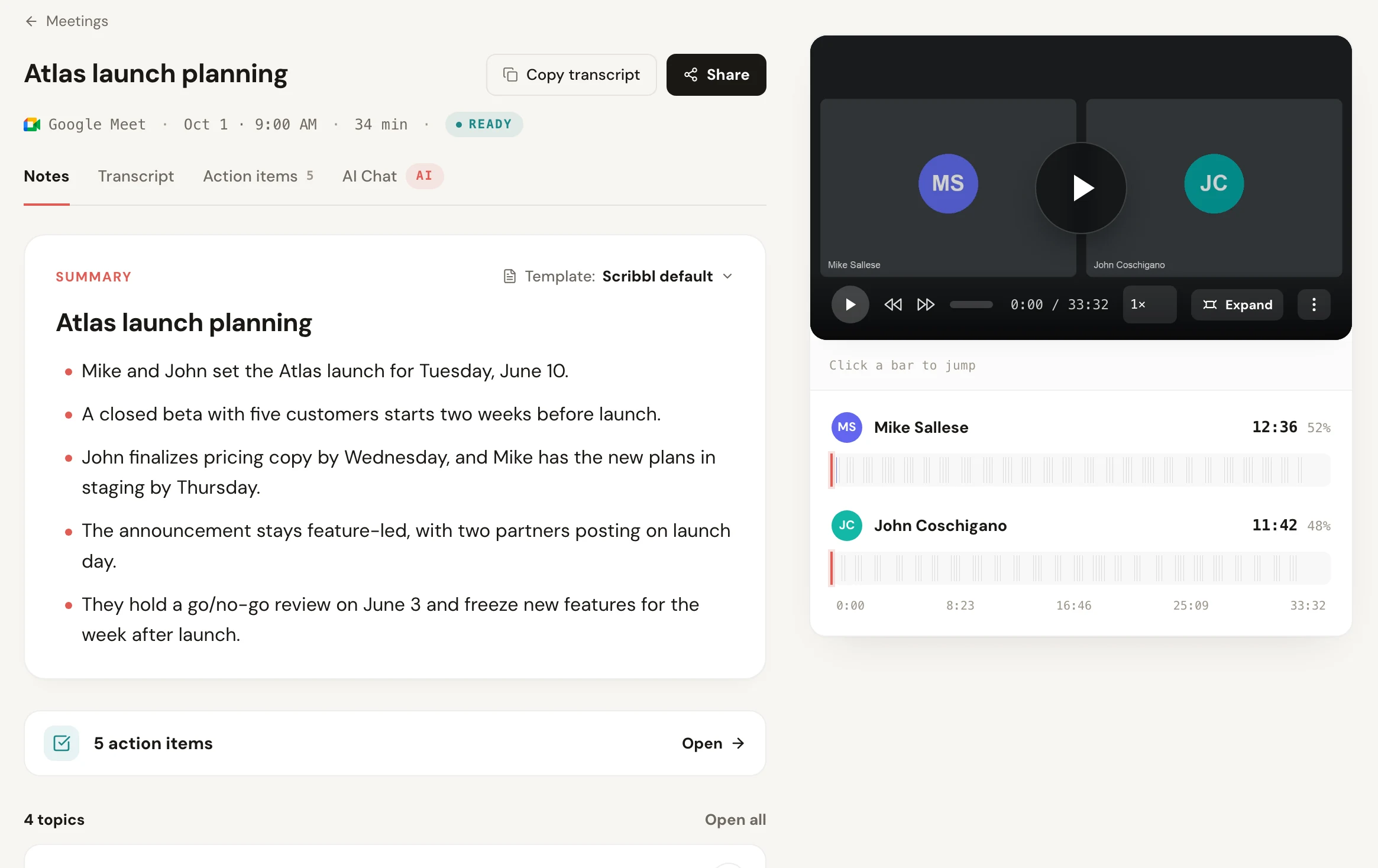
What it does between 1:1s, where most of them go wrong:
- Every 1:1 with one person in one place. Smart Collections sort each new meeting into the groups you describe, like "1:1s with Priya", so the history is there before a quarterly 1:1 or a review.
- Ask about the last three months. Connect Scribbl to ChatGPT or Claude and ask what someone said about on-call across your last few 1:1s, or which of your own action items are still open.
- Action items that don't drop. Automations can post the action items to Slack or Teams, save the notes to Notion or Confluence, or open Asana, Jira, Linear or Monday tasks for them. They ask before changing anything by default.
What it costs: the free plan includes Google Meet, Zoom and Microsoft Teams. It covers 10 meetings a month. Pro is $13 per user per month billed annually, or $20 monthly (pricing).
Privacy: recordings are private by default, and Scribbl doesn't use your meetings to train AI for anyone other than you. Tell your report you're recording at the start of each 1:1.
Try Scribbl freeTo compare AI note takers for 1:1s, see the best AI notetaker for 1-on-1 meetings. For how managers use Scribbl across their 1:1s, see Scribbl for managers. For your own notes in other meetings, see how to take better meeting notes.
FAQ
What is a one on one meeting?
A one on one meeting (also written 1:1 or 1 on 1) is a regular, private meeting between two people at work, most often a manager and one direct report. It's the employee's time to raise what's on their mind, get feedback and talk about growth. It isn't a status update or a performance review.
What should a one on one meeting template include?
How the person is doing, last meeting's action items, the employee's topics, the manager's topics, feedback both ways, and new action items with one owner and a due date each. A fuller version adds wins, priorities, blockers and a few minutes on growth. Put the employee's topics before the manager's so the 1:1 doesn't turn into a status update.
What questions should I ask in a one on one meeting?
Pick two or three open questions, not a list to work through. Good ones: What's on your mind this week? What's slowing you down? What do you need from me? What's one thing I could do differently to help you more? What skill would you most like to get better at this quarter? This page has more than 50, grouped by topic.
How long should a one on one meeting be?
30 minutes for a weekly 1:1, and 45 to 60 minutes if you meet every other week or for a quarterly 1:1 about goals and career. Gallup's research on manager conversations says 15 to 30 minutes is enough for a meaningful conversation, but only if it happens often.
How often should you have one on one meetings?
Weekly for most direct reports, especially new hires. Every other week can work for experienced people on steady work. Monthly is usually too far apart on its own, but fine for mentoring and skip-levels. Whatever you pick, reschedule instead of canceling.
Who should run a one on one meeting?
The employee leads with their topics, and the manager makes sure it happens: schedules it, keeps the shared doc, and follows up on action items. Both people add topics before the meeting.
What is the 10/10/10 format for one on ones?
It's Manager Tools' split of a 30-minute weekly 1:1: 10 minutes for the employee's topics, 10 minutes for the manager's, and 10 minutes on the future, such as coaching and career. The employee's 10 minutes come first.
What should you not do in a one on one meeting?
Don't cancel it, turn it into a status update, do most of the talking, or save all your feedback for the annual review. Don't end without action items that have an owner and a due date, and don't forget the ones you took yourself.
What's the difference between a weekly and a quarterly one on one?
A weekly 1:1 covers the next week or two: how they're doing, priorities, blockers and action items. A quarterly 1:1 steps back: last quarter's goals, next quarter's goals, career plans, and what they want more or less of in their job. Keep reviews and pay talks in their own meeting.
What's the difference between a one on one and a performance review?
A one on one is a short, regular conversation, usually weekly, where the employee sets most of the agenda and nothing is formally rated. A performance review is a formal evaluation, usually once or twice a year, that can affect pay and promotion. Feedback given in weekly 1:1s means the review holds no surprises.
How do I prepare for a one on one with my manager?
Add two or three topics to the shared doc a day ahead, check your action items from last time, and note one thing you need from your manager. Bring a question about your growth at least once a month. Then lead the meeting with your topics.
How do you take notes in a one on one without typing the whole time?
Write only the action items during the meeting and fill in the rest right after. Or, with the other person's OK, record it with an AI note taker. Scribbl gives you the video, a transcript with speaker names, AI notes and action items after a 1:1 on Google Meet, Zoom or Microsoft Teams, so you can listen instead of typing.
Can I record a one on one meeting?
Only if the other person agrees. Ask before the first one, tell them at the start of each meeting that you're recording, and pause for anything personal. In some places everyone on a call has to agree before it's recorded.
Can I use this one on one meeting template in Google Docs or Word?
Yes. Copy any template on this page and paste it into Google Docs, Word, Notion or your team's wiki, or print it. Keep one doc per person, with the newest meeting at the top.
Sources
Every outside fact above was checked on these pages on October 7, 2026.
- Gallup: A Great Manager's Most Important Habit (published May 29, 2023, updated February 16, 2026): conversation length, how often, what makes a conversation meaningful, the 80% and 16% figures on meaningful feedback, and the 10% asked how they like to be recognized
- Manager Tools: The Effective Manager: One-On-Ones (slides, PDF, 2025): weekly, 30 minutes, the 10/10/10 split, rarely missed, notes taken by hand
- Google Meet Help: "Take notes for me" in Google Meet
- Zoom Support: Using Meeting Summary with AI
- Microsoft Learn: Intelligent recap for Teams calls, meetings, and events
- Scribbl: pricing
Try Scribbl
Let your meetings take their own notes.
Scribbl records, transcribes, and summarizes your Google Meet calls from your browser. No bot joins the call. Free forever for individuals.
Add to Chrome · It's free