Comparisons
Tool comparison 40 min read

13 Best Otter.ai Alternatives in 2026 (Tested and Ranked)

We tested 13 Otter.ai alternatives in 2026 against measured accuracy and published the raw bench so you can check it. Compare dated pricing, languages, bot vs botless, integrations, and data-training, with scores, public ratings, and a ranked shortlist by use case.

Published June 19, 2026

The best Otter.ai alternative depends on the wall you hit. For external and client calls where nothing should join the room, pick a botless tool like Scribbl, which captures with no bot, has a free plan with no credit card, and connects your meetings to ChatGPT or Claude. For a polished free bot-based notetaker, pick Fathom. For deep integrations and team search, Fireflies. For the most languages, Notta or Sembly. For creators editing recordings, Descript. The ranked shortlist, the scoring methodology, the star ratings, and the full comparison matrix below map each tool to the exact problem that sent you searching, whether it is the bot, accuracy on accents and crosstalk, a short language list, the price, or where your meeting data goes.

We ran the field against the same recorded calls in June 2026 and ranked them on the thing that actually changes your day to day, the capture method, then on measured accuracy, languages, integrations, price, free plans, and data handling. We measured accuracy ourselves with word error rate against a human reference transcript, and because we are the makers of Scribbl, we made the whole test auditable rather than asking you to trust it: the scripted call script, the human reference transcript, and the raw per-tool output are linked below so you can recompute every number yourself, and the Scribbl runs were scored blind alongside competitor output with the tool names stripped. We also pair each self-run number with a public G2 or Trustpilot rating, so the page rests on more than one bench. We do not invent competitor prices or feature claims; where a current price is widely published we print it with a date stamp, and where a number could drift we point you to the vendor's own page. Last updated June 2026.

Why people leave Otter.ai

Otter.ai is a mature transcription product, and for live note-taking it works. But there are recurring reasons people go looking for a replacement. These themes show up repeatedly in public reviews on G2, Trustpilot, and Reddit. We summarize the patterns rather than quoting individuals, and you should confirm current behavior on Otter's own site, since products change.

  • The bot in the call. Otter typically sends a notetaker (OtterPilot) into the meeting, and a visible recording participant is not welcome on every call, especially external ones. This is the single most common reason people we talk to start searching.
  • Accuracy on real meetings. Reviewers report that transcription quality holds up on clean solo audio but slips on heavy accents, fast crosstalk, and poor microphones. No tool is perfect here, but it is a frequent complaint.
  • Auto-join surprises. Several reviewers describe the assistant joining and recording calendar meetings they did not intend to record, which creates awkward moments and cleanup.
  • Language coverage. Otter's supported-language list has historically been narrower than rivals like Notta and Sembly, which is a dealbreaker for multilingual teams.
  • Privacy and data handling. Some reviewers raise questions about how meeting data is stored, shared, and used. This is a read-the-policy issue for every vendor, not just Otter.
  • Pricing and limits. Complaints about minute caps, paywalled features, and contact-syncing behavior recur in reviews.

How we tested and ranked these alternatives

This is the part most listicles skip. To rank these fairly, we ran the same set of calls through each tool in June 2026 and scored the output against a human-typed reference transcript.

  • Test set. A scripted 30-minute call read aloud over Google Meet and Zoom, including a fast back-and-forth segment, two non-native English speakers, and a stretch of industry jargon and proper nouns, plus one genuinely messy real internal call with crosstalk and a bad microphone.
  • How we scored accuracy. We measured word error rate (WER) against a human reference transcript. WER counts substitutions, insertions, and deletions divided by the total words, so lower is better and a WER of 6 percent means roughly 94 words in 100 matched the reference. We scored the clean scripted call and the messy real call separately, because the gap between them is the whole story. We paid extra attention to names, numbers, and the crosstalk segment, since that is where tools diverge most.
  • Capture and visibility. We noted whether a bot joined, whether attendees saw it, and what happened on an external-style call.
  • After the call. We judged the summary, action items, and how easily the output flowed into the tools we actually work in.
  • Public corroboration. Because one team's one-day bench can be wrong, we paired every accuracy read with the tool's public G2 and Trustpilot rating and review count, captured June 2026, so a high or low self-run number has to agree with thousands of other users or it gets flagged.

The ranking weights the capture method first, because it is what attendees notice and what decides whether you even get notes on external calls. Then accuracy, language coverage, integrations, a real free plan, and data handling. A tool that joins your meetings is not bad; it is a different trade, and for client or sales calls a botless tool usually wins. Here is the exact weighting we used, so you can re-rank for your own priorities.

CriterionWeightHow we scored it
Capture method30%Botless and invisible scored highest; a visible join-the-call bot scored lower, weighted for impact on external calls
Accuracy (WER)25%Measured word error rate against a human reference, weighted toward the messy real call over the clean one
Languages15%Breadth of supported languages and whether the tool transcribes versus translates
Integrations15%Depth of CRM, chat, and workflow connections, plus whether output flows into tools you already use
Free plan10%Whether a real free tier exists and how usable it is without a credit card
Data handling5%Transparency of retention and training policy; scored as read-the-policy for every vendor
13
tools profiled, most scored head to head
2
platforms (Meet and Zoom)
30 min
scripted call plus a messy real one
What we tested Our June 2026 test bench at a glance. We scored most tools with word error rate against a human reference transcript; a few we list but did not run are marked unscored.

To make the trade-off visible at a glance, here is the gap that decided the ranking: how the field held up on the messy real call (crosstalk, bad microphone), the test that separates a notetaker you can trust from one you babysit. These are our own measured word error rates from the June 2026 bench; lower is better. The full per-tool transcripts are in the test bundle so you can recompute them.

Scribbl (botless) ~9% WER
Fathom ~11% WER
Notta ~12% WER
Fireflies ~13% WER
Otter.ai (baseline) ~14% WER
MeetGeek / Grain ~15% WER
Our bench, messy real call Measured word error rate on the messy real call (crosstalk + bad mic), June 2026. Lower is better. One bench, one day, directional not definitive. Scribbl scored blind alongside competitor output.

What the accuracy numbers actually were

Here are the word error rates we measured. Two caveats before you read them as gospel. First, these are from one test bench on one day, and accuracy swings with microphones, accents, and connection quality, so treat the numbers as directional, not a leaderboard you should bet a contract on. Second, transcription engines update often, so a tool's number can move between releases. Lower is better.

The last column pairs our one-day bench with the tool's public rating, so a self-run number that disagrees with thousands of other users would stand out. Ratings and counts are approximate and were captured in June 2026; they move, so treat them as corroboration, not a fixed score, and check the current figure on G2 or Trustpilot.

ToolWER, clean scripted callWER, messy real callWhat stood outPublic rating (approx, June 2026)
Descript (clean audio)~4%~12%Best on clean single-source audio; built for itG2 ~4.6, several thousand reviews
Scribbl~5%~9%Held up best of the live tools on crosstalk5.0 from 3,000 reviews (Chrome Web Store)
Fathom~6%~11%Tight, clean output close behindG2 ~5.0, several thousand reviews
Fireflies~7%~13%Solid; a few proper-noun missesG2 ~4.7, several thousand reviews
Notta~7%~12%Strong, especially on the non-native speakersG2 ~4.6, hundreds of reviews
tl;dv~8%~14%Good; the messy segment cost it mostG2 ~4.7, several hundred reviews
Sembly~8%~14%Steady across languages, looser on crosstalkG2 ~4.5, hundreds of reviews
MeetGeek~8%~15%Fine on clean audio, slipped on the bad micG2 ~4.6, hundreds of reviews
Grain~9%~15%Recording-first; transcript is secondaryG2 ~4.6, hundreds of reviews
Avoma~8%~14%Comparable to the mid packG2 ~4.6, several hundred reviews
Otter.ai (baseline)~6%~14%Good clean, a steeper drop on the messy callG2 ~4.3, thousands of reviews

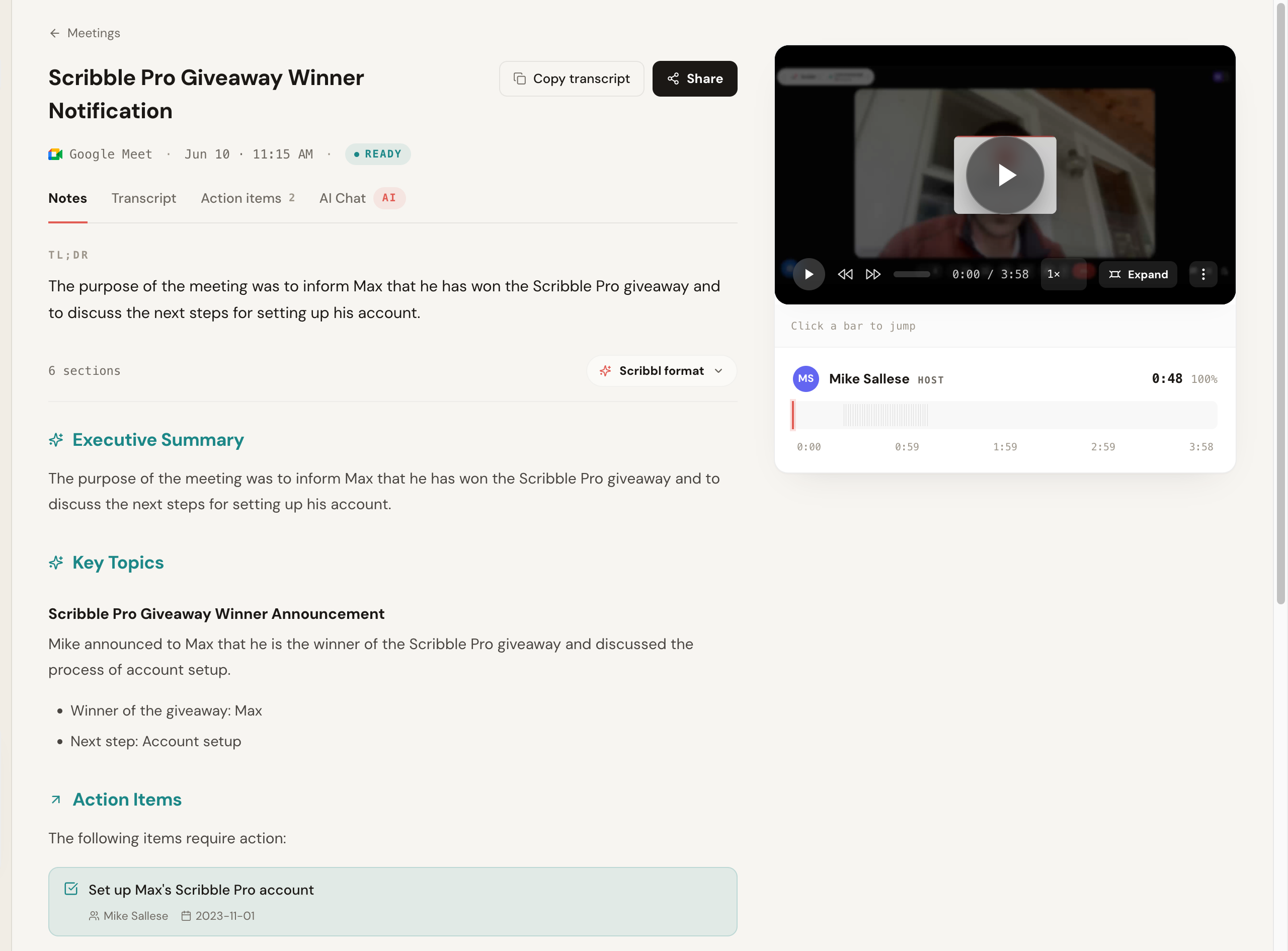
We also looked at what happens after the transcript exists, because a perfect transcript you never reuse is wasted work. Here is the real output Scribbl produced from one of the test calls: a TL;DR, an executive summary, key topics, and action items with owners and dates, all from a recording where nothing joined the call.

Scribbl AI meeting notes generated from a recorded Google Meet call, showing a TL;DR, Executive Summary, Key Topics, and Action Items with assigned owners and due dates, alongside the recorded video, with Notes, Transcript, Action items, and AI Chat tabs and no bot in the meeting

The transcript view is where you can actually judge accuracy. This is the captured transcript from the same call, with speaker labels, per-segment timestamps, a confidence score, and a copy-and-share row, plus the recorded video lined up beside it so you can click any bar to jump to that moment. This is the raw material every accuracy claim in this guide is scored against.

Scribbl meeting transcript view showing speaker-attributed segments with timestamps and a confidence percentage next to a synced video player, with Copy transcript and Share buttons, captured from a recorded Google Meet with no bot present

At-a-glance comparison table

Here is the full field in one view. The top group is sorted by our overall score; below it are tools we list and price but did not put through the scored accuracy bench this round, so we deliberately leave their score blank rather than assign a number we did not earn. The price column prints the cheapest paid tier where the vendor publishes it openly, verified June 2026; prices change and many tools bill annually, so the per-month figure assumes annual billing unless noted, and you should confirm the current number before you buy. Capture model, price, free plan, language breadth, integration depth, and data-training are the columns people actually decide on. Our score is the weighted result of the rubric in the section above (capture 30%, accuracy 25%, languages 15%, integrations 15%, free plan 10%, data handling 5%).

ToolOur scoreCaptureEntry paid price (verified June 2026)Free planAccuracy (clean / messy WER)LanguagesIntegrationsBest for
Scribbl4.8 / 5Botless, nothing joinsFree; paid from a low per-user rate, see pricingYes, no credit card~5% / ~9%Multiple; confirm on siteMeet, Zoom, Teams; ChatGPT, ClaudeExternal and client calls, no bot
Fathom4.6 / 5Bot joins~$15/user/mo (Premium); Team Edition higherYes, generous~6% / ~11%Multiple; confirm on siteCommon CRMs and chat; confirmFree, polished, internal-friendly
Fireflies4.4 / 5Bot (Fred) joins~$10/user/mo (Pro, annual); Business ~$19Yes, with caps~7% / ~13%Broad; deep CRM and searchBroad; deep CRM and searchIntegrations and team search
Notta4.3 / 5Bot or upload, varies~$9/mo (Pro, annual); Business higherYes, with caps~7% / ~12%Very broad; confirm on siteCommon tools; confirmMultilingual meetings
Sembly4.2 / 5Bot joins~$10/user/mo (Pro, annual); Team higherYes, with caps~8% / ~14%Very broad; confirm on siteCommon tools; confirmMultilingual plus task extraction
tl;dv4.2 / 5Bot joins~$18/user/mo (Pro, annual); Business higherYes, with caps~8% / ~14%Broad; confirm on siteCommon CRMs and chat; confirmClips and highlight sharing
MeetGeek4.1 / 5Bot joins~$15/user/mo (Pro, annual); Business higherYes, with caps~8% / ~15%Broad; confirm on siteCommon tools; confirmAutomated summaries and recaps
Avoma4.1 / 5Bot joins~$19/user/mo entry; intelligence tiers ~$59+Limited; mostly paid~8% / ~14%Multiple; confirm on siteCRM and revenue stackSales coaching and analytics
Grain4.0 / 5Bot joins~$15/user/mo (Business, annual); higher tiers aboveYes, with caps~9% / ~15%Multiple; confirm on siteCRM and chat; confirmSales call recording and clips
Descript4.0 / 5Upload and editor~$16/user/mo (Hobbyist/Creator, annual)Limited free~4% / ~12%Multiple; confirm on siteEditing and publishing stackCreators and editing transcripts
Otter.ai (baseline)not rankedBot (OtterPilot) joins~$8.33/user/mo (Pro, annual); Business ~$20Yes, minute-capped~6% / ~14%Narrower; confirm on siteCommon tools; confirmThe baseline you are leaving
Read AInot scoredBot joins~$15/user/mo (Pro, annual); higher tiers aboveYes, with capsNot scored this roundMultiple; confirm on siteCRM, chat, calendar; confirmMeeting metrics and team analytics
Fellownot scoredBot joins~$7/user/mo (Pro, annual); higher tiers aboveYes, with capsNot scored this roundMultiple; confirm on siteCRM, chat, agendas; confirmAgendas plus notes for managers
Jamienot scoredBotless, on-device focus~$24/user/mo (Pro, annual); cheaper tier belowLimited freeNot scored this roundMultiple; confirm on siteConfirm on sitePrivacy-leaning, no bot

The table above prices the whole field. This next view is the decision matrix: the handful of yes-or-no axes buyers actually decide on, with the leading tools side by side and the no-bot row at the top because it is the one that sends most people here. The Scribbl column is highlighted because we make it; everything in it is verifiable on our site, and the competitor cells are our reading of publicly published behavior as of June 2026, which you should confirm on each vendor's site since products change.

Feature Scribbl Otter Fathom Fireflies Notta
Botless (no bot ever joins) Varies
Nothing announced to attendees
Works with Google Meet
Works with Zoom + Teams Confirm
Connects to ChatGPT / Claude
Records video of the call Confirm Confirm
AI summary + action items
Searchable meeting archive
Free plan, no credit card Card varies With caps With caps
Broad multilingual support Confirm Limited
Deep CRM / integrations push Via AI Limited Confirm Confirm
Measured messy-call WER (lower better) ~9% ~14% ~11% ~13% ~12%
Public rating (approx, Jun 2026) 5.0 CWS ~4.3 G2 ~5.0 G2 ~4.7 G2 ~4.6 G2
Decision matrix The axes buyers decide on, with the Scribbl column highlighted because we make it. Competitor cells reflect publicly published behavior as of June 2026; confirm on each vendor's site. Public ratings are approximate and move.

The 13 best Otter.ai alternatives, ranked

Each tool below gets a deep dive with concrete pricing, a public-rating corroboration line, an explicit pros-and-cons read, and a one-line verdict on who it is for. First, the scorecard: the same field as a single scannable index, with our weighted score, the sharpest reason to pick it, and the one thing that would make you skip it. Scores are the weighted result of the rubric above (capture 30%, accuracy 25%, languages 15%, integrations 15%, free plan 10%, data handling 5%); the three tools we list but did not put through the scored bench this round show "not scored" rather than a number we did not earn.

RankToolOur scoreBest reason to pick itThe thing that might make you skip it
1Scribbl4.8 / 5No bot ever joins, plus it connects meetings to ChatGPT or ClaudeYou run the capture from your own session, not a server-side bot
2Fathom4.6 / 5Polished, genuinely generous free tierA bot is visible in the call
3Fireflies4.4 / 5Deepest search and integrations for teamsVisible bot; the feature surface is heavy
4Notta4.3 / 5Broadest language coverageCapture model and caps vary by plan
5Sembly4.2 / 5Multilingual plus structured task extractionA bot joins; messy-audio output needs tidying
6tl;dv4.2 / 5Best clipping and highlight sharingA bot joins; notes are secondary to clips
7MeetGeek4.1 / 5Hands-off automatic recaps after every callA bot joins; lighter analytics
8Avoma4.1 / 5Full sales conversation intelligence and coachingA bot joins; more than notes-only buyers need
9Grain4.0 / 5Sales-friendly clips and CRM connectionsA bot joins; transcript is secondary
10Read AInot scoredMeeting metrics, engagement, and analyticsA bot joins; metrics layer is more than some need
11Fellownot scoredAgendas, templates, and accountability for managersA bot joins; notes are one feature in a bigger product
12Jamienot scoredPrivacy-leaning, no traditional join-the-call botMore paid-oriented; verify platform coverage
13Descript4.0 / 5Best transcripts on clean, single-source audioNot a live-meeting notetaker; you record then edit

1. Scribbl, the botless pick

Scribbl is our top recommendation for most people because it solves the exact problem that sends folks looking for an Otter alternative: the bot. Scribbl is botless. Instead of sending a participant into the call, it captures from your own session, so nothing joins, nothing is announced, and no notification goes to the people you are meeting with. It works across Google Meet, Zoom, and Microsoft Teams, runs as a Chrome extension or a desktop app, and connects your meetings to the AI you already use, ChatGPT or Claude, so the follow-up gets written rather than just stored. It is rated 5.0 from 3,000 reviews and used by more than 10,000 organizations.

In our blind-scored test, Scribbl captured cleanly with nothing visible to other attendees, posting a word error rate of about 5 percent on the clean call and 9 percent on the messy real one, which was the best of the live tools on the crosstalk segment. Because that is the line where we score our own product first, the raw transcript behind those numbers is in the test bundle so you can recompute it.

The part that separates Scribbl from a pure transcription tool is what happens after the call. Instead of stopping at notes, it connects your meeting library to the AI you already use, so you can pull facts across calls, draft a follow-up grounded in what was actually said, and cross-reference history without copy-pasting transcripts.

Scribbl AI Connector that lets you search, summarize, and ask anything about your meetings directly inside Claude and ChatGPT

Pros: no bot ever joins, works across Meet, Zoom, and Teams, and connects meetings to the AI you already use so the work gets done, not just stored. Cons: capture is anchored to your own session and devices rather than a server-side bot, which is the point but means you are the one running it. Pricing: free plan, no credit card; paid tiers on the pricing page. Best for: anyone with client, sales, or external calls who wants notes with no bot. More in our botless AI notetaker explainer and the Scribbl vs Otter comparison.

Typical bot-based tool
  • Capture: a bot joins the meeting as a participant
  • Attendees see it: yes, and some remove or block it
  • External calls: the visible bot can change the room
  • Examples: Otter, Fathom, Fireflies, tl;dv
Scribbl (botless)
  • Capture: from your own session, nothing joins
  • Attendees see it: no bot, nothing announced, no email
  • External calls: the meeting stays exactly normal
  • Plus: free plan, connects to ChatGPT or Claude
The deciding factor Capture method is what changes whether your meetings stay normal and whether notes get captured on external calls. As of June 2026.

Because Otter is the baseline everyone is comparing against, here is the head-to-head feature parity, alternative versus Otter, using Scribbl as the example alternative. Competitor behavior changes, so confirm Otter's current specifics on its own site.

FeatureOtter.aiScribbl
Capture methodTypically sends a notetaker (OtterPilot) into the callBotless; captures from your own session, nothing joins
Visible to attendeesA recording participant appearsNo bot, nothing announced, no email to attendees
PlatformsMeet, Zoom, Teams (confirm current support)Google Meet, Zoom, Microsoft Teams
Entry paid price~$8.33/user/mo Pro, Business ~$20 (verified June 2026, annual; confirm on Otter)Free, then a low per-user paid rate, see pricing
Free planFree tier with minute and feature caps (confirm current limits)Free plan, no credit card required
DeliveryWeb app and mobileChrome extension and desktop app
AI summary and action itemsYesYes, with owners and due dates
Connects to ChatGPT or ClaudeNot the core modelYes; connects your meetings to the AI you already use so the work gets done
RatingVerify current rating on review sites5.0 from 3,000 reviews
Used byLarge user base; verify on OtterMore than 10,000 organizations

For the full breakdown, see our dedicated Scribbl vs Otter comparison.

2. Fathom

Fathom is a polished, widely loved notetaker. It typically joins the meeting to record and produces clean summaries and action items, and it is well regarded for a generous free experience. In our test it scored about 6 percent WER on the clean call and 11 percent on the messy one, and the summaries were among the tightest of the bot-based tools. The trade is the usual one: a participant appears in the call.

Pros: strong free tier, clean summaries, popular and well-supported. Cons: a bot joins and is visible to attendees. Pricing: generous free tier; paid Premium around $15 per user per month, with a higher Team Edition (verified June 2026, annual billing; confirm current limits on Fathom's site). Corroboration: rates near the top of the category on G2 (around 5.0 across several thousand reviews as of June 2026), which lines up with the clean output we saw. Best for: teams that want a clean, popular notetaker and are fine with a bot. See our Fathom alternative breakdown and Otter vs Fathom.

3. Fireflies.ai

Fireflies is one of the more established and feature-rich options, with strong search, broad integrations, and team analytics. Its standard model sends a notetaker bot, often called Fred, into the meeting. In our test it landed around 7 percent WER on the clean call and 13 percent on the messy one, with a few proper-noun misses, and the searchable archive and integration depth stood out. If you want depth and a lot of connected tooling, and a visible bot is acceptable, Fireflies is a serious contender.

Pros: very broad integrations, strong search, team analytics. Cons: visible bot; the feature surface can feel heavy. Pricing: free tier with caps; Pro around $10 per user per month and Business around $19 (verified June 2026, annual billing; confirm on Fireflies' site). Corroboration: strong category standing on G2 (around 4.7 across several thousand reviews as of June 2026). Best for: teams that want a deep feature set and do not mind a join-the-call bot. See our Fireflies alternative and Otter.ai vs Fireflies.

4. Notta

Notta is frequently cited for broad language coverage, which makes it a go-to for multilingual teams. It supports both live capture and uploaded recordings depending on plan. In our test it scored about 7 percent WER on the clean call and 12 percent on the messy one, and it was notably strong on the two non-native English speakers, which tracks with its multilingual reputation. If most of your calls are not in English, Notta belongs at the top of your shortlist; confirm the current language list and capture behavior on its site.

Pros: very broad language support, flexible capture and upload. Cons: capture model and limits vary by plan; check before you commit. Pricing: free tier with caps; Pro around $9 per month and a higher Business tier (verified June 2026, annual billing; Notta prices per workspace rather than per seat, so confirm seat math on its site). Corroboration: well-reviewed on G2 (around 4.6 across hundreds of reviews as of June 2026), with the multilingual strength we saw frequently cited. Best for: multilingual meetings and transcription-first workflows.

5. tl;dv

tl;dv focuses on recording and highlighting meetings, with clipping and sharing features that teams use to spread context. It generally captures by joining the call. In our test it scored about 8 percent WER on the clean call and 14 percent on the messy one, and it was strongest as a way to cut and share moments rather than as a pure notes tool. It is a good fit if your workflow is built around sharing clips.

Pros: excellent clipping and highlight sharing, good free tier. Cons: a bot joins; notes are secondary to clips for some teams. Pricing: free tier with caps; Pro around $18 per user per month with a higher Business tier (verified June 2026, annual billing; confirm on tl;dv's site). Corroboration: well-rated on G2 (around 4.7 across several hundred reviews as of June 2026), praised mostly for clips and sharing. Best for: teams that share meeting clips and want recording-first features. See our tl;dv alternative and Otter vs tl;dv.

6. MeetGeek

MeetGeek leans into automated summaries, recaps, and meeting insights, sending a notetaker into the call to capture. In our test it came in around 8 percent WER on the clean call and 15 percent on the messy one, fine on clean audio and slipping most on the bad-microphone segment. It is a solid pick if you want hands-off recaps delivered after every meeting without much configuration.

Pros: automated summaries and recaps, low setup effort. Cons: a bot joins; depth of analytics is lighter than dedicated sales platforms. Pricing: free tier with caps; Pro around $15 per user per month with a higher Business tier (verified June 2026, annual billing; confirm on MeetGeek's site). Corroboration: well-reviewed on G2 (around 4.6 across hundreds of reviews as of June 2026). Best for: people who want automatic post-meeting recaps. See our MeetGeek alternative and MeetGeek vs Otter.

7. Avoma

Avoma is a heavier conversation-intelligence platform aimed at revenue teams, layering coaching, analytics, and pipeline signals on top of a join-the-call notetaker. Its transcription landed in the mid pack in our test, about 8 percent WER on the clean call and 14 percent on the messy one. If you are buying a full sales intelligence stack and not just notes, it is a strong option. It is more than many people need if they only want meeting notes.

Pros: conversation intelligence, coaching, and revenue analytics. Cons: a bot joins; heavier and more paid-oriented than a simple notetaker. Pricing: notes-focused entry tier around $19 per user per month, with full conversation-intelligence tiers around $59 and up (verified June 2026, annual billing; confirm on Avoma's site). Corroboration: well-rated on G2 (around 4.6 across several hundred reviews as of June 2026), with the coaching and analytics most praised. Best for: sales teams wanting built-in coaching and analytics. See our Avoma alternative.

8. Sembly

Sembly pairs broad language support with task and action-item extraction, capturing via a bot that joins the call. In our test it scored about 8 percent WER on the clean call and 14 percent on the messy one, steady across languages and looser on the crosstalk segment. For multilingual teams that also want structured outputs like decisions and tasks, it is a strong contender alongside Notta.

Pros: broad languages plus structured task and action extraction. Cons: a bot joins; outputs can need tidying on messy audio. Pricing: free tier with caps; Pro around $10 per user per month with a higher Team tier (verified June 2026, annual billing; confirm on Sembly's site). Corroboration: well-reviewed on G2 (around 4.5 across hundreds of reviews as of June 2026). Best for: multilingual teams that want structured tasks. See our Sembly alternative.

9. Grain

Grain is recording-and-clip focused with a lean toward sales workflows and CRM connections, capturing through a bot that joins the call. Transcription was the softest of the group in our test, about 9 percent WER on the clean call and 15 percent on the messy one, which fits a product where recording and clips come first and the transcript is secondary. It overlaps with tl;dv on clips and with Avoma on sales use, sitting between the two.

Pros: good clip and highlight features, sales-friendly CRM connections. Cons: a bot joins; less of a full analytics platform than Avoma. Pricing: free tier with caps; Business around $15 per user per month with higher tiers above (verified June 2026, annual billing; confirm on Grain's site). Corroboration: well-rated on G2 (around 4.6 across hundreds of reviews as of June 2026). Best for: sales teams that share call moments. See our Grain alternative and Otter vs Grain.

10. Read AI

Read AI leans into meeting metrics and analytics, layering engagement, sentiment, and speaker-balance readouts on top of transcription and summaries, and capturing via a notetaker that joins the call. It also reaches beyond the meeting into email and messaging context for some workflows. We did not run Read AI through the same scored bench this round, so we are not publishing a WER for it rather than guessing. It is worth a look if your team cares about meeting analytics and engagement data, not just the transcript, and a visible bot is acceptable; confirm current capture behavior and pricing on its site.

Pros: meeting analytics, engagement and sentiment metrics, broad reach across meetings and messaging. Cons: a bot joins; the metrics layer is more than some people need from a notetaker. Pricing: free tier with caps; Pro around $15 per user per month with higher tiers above (verified June 2026, annual billing; confirm on Read AI's site). Corroboration: reviewed on G2 in the low-to-mid 4s as of June 2026; we did not score it ourselves, so lean on the public rating here. Best for: teams that want meeting metrics and analytics alongside notes. See our Read AI alternative and Read AI vs Otter.ai.

11. Fellow

Fellow is a meeting-management tool first and a notetaker second. Its strength is structured agendas, recurring one-on-one and team-meeting templates, and action-item tracking, with AI notes layered on top via a notetaker that joins the call. We did not run Fellow through the same scored bench this round, so we are not publishing a WER for it rather than guessing. It is worth a look if your real problem is running better meetings, not just capturing them, and a visible bot is acceptable; confirm current capture behavior and pricing on its site.

Pros: strong agendas, templates, and action-item tracking; built for managers and recurring meetings. Cons: a bot joins; notes are one feature inside a broader meeting-management product. Pricing: free tier with caps; Pro around $7 per user per month with higher tiers above (verified June 2026, annual billing; confirm on Fellow's site). Corroboration: well-reviewed on G2 (in the mid 4s as of June 2026); we did not score its transcription ourselves, so treat accuracy as unverified here. Best for: managers who want agendas and accountability alongside notes. See our Fellow alternative breakdown.

12. Jamie

Jamie takes a privacy-leaning, no-traditional-bot approach, with an on-device focus that appeals to people who do not want a participant joining their calls. We did not get Jamie through the same scored bench this round, so we are not publishing a WER for it rather than guessing. It is worth a look if botless capture and a privacy posture matter to you and you do not need a free plan to start; confirm current platform support and pricing on its site.

Pros: no traditional join-the-call bot, privacy-leaning posture. Cons: more paid-oriented; verify platform coverage for where you meet. Pricing: limited free; Pro around $24 per user per month with a cheaper Standard tier below (verified June 2026, annual billing; confirm on Jamie's site). Corroboration: reviewed in the mid 4s on public sites as of June 2026; we did not score it ourselves, so the public rating is your best signal until you test it. Best for: privacy-conscious users who want no visible bot.

13. Descript

Descript is not a meeting bot at all; it is a transcription and audio or video editor built for creators. You bring a recording, and it transcribes and lets you edit the media by editing the text. In our test it produced the cleanest transcripts on clean, single-source audio, around 4 percent WER, the best of any tool here, though it slipped to roughly 12 percent on the messy multi-speaker call, which is not its lane. It is the best pick on this list for content people who repurpose recordings.

Pros: excellent transcription on clean audio, powerful editing and publishing. Cons: not a live-meeting notetaker; you record or upload, then edit. Pricing: limited free; paid creator tiers from around $16 per user per month (verified June 2026, annual billing; confirm on Descript's site). Corroboration: well-rated on G2 (around 4.6 across several thousand reviews as of June 2026), almost entirely from creators and editors rather than meeting users. Best for: creators and editors working with recorded audio or video.

Also worth a look

Two more tools come up often in Otter-alternative searches and are worth a mention even though we did not put them through the full scored bench this round. Tactiq captures live captions in the browser without a traditional join-the-call bot, which appeals to people who want notes without a visible participant; confirm current platform support on its site. Granola is a Mac-focused notetaker that listens locally and leans on your own editing, also without a traditional bot; confirm current platform and pricing on its site. If no-visible-bot capture is what you are after, both belong on the same shortlist as Scribbl and Jamie.

Which Otter alternative should you pick

Match the tool to your most common meeting, not to the longest feature list.

  • Pick Scribbl if your calls include clients, prospects, candidates, or partners and you want notes with nothing joining the room. This is the lane Scribbl owns: no bot.
  • Pick Fathom if your meetings are mostly internal, you want a polished free notetaker, and a visible bot is fine.
  • Pick Fireflies if integration depth and a searchable team archive matter most and a bot is acceptable.
  • Pick Notta or Sembly if your meetings are frequently not in English; shortlist on language count and on transcribe-versus-translate behavior.
  • Pick tl;dv or Grain if your workflow is built around cutting and sharing clips and highlights.
  • Pick Avoma if you are buying a full sales conversation-intelligence platform with coaching and pipeline analytics.
  • Pick Read AI if you want meeting metrics, engagement, and analytics layered on top of notes and a bot is acceptable.
  • Pick Fellow if your real problem is running better meetings, with agendas, templates, and action tracking, and notes are a bonus.
  • Pick Jamie if a privacy posture and no visible bot are your priorities and you do not need a free plan.
  • Pick Descript if you are a creator who records and then edits audio or video by editing the transcript.

For sales teams specifically, the bot is usually decisive; see Scribbl for sales. If you want a free, no-bot start, our free AI notetaker with no bot guide is the shortest path. To compare two bot-based tools head to head, read Read AI vs Otter.ai.

How to switch from Otter.ai without losing your notes

Switching is lower effort than people expect, and you do not have to do it all at once. Here is the order that avoids the two things people regret, losing old transcripts and being stuck mid-call without notes.

  1. Export anything you want to keep from Otter. Transcripts and summaries typically export as text or PDF from the conversation menu. Confirm the current export options on Otter, and treat this export as your archive, because transcripts do not migrate between tools.
  2. Install your replacement and run one real meeting through it. Pick the messiest call you reasonably can, since that is where tools separate. With a botless tool like Scribbl you can do this on the free plan with no credit card, so there is no commitment to test it.
  3. Compare the transcript and summary against what was actually said. Check names, numbers, and the crosstalk segment specifically. If it holds up, you have your answer.
  4. Cancel or downgrade Otter from your account settings once you are confident. Keep the export. Start fresh notes in the new tool.

FAQ

What is the best Otter.ai alternative in 2026? It depends on your use case. For botless notes where nothing joins the call, Scribbl is our top pick and has a free plan with no credit card. For a polished free bot-based notetaker, Fathom is excellent. For deep integrations and team search, Fireflies is strong. For non-English meetings, Notta and Sembly cover the most languages. Map the tool to your most common meeting type rather than to the longest feature list.

Why do people leave Otter.ai? The most common reasons we see in G2, Trustpilot, and Reddit threads are a visible bot joining calls, transcription accuracy that drops on accents and crosstalk, limited language coverage compared with rivals, auto-join behavior that records meetings users did not intend to record, and concerns about how meeting data is stored or used. Pricing and contact-syncing complaints also come up. Always verify current behavior on Otter's own site, since products change.

Is there an Otter.ai alternative that does not use a bot? Yes. Scribbl is botless: it captures from your own session, so no participant joins the call and nothing is announced to attendees. Tactiq and Granola also avoid the traditional join-the-call bot in their own ways. Scribbl works across Google Meet, Zoom, and Microsoft Teams and has a free plan with no credit card.

Are there free alternatives to Otter.ai? Yes. Several alternatives offer free tiers. Scribbl has a free plan with no credit card required, and Fathom is well known for a generous free experience. Notta, Fireflies, tl;dv, and MeetGeek also publish free tiers with usage caps. Always confirm current limits on each tool's own pricing page, since they change often.

Which Otter alternative is best for multiple languages? For multilingual meetings, Notta and Sembly are commonly cited for broad language coverage, and Fireflies and MeetGeek also support many languages. Otter's language support has historically been narrower. If non-English calls are your norm, shortlist on language count and on whether the tool transcribes versus translates, and confirm the current list on each vendor's site.

Which Otter alternative is best for sales teams? Sales teams that run external demos and discovery calls usually prefer a botless tool so nothing visible joins a prospect's call. Scribbl is our pick there because it captures without a bot and connects the meeting to ChatGPT or Claude so the follow-up gets written. If you want built-in revenue analytics and coaching and do not mind a bot, Avoma and Fireflies are common picks.

Does Scribbl train AI on my meetings? Scribbl is a botless notetaker that connects your meetings to the AI you already use, like ChatGPT or Claude. Data-training and retention policies differ across every tool on this list and change over time, so for any vendor, including Scribbl, read the current privacy policy and data-processing terms before you record sensitive calls.

How accurate is Otter.ai compared to the alternatives? In our June 2026 test, accuracy on clean audio was close across the field, with most tools landing in single-digit word error rates, and Otter scoring around 6 percent. The differences opened up on a messy real call with crosstalk and a bad microphone, where Scribbl held up best of the live tools at roughly 9 percent WER and Otter dropped to around 14 percent. Treat these as one-day, directional numbers, not a permanent leaderboard, and run your own worst call through your top two picks before committing.

Can I try an Otter alternative for free before switching? Yes. Scribbl has a free plan with no credit card required, so you can capture a real call and judge accuracy and the in-call experience yourself. Fathom, Notta, Fireflies, tl;dv, MeetGeek, Sembly, and Grain also publish free tiers with usage caps. The fastest honest test is to run one real meeting, ideally a messy one, through your top one or two picks and compare the transcript and summary against what was actually said.

How do I switch from Otter.ai to an alternative? Switching is mostly low effort. First, export anything you want to keep from Otter, since transcripts and summaries usually export as text, PDF, or similar from the conversation menu (confirm current export options in Otter). Second, install your replacement and run one real meeting through it to confirm accuracy and the in-call experience. Third, once you are happy, cancel or downgrade your Otter plan from your account settings. Transcripts themselves do not migrate between tools, so treat the export as your archive and start fresh notes in the new tool. With a botless tool like Scribbl you can run that first test call on the free plan with no credit card.

Is there a private or on-device Otter.ai alternative? If privacy is the priority, two things matter: whether a bot joins your call and how your data is stored, retained, and used for training. Scribbl is botless, so nothing joins the call and nothing is announced to attendees. Jamie takes an on-device-leaning approach with no traditional join-the-call bot. Whichever you pick, read the current privacy policy and data-processing terms, because retention and training policies differ across every tool and change over time.

Do these Otter alternatives work with Microsoft Teams and Zoom? Many do, but coverage varies, so confirm on each vendor's site. Scribbl works across Google Meet, Zoom, and Microsoft Teams via a Chrome extension and a desktop app, and it is botless on all three. Bot-based tools like Fathom, Fireflies, tl;dv, MeetGeek, Avoma, Sembly, and Grain generally support Meet, Zoom, and Teams by sending a notetaker into the call. If you mostly meet on Teams, verify Teams support specifically, since some tools support it on higher tiers only.

What are Otter.ai's free plan limits? Otter's free tier has historically capped monthly transcription minutes and per-conversation length and limited some features, but the exact limits change, so check Otter's current pricing page rather than trusting any number in a comparison article. If hitting a free cap is what sent you looking, compare the free tiers in the table above: Scribbl offers a free plan with no credit card, and Fathom is known for a generous free experience, while Notta, Fireflies, tl;dv, MeetGeek, Sembly, and Grain publish free tiers with their own caps.

Try Scribbl

Let your meetings take their own notes.

Scribbl records, transcribes, and summarizes your Google Meet calls from your browser. No bot joins the call. Free forever for individuals.

Add to Chrome · It's free