
5 Best Tactiq Alternatives in 2026 (Compared and Ranked)
We compared the best Tactiq alternatives in 2026 against the limits that make people leave: no video recording, Chrome-only, pricing, accuracy. Compare features, pricing, ratings, and a ranked shortlist by use case.
Updated October 7, 2026
On this page7 sections
The best Tactiq alternative for most people is Scribbl. If you outgrew Tactiq because it gives you a transcript but no video recording or replay, Scribbl records the meeting as video with a synced, speaker-labeled transcript, stays botless so nothing joins the call, has a free plan with no credit card, and connects your meetings to ChatGPT or Claude so the follow-up actually gets written. If you need more than a Chrome browser tab (a desktop app, or a real Teams workflow), Scribbl ships both: the Chrome extension for Google Meet, and Scribbl Desktop for Zoom and Teams. The ranked shortlist, the scoring methodology, the star ratings, and the full comparison matrix below map each tool to the exact problem that sent you searching.
We compared the field in June 2026 and ranked them on what actually changes your day to day: what you get back after the call (a transcript, a recording, or finished work), then capture method, accuracy, languages, integrations, price, free plans, and data handling. We published our weighting below. We do not invent competitor prices or feature claims, because they change. Where a number could drift, we say so and point you to the vendor's own page. Last updated October 7, 2026.
Why people leave Tactiq
Tactiq is botless, which is a reason people pick it in the first place, so when someone goes looking for a replacement, it is rarely about the bot. It is one of a handful of specific limits. These themes show up repeatedly in public reviews and threads. We summarize the patterns rather than quoting individuals, and you should confirm current behavior on Tactiq's own site, since products change.
- No native video recording or replay. This is the one we hear most. Tactiq centers on the transcript: you get the words, but not the meeting back. When you need to rewatch how something was said or review a demo, a text-only record is not enough. If this is your trigger, you want a tool that records the video too.
- Chrome-extension first, so desktop and offline are awkward. Tactiq lives in the browser tab. That is fine until you are on a desktop meeting client, your laptop is offline, or you want capture that is not tied to one Chrome window. Reviewers who work outside the browser hit this wall.
- Weak Microsoft Teams desktop workflow. Teams is increasingly a desktop-app meeting, and a browser-extension transcriber is an uncomfortable fit there. If Teams is your main platform, this gap is decisive.
- Pricing and paywalled premium features. Tactiq has a free option, but reviewers note that higher AI-action limits, more meetings, and team features move you up the paid tiers, which small teams and individuals find pricey for what is, at the core, a transcript.
- Accuracy and multilingual misfires. Because Tactiq reads a meeting's existing captions, its transcript inherits whatever those captions get wrong. On heavy accents, crosstalk, bad microphones, and non-English calls, reviewers report misheard words and mixed-language stumbles. No tool is perfect here, but it is a frequent complaint.
- Privacy and where the data goes. As with any tool that processes your meeting content, some reviewers want clarity on retention and whether data is used for training. This is a read-the-policy issue for every vendor, not just Tactiq.
How we compared and ranked these Tactiq alternatives
This is the part most listicles skip. To rank these fairly, we paid particular attention to the Tactiq triggers above: do you get the video back, does it work outside a Chrome tab, and how does it hold up on a messy, multi-accent call.
- Accuracy. How the transcript holds up on a messy call with crosstalk and a bad microphone, not just on clean audio.
- What you get back. We noted whether the tool returns a transcript only, a transcript plus video recording and replay, or finished follow-up work, since that is the number-one Tactiq gap.
- Capture and reach. Whether a bot joins, whether attendees see it, and whether the tool is limited to a Chrome tab or also runs as a desktop app across platforms.
- After the call. The summary, action items, and how easily the output flows into the tools you already work in.
The ranking weights what you get back after the call first, because returning the meeting (not just its words) is the exact thing Tactiq leavers are missing. Then capture method, accuracy, language coverage, integrations, a real free plan, and data handling. Here is the exact weighting we used, so you can re-rank for your own priorities.
| Criterion | Weight | How we scored it |
|---|---|---|
| What you get back | 25% | Transcript only scored lowest; transcript plus video recording and replay scored higher; finished work connected to your own AI scored highest |
| Capture method | 20% | Botless and invisible scored highest; a visible join-the-call bot scored lower, weighted for impact on external calls |
| Reach beyond the browser | 15% | Chrome-only scored lowest; desktop app plus broad platform and Teams support scored highest |
| Accuracy | 20% | Accuracy on messy calls with crosstalk and bad microphones, weighted over clean audio |
| Languages | 10% | Breadth of supported languages and whether the tool transcribes versus translates |
| Free plan | 5% | Whether a real free tier exists and how usable it is without a credit card |
| Data handling | 5% | Transparency of retention and training policy; scored as read-the-policy for every vendor |
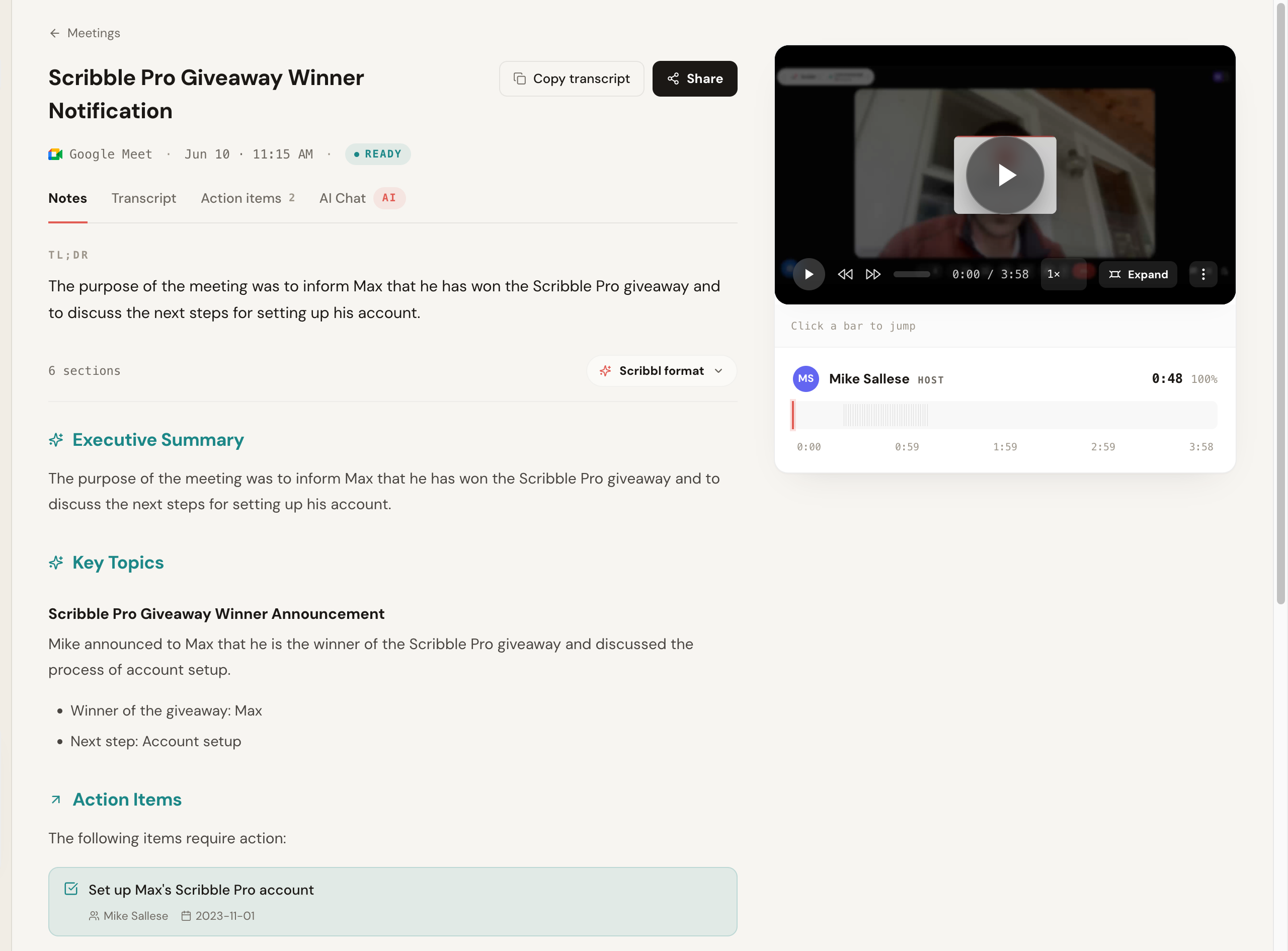
We also looked at what happens after the transcript exists, because the number-one Tactiq gap is that you get words but not the meeting. Here is the Scribbl notes view after a Google Meet call: a TL;DR, an executive summary, key topics, and action items with owners and dates, alongside the recorded video, all from a call where nothing joined the room.
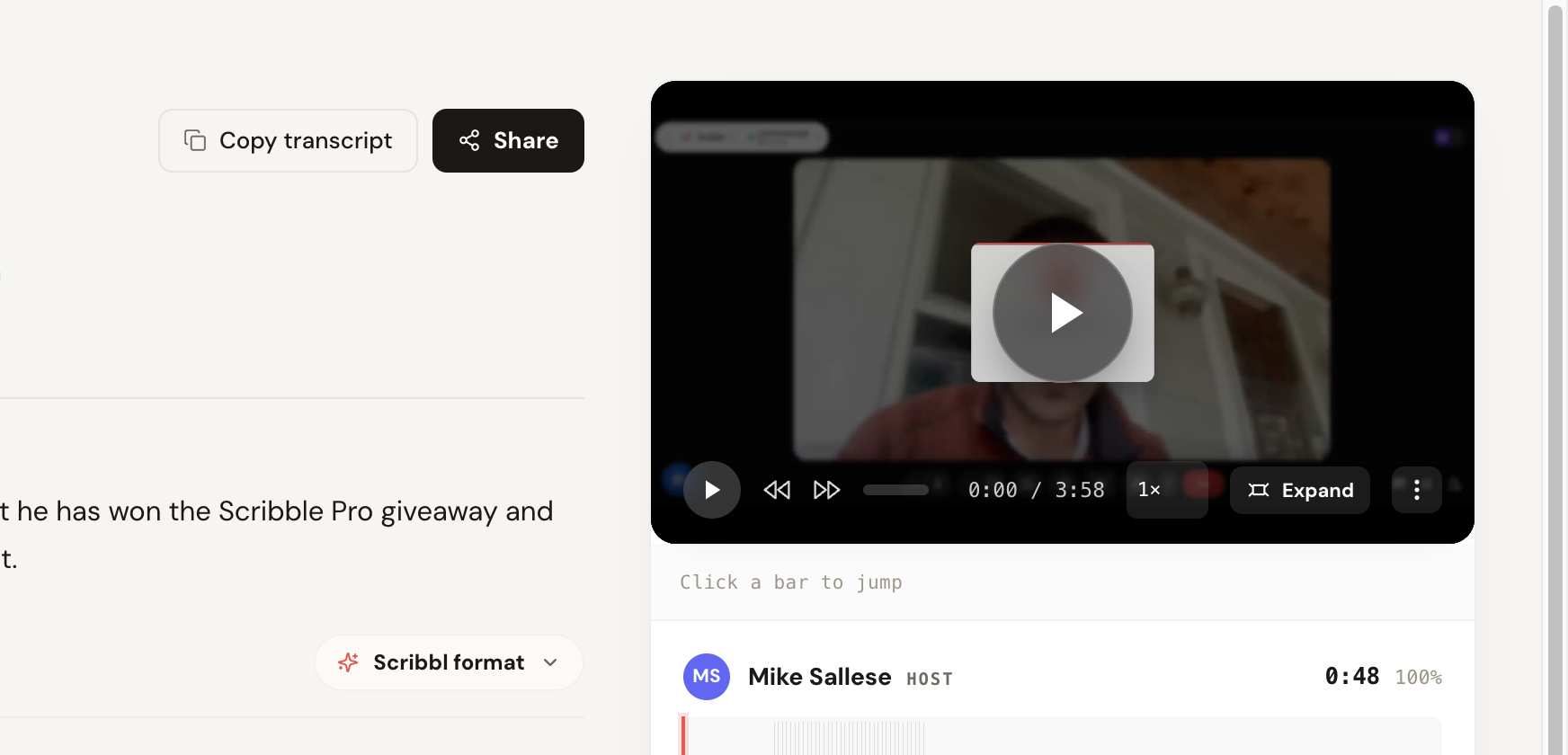
This is the piece Tactiq does not give you: the recording itself. Here is the transcript view where you can judge accuracy, with speaker labels, per-segment timestamps, a confidence score, and a copy-and-share row, plus the recorded video lined up beside it so you can click any line to replay that exact moment. A text-only transcript cannot do this.
Tactiq alternatives compared at a glance
Here is the full field in one view, in our ranking order. What you get back, capture model, reach beyond the browser, price, free plan, languages, and a public-rating read are the columns people actually decide on. Specifics like exact language counts, prices, and live ratings change, so treat the directional reads below as a shortlist builder and confirm current details on each vendor's site. The rating column is a directional read of public review aggregates (G2, Capterra, Chrome Web Store, Trustpilot, Product Hunt); the exact star value and review count drift constantly, so verify on the source before you quote it.
| Tool | You get back | Capture | Reach | Price (paid, per user/mo) | Free plan | Public rating (verify on source) |
|---|---|---|---|---|---|---|
| Scribbl | Video + transcript + AI follow-up | Botless, nothing joins | Chrome extension for Meet; Scribbl Desktop for Zoom and Teams | Pro $13 billed annually or $20 monthly | Yes: 10 meetings a month, each with AI notes, no credit card | 5.0 from 3,000 reviews on the Chrome Web Store; 4.9 from 725 reviews on G2 |
| Fathom | Video + transcript + summary | Bot joins | Meet, Zoom, Teams via bot | Premium $16 billed annually or $20 monthly | Yes; advanced summaries on your first 5 calls a month | High; verify current on G2/Capterra |
| Fireflies | Audio/transcript + search | Bot (Fred) joins | Meet, Zoom, Teams via bot | Pro $10 billed annually or $18 monthly | Yes, with caps | High; verify current on G2/Capterra |
| tl;dv | Video + clips + transcript | Bot joins | Meet, Zoom, Teams via bot | Free, then ~mid; confirm on site | Yes, with caps | High; verify current on G2/Capterra |
| Tactiq (baseline) | Transcript only | Botless, nothing joins | Chrome extension first | Pro $8 billed annually or $12 monthly; Team $16.67 or $20; Business $29.17 or $40 | Yes: 10 transcripts and 5 AI credits a month | High; verify current on G2/Chrome Web Store |
If you want the same thing in a faster scan, here is the feature-by-feature read across the four tools people compare most in this search: Scribbl, the Tactiq baseline, Fathom, and Fireflies. Competitor cells are directional and change often, so treat anything hedged as a shortlist signal and confirm on each vendor's own site.
| Feature | Scribbl | Tactiq | Fathom | Fireflies |
|---|---|---|---|---|
| Botless: no bot joins the call | Yes | Yes | No | No |
| Nothing announced, no email to attendees | Yes | Yes | No | No |
| Records the meeting as video | Yes | No | Yes | Yes |
| Synced, speaker-labeled transcript replay | Yes | No | Yes | Yes |
| Google Meet | Yes | Yes | Yes | Yes |
| Zoom | Yes | Confirm | Yes | Yes |
| Microsoft Teams | Yes | Confirm | Yes | Yes |
| Desktop app (beyond a Chrome tab) | Yes | No | Confirm | Confirm |
| Connects meetings to ChatGPT or Claude | Yes | Yes; Team plan or higher for transcripts | Yes | Yes |
| Free plan, no credit card | Yes | Free tier | Free tier | Free tier |
| Pricing approach | Free, then $13 billed annually or $20 monthly | Free, then paid | Free, then paid | Free, then paid |
| Public rating | 5.0 from 3,000 reviews on the Chrome Web Store | Verify on source | Verify on source | Verify on source |
The 5 best Tactiq alternatives, ranked
1. Scribbl, the botless pick that records the meeting
Scribbl is our top recommendation because it closes the gaps that send people away from Tactiq while keeping the one thing Tactiq gets right: no bot. Like Tactiq, Scribbl is botless: nothing joins the call, nothing is announced, and no email goes to attendees. Unlike Tactiq, it does not stop at the transcript. It records the meeting as video with a synced, speaker-labeled transcript you can click into and replay, and it runs as a Chrome extension on Google Meet and Scribbl Desktop on Zoom and Microsoft Teams. You can also ask ChatGPT or Claude about every meeting. It is rated 5.0 from 3,000 reviews on the Chrome Web Store and 4.9 from 725 reviews on G2, and used by more than 10,000 organizations.
Nothing is visible to other attendees. The free plan covers 10 meetings a month with no credit card, so you can verify all of this on a real call before paying.
The part that separates Scribbl from a pure transcriber is what happens after the call. It connects your meetings to Claude or ChatGPT, so you can pull facts across calls and draft a follow-up grounded in what was actually said. Smart Collections sort each new meeting into groups you describe in one sentence, so you can ask about just one group, like "What were the main objections in my sales calls this week?" Automations do the follow-up for you: they draft the email, log notes in HubSpot or Pipedrive, post to Slack or Teams, save to Notion, Google Drive or Confluence, or open Linear, Jira, Asana or Monday tickets, and by default they ask before changing anything. You can also tell Scribbl the job in plain words, and it runs with your own Claude.
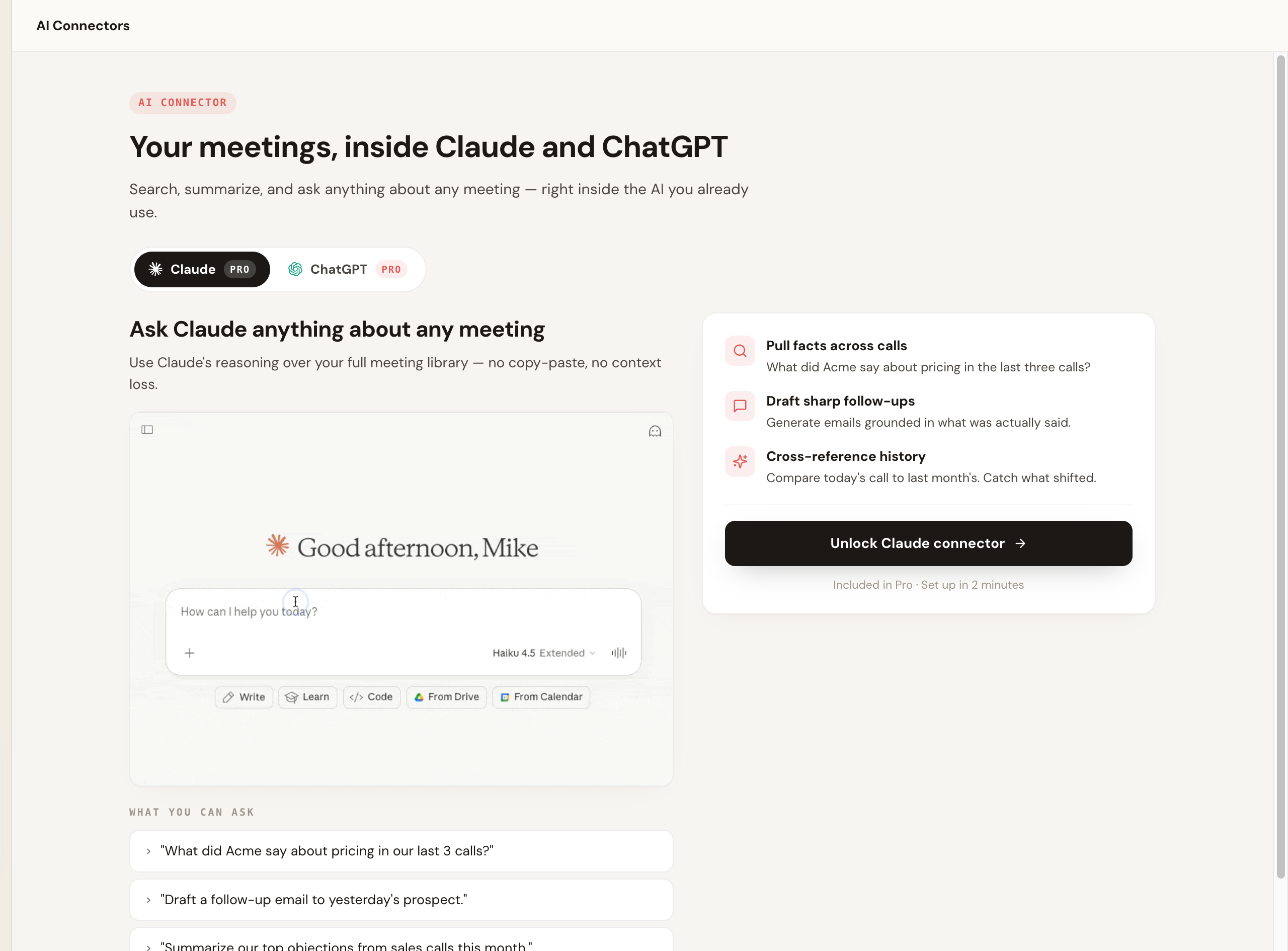
Pros: records video plus a synced, replayable transcript (the top Tactiq gap), botless so nothing joins, Chrome extension for Google Meet and Scribbl Desktop for Zoom and Teams, free plan with no credit card, ask ChatGPT or Claude about every meeting, and Automations do the follow-up. Pricing: free plan with 10 meetings a month and no credit card; Pro is $13 per user per month billed annually, or $20 monthly, on the pricing page. Best for: anyone who left Tactiq because they wanted the recording, replay, a desktop or Teams workflow, or finished follow-up, not just a transcript. More in our botless AI notetaker explainer and the dedicated Scribbl vs Tactiq comparison.
- You get back: a transcript, no native video recording or replay
- Capture: botless; reads the meeting's live captions
- Reach: Chrome-extension first; desktop and Teams are awkward
- After the call: transcript and AI summaries by tier
- You get back: the meeting as video plus a synced, replayable transcript
- Capture: botless; nothing joins the call
- Reach: Chrome extension for Meet; Scribbl Desktop for Zoom and Teams
- After the call: Automations do the follow-up, and you can ask ChatGPT or Claude about every meeting; free plan
Because Tactiq is the baseline everyone is comparing against, here is the head-to-head feature parity, Scribbl versus Tactiq. Competitor behavior changes, so confirm Tactiq's current specifics on its own site.
| Feature | Tactiq | Scribbl |
|---|---|---|
| Capture method | Botless; reads the meeting's live captions | Botless; nothing joins the call |
| Visible to attendees | No bot, nothing announced | No bot, nothing announced, no email to attendees |
| Video recording and replay | Not the core model; transcript-first | Yes; records video with a synced, click-to-replay transcript |
| Delivery | Chrome extension first | Chrome extension (Google Meet) and Scribbl Desktop (Zoom, Teams) |
| Platforms | Meet, Zoom, Teams via the browser (confirm current) | Google Meet, Zoom, Microsoft Teams |
| Free plan | 10 transcripts and 5 AI credits a month | 10 meetings a month, each with the video and AI notes, no credit card |
| AI summary and action items | Yes, with limits by tier | Yes, with owners and due dates |
| Connects to ChatGPT or Claude | Yes; on Free and Pro it only searches and lists meetings, Team or higher reads summaries and transcripts | Yes, on Pro; Smart Collections let you ask about one group of meetings |
| Rating | Verify current rating on review sites | 5.0 from 3,000 reviews on the Chrome Web Store; 4.9 from 725 reviews on G2 |
| Used by | Large user base; verify on Tactiq | More than 10,000 organizations |
For the full breakdown, see our dedicated Scribbl vs Tactiq comparison.
2. Fathom
Fathom is a polished, widely used notetaker, and unlike Tactiq it records the meeting as video with clean summaries. A bot typically joins the meeting to record. The trade versus Tactiq is the opposite one: you gain the recording, but a participant appears in the call. On the free plan every call gets an AI summary, but advanced summaries cover only your first 5 calls each month, and AI action items and follow-up emails need Premium.
Pros: records video, free plan, clean summaries, popular and well-supported. Cons: a bot joins and is visible to attendees, the thing Tactiq users picked Tactiq to avoid; AI action items need a paid plan. Pricing: free plan; Premium is $16 per user per month billed annually, or $20 monthly (Fathom pricing). Best for: teams that want a recorded, polished notetaker and are fine with a bot. See our Fathom alternative breakdown.
3. Fireflies.ai
Fireflies is one of the more established and feature-rich options, with strong search, broad integrations, and team analytics, all things a transcript-first tool like Tactiq does not center on. Its standard model sends a notetaker bot, often called Fred, into the meeting. If you left Tactiq for deeper tooling and a visible bot is acceptable, Fireflies is a serious contender.
Pros: very broad integrations, strong search, team analytics, records the meeting. Cons: visible bot; the feature surface can feel heavy. Pricing: free plan with caps; Pro is $10 per seat per month billed annually or $18 monthly, and Business is $19 billed annually or $29 monthly (Fireflies pricing). Best for: teams that want a deep feature set and a searchable archive and do not mind a join-the-call bot. See our Fireflies alternative.
4. tl;dv
tl;dv focuses on recording and highlighting meetings, with clipping and sharing features that teams use to spread context, exactly the video-and-replay layer Tactiq lacks. It generally captures by joining the call. It is a good fit if your workflow is built around sharing clips.
Pros: excellent clipping and highlight sharing, records video, good free tier. Cons: a bot joins; notes are secondary to clips for some teams. Pricing: free tier with caps plus paid plans; confirm on tl;dv's site. Best for: teams that share meeting clips and want recording-first features. See our tl;dv alternative.
5. Tactiq itself, as the baseline
Tactiq is on its own alternatives list as the baseline the other four are measured against: botless, lightweight transcription in the browser. A higher Tactiq tier raises AI limits and meeting counts, but it cannot add what is structurally missing from a transcript-first product: the meeting recorded and replayable, a desktop or true Teams workflow, or finished follow-up instead of a transcript. Confirm Tactiq's current tiers on its own site.
Otter and Granola
Two other names come up in Tactiq-alternative searches. Otter.ai records and summarizes, but it typically sends a visible notetaker (OtterPilot) into the call, the opposite of Tactiq's botless model; see our Otter alternative breakdown. Granola takes notes without a bot, but it transcribes and then deletes the audio, so there is no recording to replay, the same gap that sends people away from Tactiq. If you want to keep Tactiq's no-bot experience while gaining a recording, Scribbl is botless across Google Meet, Zoom, and Microsoft Teams, records the video, and has a free plan with no credit card.
Which Tactiq alternative should you pick
For most people leaving Tactiq, the pick is Scribbl. It keeps the botless experience you chose Tactiq for and fits best when:
- You want the meeting back, not just the words. Scribbl records the meeting as video with a synced, speaker-labeled transcript you can click into and replay, and nothing joins the call.
- You need more than a Chrome tab. The Chrome extension covers Google Meet, and Scribbl Desktop (Mac with Apple silicon, and Windows) covers Zoom and Microsoft Teams, all in one account.
- You want the follow-up done. Ask Claude or ChatGPT about every meeting, and let Automations draft the email, log notes in HubSpot or Pipedrive, or post to Slack or Teams.
- You want a free start. The free plan covers 10 meetings a month with no credit card, and each one gets AI notes and action items.
The other tools on this list that record video mostly do it by sending a bot into the call, the thing Tactiq users picked Tactiq to avoid.
For sales teams specifically, the recording and the no-bot capture are usually decisive; see Scribbl for sales. If you want a free, no-bot start, our free AI notetaker with no bot guide is the shortest path. If staying inside one browser tab was your frustration, the AI notetaker Chrome extension overview and our Windows and Mac desktop notes (Windows, Mac) show how a desktop app changes the workflow.
How to switch from Tactiq without losing your notes
Switching is lower effort than people expect, and you do not have to do it all at once. Here is the order that avoids the two things people regret, losing old transcripts and being stuck mid-call without notes.
- Export anything you want to keep from Tactiq. Transcripts and summaries typically export as text or PDF, or push to a connected doc tool, from the meeting menu. Confirm the current export options on Tactiq, and treat this export as your archive, because transcripts do not migrate between tools.
- Install your replacement and run one real meeting through it. Pick the messiest or most multilingual call you reasonably can, since that is where tools separate, and the one where you most wish you had the video. With a botless tool like Scribbl you can do this on the free plan with no credit card, so there is no commitment to test it.
- Check the thing that made you leave. If it was the missing recording, confirm you got replayable video. If it was Teams or desktop, run it where you actually meet. If it was multilingual accuracy, read the transcript in your language. If it was follow-up, see whether the summary and AI handoff save you the writing.
- Cancel or downgrade Tactiq from your account settings once you are confident. Keep the export. Start fresh in the new tool.
Tactiq alternatives FAQ
What is the best Tactiq alternative in 2026? Scribbl is our top pick for most people leaving Tactiq, especially if you outgrew it because it has no video recording or replay: it captures the meeting video and a synced, speaker-labeled transcript, is botless so nothing joins the call, works on Google Meet, Zoom, and Microsoft Teams, has a free plan with no credit card, and connects your meetings to ChatGPT or Claude so the follow-up gets written.
Why do people leave Tactiq? The patterns we see most in public reviews and threads are: it is Chrome-extension first with no native video recording or replay, so you get a transcript but not the meeting back; it is browser-bound, which makes a true Teams desktop or offline workflow awkward; premium features and higher AI limits sit behind paid tiers that small teams find pricey; and reviewers report accuracy gaps and multilingual misfires on accents, crosstalk, and non-English calls. Tactiq's botless capture is a genuine strength, so the trigger is usually one of those gaps, not the bot question. Confirm current behavior on Tactiq's own site, since products change.
Is there a Tactiq alternative that records video, not just the transcript? Yes. This is the most common reason people leave Tactiq. Scribbl records the meeting as video with a synced, speaker-labeled transcript you can click into and replay, while staying botless, so nothing joins the call. Bot-based tools like Fathom, Fireflies, and tl;dv also record video, but a visible participant joins the meeting to do it. If you want the recording without a bot, Scribbl is the pick, and it has a free plan with no credit card.
Is there a Tactiq alternative that works beyond the Chrome browser, on desktop or Teams? Yes. Tactiq is Chrome-extension first, which makes desktop-app and native Teams workflows harder. Scribbl ships both: the Chrome extension for Google Meet, and Scribbl Desktop (Mac with Apple silicon and Windows) for Zoom and Microsoft Teams, so Zoom and Teams calls are not tied to a browser tab. Most bot-based tools also cover Teams and Zoom by sending a notetaker into the call. If Teams is your main platform, verify Teams support specifically on each vendor's site, since some tools gate it to higher tiers.
Are there free alternatives to Tactiq? Yes. Scribbl has a free plan with no credit card required: 10 meetings a month on Google Meet, Zoom, and Microsoft Teams, each with the video, a transcript with speaker names, AI notes and action items, and no bot in the call. Fathom, Fireflies, and tl;dv also have free tiers, but each sends a bot into the call. Tactiq's own free plan covers 10 transcripts and 5 AI credits a month, so if hitting that cap or a paywalled feature is what sent you looking, compare the free plans in the comparison table and confirm the current limits on each vendor's own pricing page, since they change often.
Which Tactiq alternative is best for multiple languages? Multilingual misfires are a recurring reason people leave Tactiq. If non-English or mixed-language calls are your norm, shortlist on the published language count and on whether the tool transcribes versus translates, then run one real call in your language through your top pick. Confirm the current list on each vendor's site, since language support changes.
Which Tactiq alternative is best for sales teams? Sales teams that run external demos and discovery calls usually want the meeting recorded for review and coaching, without a visible participant joining a prospect's call. Scribbl is our pick there: it records video and transcript botless, so nothing joins, and it connects the meeting to ChatGPT or Claude so the follow-up and CRM-ready recap get written. Its Automations draft the follow-up email, log notes in HubSpot or Pipedrive, and post to Slack or Teams, asking before they change anything by default.
Does Scribbl train AI on my meetings? No. Scribbl doesn't use your meetings to train AI for anyone other than you, and recordings are private by default. Training and data policies differ across the other tools in this guide and change over time, so read each vendor's current privacy policy and data-processing terms before you record sensitive calls.
How accurate is Tactiq compared to the alternatives? Tactiq captures from a meeting's existing captions, so on a call with weak captions or heavy accents its transcript inherits those gaps, which matches the multilingual misfires reviewers report. No tool is perfect here, so run your own worst call through your top two picks before committing.
Can I try a Tactiq alternative for free before switching? Yes. Scribbl has a free plan with no credit card required, so you can record a real call and judge the recording, replay, and the in-call experience yourself. The fastest test is to run one real meeting through it and compare the transcript, the recording, and the summary against what was actually said.
How do I switch from Tactiq to an alternative? Switching is mostly low effort. First, export anything you want to keep from Tactiq, since transcripts and summaries usually export as text, PDF, or to a connected doc tool from the meeting menu (confirm current export options in Tactiq). Second, install your replacement and run one real meeting through it to confirm accuracy, replay, and the in-call experience. Third, once you are happy, cancel or downgrade your Tactiq plan from your account settings. Transcripts do not migrate between tools, so treat the export as your archive and start fresh in the new tool. With a botless tool like Scribbl you can run that first test call on the free plan with no credit card.
Do these Tactiq alternatives work with Microsoft Teams and Zoom? Many do, but coverage varies, so confirm on each vendor's site. Scribbl works on Google Meet with its Chrome extension and on Zoom and Microsoft Teams with Scribbl Desktop (Mac with Apple silicon and Windows), and it is botless on all three. Bot-based tools like Fathom, Fireflies, and tl;dv generally support Meet, Zoom, and Teams by sending a notetaker into the call. If you mostly meet on Teams, verify Teams support specifically, since some tools support it on higher tiers only or lean on the browser tab.
Try Scribbl
Let your meetings take their own notes.
Scribbl records, transcribes, and summarizes your Google Meet calls from your browser. No bot joins the call. Free forever for individuals.
Add to Chrome · It's free