
6 Best Read AI Alternatives in 2026 (Compared and Ranked)
Switching from Read AI? Here are the 6 best alternatives in 2026. Compare pricing, bot vs botless capture, accuracy, languages, integrations, and privacy, with a ranked shortlist by use case and a how-to-remove-Read-AI guide.
Updated October 7, 2026
On this page8 sections
- 01Why people leave Read AI
- 02How we compared and ranked these Read AI alternatives
- 03Read AI alternatives compared at a glance
- 04The 6 best Read AI alternatives, ranked
- 05Which Read AI alternative should you pick
- 06How to remove or disconnect Read AI
- 07How to switch from Read AI without losing your notes
- 08Read AI alternatives FAQ
The best Read AI alternative for most people is Scribbl. If the bot auto-joining your calendar calls and transcripts spreading across your org sent you searching, the fix is a botless tool: Scribbl captures with no bot, sends no email to the room, works on Google Meet, Zoom, and Microsoft Teams, has a free plan with no credit card, and its Automations do the follow-up. The ranked shortlist, the comparison matrix, and the how-to-remove-Read-AI guide below map each tool to the exact grievance, whether it is the bot, the auto-emailed transcript, the broad SSO permissions, the tone-deaf coaching, or the price.
We ranked the field on the thing that actually changes your day to day, the capture method, then on accuracy, languages, integrations, price, free plans, and privacy. Prices come from each vendor's own pricing page, checked in October 2026. Last updated October 7, 2026.
| Feature | Scribbl | Read AI | Fathom | Otter | Fireflies |
|---|---|---|---|---|---|
| No bot by default | Yes | No | No | No | No |
| Nothing announced to attendees | Yes | No | No | No | No |
| No transcript auto-emailed to the room | Yes | No | Confirm | Confirm | Confirm |
| No calendar auto-join to revoke | Yes | No | No | No | No |
| Google Meet, Zoom, and Teams | Yes | Yes | Yes | Yes | Yes |
| Connects to ChatGPT or Claude | Yes | Yes | Yes | Yes | Yes |
| Records video of the meeting | Yes | Confirm | Yes | Audio playback | Confirm |
| Cross-meeting search | Yes | Yes | Yes | Yes | Yes |
| Free plan, no credit card | Yes | Limited | Yes | Limited | Limited |
| No sentiment or charisma grading of your meetings | Yes | No | Yes | Yes | Confirm |
| 5.0 from 3,000 reviews on the Chrome Web Store | Yes | No | No | No | No |
Why people leave Read AI
Read AI is a capable product with a real following, especially for teams that want engagement metrics and recaps across meetings and messaging. But there is a specific, recurring set of reasons people go looking for a replacement. These themes show up repeatedly in public reviews on G2, Trustpilot, ProductHunt, and Reddit. We summarize the patterns rather than quoting individuals, and you should confirm current behavior on Read AI's own site, since products change.
- The bot auto-joins without clear consent. Read AI is widely reported to send a notetaker into calendar meetings automatically, and a recording participant nobody invited is not welcome on every call, especially external ones. This is the single most common reason people we talk to start searching.
- Transcripts spread across the org. Recaps and transcripts getting auto-emailed to attendees is part of how Read AI grows, but it also means meeting content lands in inboxes you did not choose, sometimes across company boundaries. For teams handling sensitive conversations, that is a dealbreaker.
- Broad SSO and calendar permissions. At sign-in, Read AI is reported to request wide Google or Microsoft scopes, including ongoing calendar access so it can auto-join. Reviewers raise this as a security and governance concern, particularly for admins.
- Removal is harder than it should be. Several reviewers describe a multi-step removal that may need an IT or workspace admin to fully revoke, because the app was installed with org-wide scopes. We cover the actual steps in the removal guide below.
- Tone-deaf sentiment and Charisma coaching. The sentiment scores and the Charisma coaching are among the most-criticized features. Reviewers describe them as culturally insensitive, not actionable, or simply uncomfortable, since you are being graded on engagement during your own meetings.
- Video and some outputs locked to higher tiers. Reviewers note that meeting video and certain features sit behind upper plans, so the free or lower tiers can feel thinner than expected.
- Support and reliability complaints. Slow support responses, speaker misattribution, and a fairly narrow supported-language list compared with rivals come up repeatedly.
- Documented institutional restrictions. Several universities, including Chapman University and the University of Washington, have published guidance restricting or warning against Read AI auto-joining campus meetings. Treat these as a credible third-party signal about the auto-join behavior, and confirm the current policies on those institutions' pages.
How we compared and ranked these Read AI alternatives
This is the part most listicles skip. Here is what we compared each tool on.
- Capture and visibility. We compared whether a bot joins, whether attendees see it, and whether anything is auto-emailed.
- Privacy and governance. We noted the capture model, whether transcripts spread by default, and how much access each tool asks for at sign-in.
- After the call. We compared what each tool gives you after the call: the summary, action items, and how easily the output flows into the tools you already use.
The ranking weights the capture method first, because it is what attendees notice and what decides whether you even get notes on external calls, and because it is the root of the top Read AI complaint. Then accuracy, privacy and governance, integrations, languages, and a real free plan. A tool that joins your meetings is not bad; it is a different trade, and for client, sales, or sensitive calls a botless tool usually wins. Here is the exact weighting, so you can re-rank for your own priorities.
| Criterion | Weight | How we scored it |
|---|---|---|
| Capture method | 30% | Botless and invisible scored highest; an auto-joining, transcript-spreading bot scored lower, weighted for impact on external and sensitive calls |
| Accuracy | 20% | How well the transcript holds up, especially on messy calls with crosstalk and a bad microphone |
| Privacy and governance | 20% | Whether transcripts spread by default, breadth of permissions requested, and ease of removal |
| Integrations | 15% | Depth of CRM, chat, and workflow connections, plus whether output flows into tools you already use |
| Languages | 10% | Breadth of supported languages and whether the tool transcribes versus translates |
| Free plan | 5% | Whether a real free tier exists and how usable it is without a credit card |
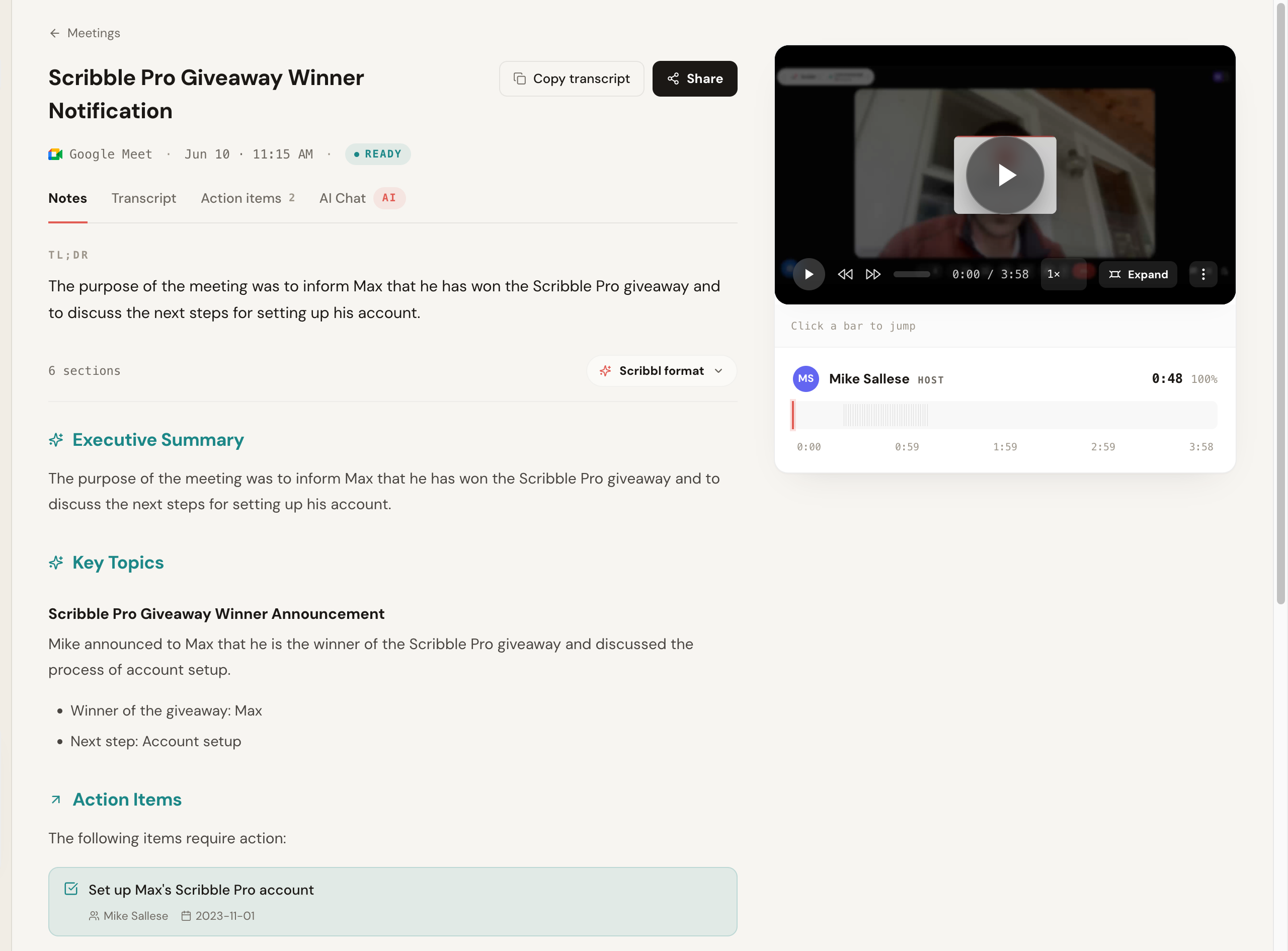
We also looked at what happens after the transcript exists, because a perfect transcript you never reuse is wasted work. Here is the Scribbl notes view after a Google Meet call: a TL;DR, an executive summary, key topics, and action items with owners and dates. Nothing joined the call.
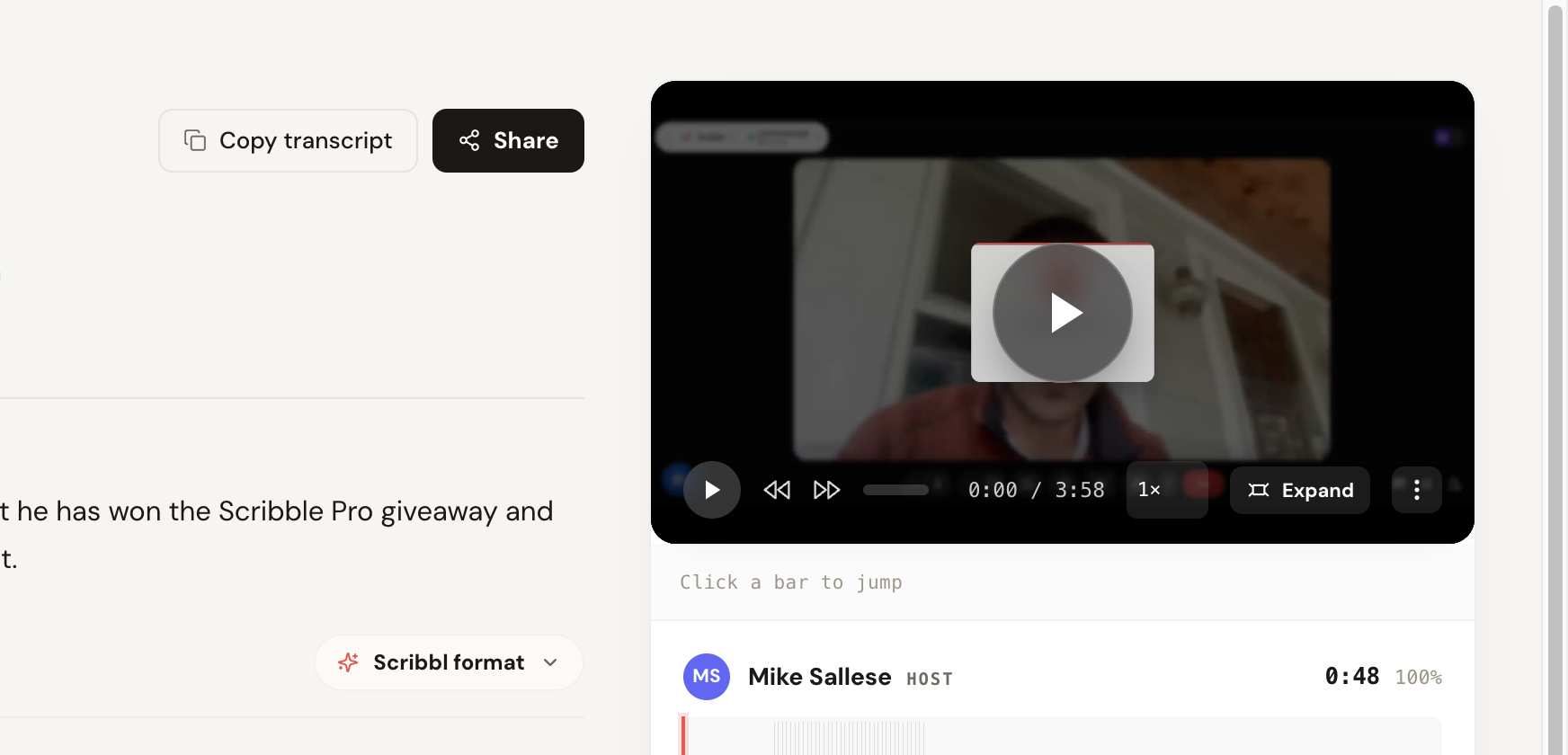
The transcript view is where you can actually judge accuracy. It shows speaker labels, per-segment timestamps, a confidence score, and a copy-and-share row, plus the recorded video lined up beside it so you can click any bar to jump to that moment.
Read AI alternatives compared at a glance
Here is the full field in one view, in our ranking order. Capture model, price, free plan, languages, integrations, and privacy or compliance posture are the columns people actually decide on. Prices and free plans are from each vendor's pricing page in October 2026; language counts and certifications change, so confirm those on each vendor's site.
| Tool | Capture | Price (paid, per user/mo) | Free plan | Languages | Integrations | Privacy and compliance | Best for |
|---|---|---|---|---|---|---|---|
| Scribbl | Botless, nothing joins, no email to room | Free, then $13 billed annually or $20 monthly | Yes, 10 meetings a month, no credit card | Multiple; confirm on site | Meet, Zoom, Teams; ChatGPT, Claude; HubSpot, Pipedrive, Slack, Notion | No bot, no auto-spread, nothing emailed to the room | Switching off the Read AI bot and transcript spread |
| Fathom | Bot joins by default | Free, then $16 billed annually or $20 monthly (Premium) | Unlimited recordings; advanced summaries on 5 calls a month | Multiple; confirm on site | Common CRMs and chat; confirm | Confirm certs on site | Free, polished, internal-friendly |
| Fireflies | Bot (Fred) joins by default | Free, then $10 billed annually or $18 monthly (Pro) | Unlimited only with auto-join on, otherwise 3 meetings | Broad; confirm on site | Very broad; deep CRM and search | Confirm certs on site | Integrations and team search |
| Otter.ai | Bot (OtterPilot) joins by default | Free, then $8.33 billed annually or $16.99 monthly (Pro) | 300 minutes a month; first 30 minutes of each viewable | Narrower; confirm on site | Common tools; confirm | Confirm certs on site | Live transcription and quick recaps |
| tl;dv | Bot joins by default | Free, then $18 billed annually or $29 monthly (Pro) | Unlimited recordings; AI notes on your first 10 meetings | Broad; confirm on site | Common CRMs and chat; confirm | Confirm certs on site | Clips and highlight sharing |
| Granola | No bot; keeps no recording | Free, then $14 billed monthly (Business) | Notes from the last 30 days | Multiple; confirm on site | Slack on free; Notion, HubSpot, Zapier on Business | No bot; AI training on by default, opt out per user | People who type their own notes |
The 6 best Read AI alternatives, ranked
1. Scribbl, the botless pick
Scribbl is our top recommendation for most people leaving Read AI because it removes the exact two things people complain about most: the auto-joining bot and the transcript that spreads itself across an org. Scribbl is botless. It never sends a participant into the call, so nothing joins, nothing is announced, and no notification or recap is emailed to the people you are meeting with. There is no calendar auto-join to revoke, because Scribbl never tries to join. It works on Google Meet with its Chrome extension and on Zoom and Microsoft Teams with Scribbl Desktop (Mac with Apple silicon and Windows), and lets you ask Claude or ChatGPT about your meetings. It has 5.0 from 3,000 reviews on the Chrome Web Store and 4.9 from 725 reviews on G2, and is used by more than 10,000 organizations.
The free plan needs no credit card, so you can verify all of this on a real call before paying.
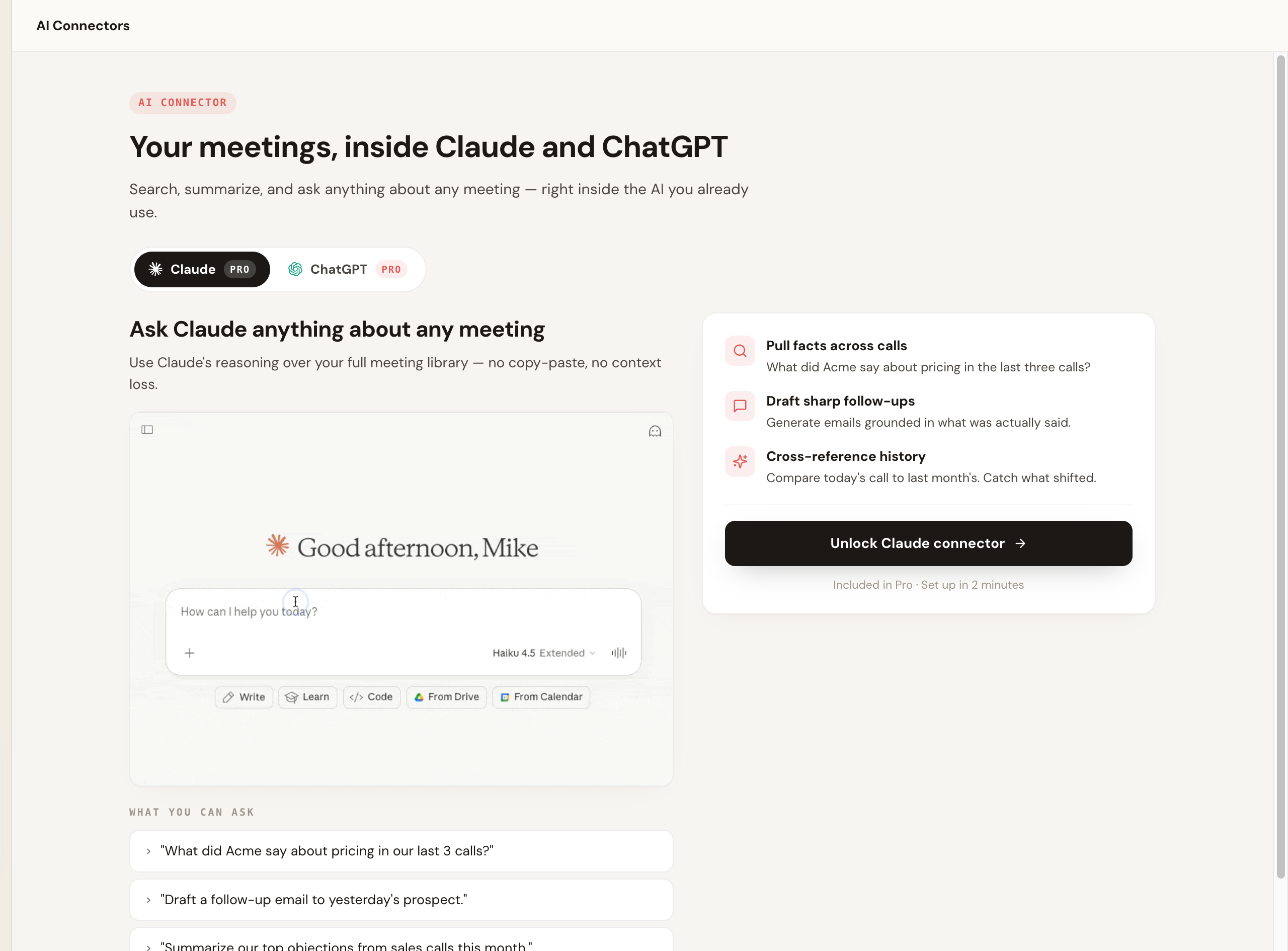
The part that separates Scribbl from a pure transcription tool, and from Read AI's metrics-and-coaching layer, is what happens after the call. Instead of scoring you on charisma, it does the follow-up. Smart Collections sort each meeting into the groups you describe in one sentence, so you can ask Claude or ChatGPT about just one group ("What were the main objections in my sales calls this week?"). Automations do the follow-up for you: they draft the email, log notes in HubSpot or Pipedrive, post to Slack or Teams, save notes to Notion, Google Drive or Confluence, or open Linear, Jira, Asana or Monday tickets, and by default they ask before changing anything. You can also tell it the job in plain words, and it runs with your own Claude.
Pros: no bot ever joins and no email goes to the room, so nothing spreads across your org; no calendar SSO auto-join to manage; works across Meet, Zoom, and Teams; free plan with no credit card; Smart Collections and Automations do the follow-up. Pricing: free plan with 10 meetings a month and no credit card; Pro is $13 per user per month billed annually, or $20 monthly. See the pricing page. Best for: anyone with client, sales, or sensitive calls who wants notes with no bot and no auto-spread, and a free start. More in our botless AI notetaker explainer.
- Capture: a notetaker joins the meeting, often auto-joining from your calendar
- Attendees see it: yes, and recaps or transcripts can be emailed to the room
- Spread: content can travel across inboxes and org boundaries
- Extras: sentiment and Charisma coaching some users find tone-deaf
- Capture: nothing joins the call, no auto-join to revoke
- Attendees see it: no bot, nothing announced, no email to the room
- Spread: nothing auto-emails itself across your org
- Plus: free plan, and Automations that do the follow-up
Because Read AI is the baseline you are comparing against, here is the head-to-head feature parity, Scribbl versus Read AI. Read AI behavior depends on your settings and admin config and changes over time, so confirm the current specifics on its own site.
| Feature | Read AI | Scribbl |
|---|---|---|
| Capture method | Notetaker joins the call, often auto-joining from your calendar | No bot; nothing joins the call |
| Visible to attendees | A recording participant appears | No bot, nothing announced, no email to attendees |
| Transcript spread | Recaps or transcripts can be auto-emailed to attendees | Nothing is auto-emailed; output stays with you |
| Permissions at sign-in | Broad SSO and calendar scopes reported | No calendar auto-join; runs as an extension or desktop app |
| Platforms | Meet, Zoom, Teams | Google Meet, Zoom, Microsoft Teams |
| Free plan | 5 meetings a month, each up to 1 hour; video and some outputs on higher tiers | 10 meetings a month, no credit card required |
| Paid from | Pro $15 billed annually, $19.75 monthly | Pro $13 per user billed annually, $20 monthly |
| Extras | Sentiment scores and Charisma coaching | Smart Collections and Automations that do the follow-up |
| Rating | Verify current rating on review sites | 5.0 from 3,000 reviews on the Chrome Web Store |
| Used by | Large user base; verify on Read AI | More than 10,000 organizations |
For a head-to-head against another common pairing, see Read AI vs Otter.ai.
2. Fathom
Fathom is a polished, widely loved notetaker with unlimited free recording. Its notetaker joins the meeting by default (bot-free capture is a beta for Mac) and produces clean summaries. Compared with Read AI it is notes-first rather than metrics-first, so you are not graded on charisma. The trade is the usual one: a participant appears in the call.
Pros: unlimited free recording, clean summaries, notes-first rather than analytics-heavy, popular and well-supported. Cons: a bot joins and is visible to attendees, so it does not solve the no-bot requirement; on the free plan, advanced summaries cover only your first 5 calls each month, and AI action items are paid. Pricing: free plan; Premium is $16 per user per month billed annually, or $20 monthly. Best for: teams that want a clean, popular notetaker and are fine with a bot. See our Fathom alternative breakdown and Scribbl vs Fathom.
3. Fireflies.ai
Fireflies is one of the more established and feature-rich options, with strong search, broad integrations, and team analytics. Its notetaker bot, often called Fred, joins the meeting by default.
Pros: very broad integrations, strong cross-meeting search, team analytics. Cons: visible bot; the feature surface can feel heavy; free transcription is unlimited only with calendar auto-join on, otherwise 3 meetings. Pricing: free plan; Pro is $10 per seat per month billed annually, or $18 monthly. Best for: teams that want a deep feature set and a searchable archive and do not mind a join-the-call bot. See our Fireflies alternative and Scribbl vs Fireflies.
4. Otter.ai
Otter is a mature, transcription-first tool known for fast live captions and quick recaps. Its assistant, OtterPilot, joins the call by default. Its supported-language list has historically been narrower than rivals, so check that if you meet in multiple languages.
Pros: strong live transcription, quick recaps, large user base. Cons: a bot joins; some auto-join surprises reported; narrower language list; the free plan shows only the first 30 minutes of each conversation. Pricing: the free Basic plan gives 300 transcription minutes a month; Pro is $8.33 per user per month billed annually, or $16.99 monthly. Best for: live transcription and fast recaps where a bot is acceptable. See our Otter alternative and the full best Otter.ai alternatives roundup.
5. tl;dv
tl;dv focuses on recording and highlighting meetings, with clipping and sharing features that teams use to spread context deliberately, rather than auto-emailing transcripts the way Read AI does. Its bot joins the call by default.
Pros: excellent clipping and highlight sharing, unlimited free recordings. Cons: a bot joins; notes are secondary to clips for some teams; free AI notes cover only your first 10 meetings. Pricing: free plan; Pro is $18 per seat per month billed annually, or $29 monthly. Best for: teams that share meeting clips and want recording-first features. See our tl;dv alternative.
6. Granola
Granola records your computer's audio and fills in the rough notes you type, with no bot in the call. It transcribes and then deletes the audio, so it keeps no recording. It runs on Mac, Windows, iOS and Android.
Pros: no join-the-call bot; good for people who shape their own notes. Cons: keeps no recording; the free plan shows only notes from the last 30 days; AI training on your data is on by default on Basic and Business, with a per-user opt-out. Pricing: free Basic plan; Business is $14 per user per month, billed monthly. Best for: people who type their own notes and don't need the recording. See our Granola alternative.
Which Read AI alternative should you pick
For most people leaving Read AI, the pick is Scribbl. It fits best when:
- The auto-joining bot is the problem. Nothing joins the call and nothing is announced, and there is no calendar auto-join to revoke, because Scribbl never tries to join.
- Transcripts spreading across your org is the problem. No recap or transcript is emailed to the room, so meeting content stays with you.
- You meet on more than one platform. Google Meet, Zoom, and Microsoft Teams sit in one account: the Chrome extension for Google Meet, Scribbl Desktop (Mac with Apple silicon, and Windows) for Zoom and Teams.
- You want the follow-up done, not a charisma score. Every meeting gets the video, a transcript with speaker names, AI notes and action items. Ask Claude or ChatGPT about every meeting, and let Automations draft the email, log notes in HubSpot or Pipedrive, or post to Slack or Teams.
- You want a free start. The free plan covers 10 meetings a month with no credit card; Pro is $13 per user per month billed annually, or $20 monthly.
The other tools on this list suit narrower jobs, and most of them send a bot into the call, which is the Read AI behavior you are trying to leave.
For sales teams specifically, the bot is usually decisive; see Scribbl for sales. If you want a free, no-bot start, our free AI notetaker with no bot guide is the shortest path.
How to remove or disconnect Read AI
If the auto-joining bot or the broad permissions are why you are leaving, removal is the other half of the job. Read AI is often installed with org-wide SSO and calendar scopes, so a personal uninstall does not always stop it everywhere. Here is the order that fully cuts it off.
- Turn off auto-join inside Read AI. In Read AI's own settings, disable the auto-join or meeting-assistant behavior so it stops adding itself to calendar meetings. Confirm the current toggle names in Read AI's help docs.
- Revoke calendar and SSO access at the source. In your Google Account (Security, then third-party access) or your Microsoft account (App permissions), remove Read AI's access. This is what actually stops it from reading your calendar and joining on your behalf.
- Delete your Read AI account. From account settings, delete the account and request deletion of stored data if you want it gone.
- Have your admin revoke it org-wide. Because Read AI is often installed with workspace-level scopes, your Google Workspace or Microsoft 365 admin may need to revoke the app for the whole organization so it stops joining colleagues' meetings too.
- Export first if you need the history. Transcripts and reports typically export from the meeting or report view. Pull anything you want to keep before deleting, since it will not migrate into another tool.
How to switch from Read AI without losing your notes
Switching is lower effort than people expect, and you do not have to do it all at once. Here is the order that avoids the two things people regret, losing old transcripts and being stuck mid-call without notes.
- Export anything you want to keep from Read AI. Transcripts and reports typically export from the meeting or report view. Confirm the current export options, and treat this export as your archive, because transcripts do not migrate between tools.
- Revoke its access and turn off auto-join using the removal steps above, so it stops joining your calls while you evaluate the replacement.
- Install your replacement and run one real meeting through it. Pick the messiest call you reasonably can, since that is where tools separate. With a botless tool like Scribbl you can do this on the free plan with no credit card, so there is no commitment to test it.
- Compare the transcript and summary against what was actually said. Check names, numbers, and the crosstalk segment specifically. If it holds up, you have your answer.
- Delete Read AI once you are confident, and have your admin revoke it org-wide if it was installed for the whole team. Keep the export. Start fresh notes in the new tool.
Read AI alternatives FAQ
What is the best Read AI alternative in 2026? Scribbl is our top pick for most people leaving Read AI, especially if the reason was the bot auto-joining calls and transcripts spreading across your org. It captures with no bot, sends no email to the room, works on Google Meet, Zoom, and Microsoft Teams, has a free plan with no credit card, and its Automations do the follow-up work.
Why do people leave Read AI? The recurring reasons in public reviews and Reddit threads are: a bot auto-joining calendar meetings without clear consent, transcripts and recaps getting auto-emailed and spreading across an organization, broad SSO and calendar permissions at sign-in, a removal process that often needs an IT or workspace admin, tone-deaf sentiment scoring and vague Charisma coaching, video and some outputs locked to higher tiers, and slow support. Several universities, including Chapman and the University of Washington, have published guidance restricting or warning against Read AI auto-joining campus meetings. Always confirm current behavior on Read AI's own site, since products change.
Is there a Read AI alternative that does not use a bot? Yes. Scribbl is botless: no participant joins the call, nothing is announced, and no email goes to other attendees. That directly removes the two most-cited Read AI complaints, the auto-joining bot and the transcript that spreads itself across an org. Scribbl works across Google Meet, Zoom, and Microsoft Teams and has a free plan with no credit card.
How do I remove or disconnect Read AI? Roughly: revoke its access in your Google or Microsoft account security settings (so it can no longer auto-join from your calendar), turn off auto-join or the meeting assistant inside Read AI's own settings, then delete your Read AI account from account settings. Because Read AI often requests workspace-level SSO and calendar scopes, a full org-wide removal may require your Google Workspace or Microsoft 365 admin to revoke the app for everyone. Confirm the current steps in Read AI's help docs and your identity provider's admin console, since these change.
Are there free alternatives to Read AI? Yes. Scribbl has a free plan with no credit card required: 10 meetings a month on Google Meet, Zoom, and Microsoft Teams, with no bot joining and nothing emailed to the room. Most other free tiers, including Fathom, Otter, Fireflies, and tl;dv, send a bot into the call. Always confirm current limits on each tool's own pricing page, since they change often.
Which Read AI alternative is best for privacy? For privacy, two things matter most: whether a bot joins your call and where your meeting content goes afterward. Scribbl is botless, so nothing joins and nothing is announced, and it does not auto-email transcripts to a room the way Read AI is known for, so meeting content does not travel across inboxes and org boundaries. There is also no calendar auto-join to grant or revoke, because Scribbl never tries to join.
Which Read AI alternative is best for sales teams? Sales teams that run external demos and discovery usually want a botless tool so nothing visible joins a prospect's call and no auto-emailed transcript leaks across accounts. Scribbl is our pick there because it captures with no bot, its Smart Collections let you ask Claude or ChatGPT about just your sales calls, and its Automations draft the follow-up email and log notes in HubSpot or Pipedrive, asking before they change anything by default.
Is Read AI's sentiment and Charisma coaching accurate? It is one of the most-criticized parts of the product in public reviews. Reviewers describe the sentiment scores and Charisma coaching as tone-deaf, culturally insensitive, or simply not actionable, and some find being scored on engagement during their own meetings uncomfortable. If you want notes and action items without being graded, a notes-first tool like Scribbl is a closer fit: every meeting gets the video, a transcript with speaker names, AI notes and action items, and nobody is scored. This is a subjective area, so weigh it against your own use.
Does Read AI auto-join my meetings and email transcripts? Read AI is widely reported to auto-join calendar meetings via a connected notetaker and to send recaps or transcripts to attendees, which is how it spreads across an organization. Behavior depends on your settings and admin configuration, so confirm current defaults in Read AI's settings and help docs. If that behavior is exactly what you want gone, a botless tool like Scribbl removes it entirely: nothing joins and no email is sent to the room.
How accurate are these Read AI alternatives compared to Read AI? Accuracy swings with microphones, accents, and connection quality, so no single tool wins every call, and transcription engines update often. Real meetings have crosstalk and bad microphones, so run your own worst call through your top two picks before committing.
How do I switch from Read AI without losing my notes? Export anything you want to keep from Read AI first, since transcripts and summaries typically export from the meeting or report view (confirm current export options). Then revoke its calendar and SSO access so it stops auto-joining, install your replacement, and run one real meeting through it. Once you are happy, delete your Read AI account, and have your Workspace or Microsoft 365 admin revoke the app org-wide if it was installed for the whole team. Transcripts do not migrate between tools, so treat the export as your archive. With a botless tool like Scribbl you can run that first test call on the free plan with no credit card.
Do these Read AI alternatives work with Microsoft Teams and Zoom? Many do, but coverage varies, so confirm on each vendor's site. Scribbl works on Google Meet with its Chrome extension and on Zoom and Microsoft Teams with Scribbl Desktop (Mac with Apple silicon and Windows), and it is botless on all three. Bot-based tools like Fathom, Otter, Fireflies, and tl;dv support Meet, Zoom, and Teams by sending a notetaker into the call by default. If you mostly meet on Teams, verify Teams support specifically, since some tools support it on higher tiers only.
Try Scribbl
Let your meetings take their own notes.
Scribbl records, transcribes, and summarizes your Google Meet calls from your browser. No bot joins the call. Free forever for individuals.
Add to Chrome · It's free