
7 Best Bluedot Alternatives in 2026 (Bot-Free Picks, Real Pricing, and an Honest vs-Bluedot Matrix)
Comparing Bluedot alternatives in 2026? We line up 7 AI meeting notetakers on bot-free capture, platform support, accuracy, languages, CRM, and action items, with a 10-row vs-Bluedot matrix and a free botless pick (Scribbl), plus Otter, Fathom, Fireflies, Granola, tldv, and Read.ai.
Updated October 7, 2026
On this page10 sections
- 01Why people switch from Bluedot
- 02How we compared these Bluedot alternatives
- 03Best Bluedot alternative by use case
- 04Comparison table: Bluedot alternatives at a glance
- 05The 7 best Bluedot alternatives
- 06Bot-free is the property to protect
- 07Scribbl vs Bluedot
- 08How to choose your Bluedot alternative
- 09How to switch from Bluedot without losing anything
- 10Bluedot alternatives FAQ
Scribbl is the pick for most people leaving Bluedot. Bluedot is already bot-free and browser-based, so unlike most alternatives lists, the question is not bot versus no bot. It is which bot-free tool fixes Bluedot's real gaps: a desktop app instead of browser-only capture, broader platform support, more integrations, and AI that does the follow-up work. Scribbl keeps nothing in the room and has a free plan (no credit card). It uses a Chrome extension for Google Meet and Scribbl Desktop for Zoom and Microsoft Teams, connects your meetings to ChatGPT or Claude, and its Automations do the follow-up: draft the email, log notes in HubSpot or Pipedrive, post to Slack or Teams. Below we line up seven alternatives on bot-free capture, real pricing, accuracy, languages, CRM, and action items, with a 10-row matrix straight against Bluedot.
We are the makers of Scribbl, so we are upfront about it: treat us as a primary source on Scribbl and a fair-but-interested reviewer of everything else. Where we state a competitor price or feature, we link it to the vendor's own page or mark it as approximate, because those details change often.
Why people switch from Bluedot
Bluedot gets the most important thing right: it is bot-free, so nothing visible joins your meeting. None of the reasons below are knocks on that instinct, which is exactly the one Scribbl is built around too. They are the practical gaps that send Bluedot users looking for something with the same bot-free feel and fewer limits.
- Browser and extension dependency. Bluedot largely lives inside the browser through an extension. That is elegant for online calls in a supported tab, but it means your capture is tied to that browser being open and behaving. If you bounce between a desktop meeting client and the browser, or your extension hiccups, capture can be at risk. A tool with a native desktop app removes that single point of dependency.
- Integration and CRM gaps. Bluedot offers integrations, but people who want notes logged in their CRM after every call, or a long list of automation hooks, often find the connector set thinner than heavier platforms. If a blank CRM field after every call is your pain, this matters.
- Occasional reliability glitches. Some users report intermittent glitches, a missed capture, a summary that did not generate, or a call that did not record cleanly.
- English-leaning experience. Like many newer notetakers, Bluedot is strongest in English. Teams whose meetings span many languages sometimes want a tool that leads with broader language coverage.
- Follow-up that is still manual. Many people now want the recap, the draft email, the CRM notes, and the next steps done after every call, rather than a summary they still have to act on by hand.
If two or more of these describe you, you are exactly who this list is for. The rest of this guide maps each pain point to the tools that fix it, while keeping bot-free front and center because that is the property you came to Bluedot for.
How we compared these Bluedot alternatives
This is the part most listicles skip, so it is where we put the work. Here is what we compared each tool on.
- Capture and visibility. We compared whether anything joins the call, whether attendees see it, and whether capture depends on a single browser tab, since that is where Bluedot users report problems.
- Accuracy. Results swing with audio quality, accents, jargon, and crosstalk, so we do not publish an accuracy rating for any tool. Run one real call with your own product names and judge accuracy yourself.
- After the call. We compared what each tool gives you after the call: the summary, the action items, the CRM and follow-up flow, and how easily the output moves into the tools you already use.
- Price, languages, and ratings. We pulled each tool's published starting price, noted its cited language breadth, and pointed to where its third-party reviews live (G2, Capterra, Trustpilot, the Chrome Web Store, or the app stores), so you can sanity-check both yourself.
We weighted the read in this order, because for a Bluedot leaver it is the order that changes your day to day: stay bot-free first, then close the platform gaps, then price and free tier, then accuracy and languages, then what happens after the call. We say this openly because it explains why a botless, desktop-and-browser tool that does the follow-up scores well on our weighting. If your priorities differ, the table gives you the raw inputs to re-rank for yourself.
Best Bluedot alternative by use case (quick routing)
If you only have a minute, jump to the one that matches your situation. Each links to the full write-up below.
- Best bot-free alternative (stays nothing-in-the-room like Bluedot): Scribbl.
- Best free Bluedot alternative: Scribbl (free, no credit card, 10 meetings a month on Google Meet, Zoom, and Teams).
- Best for Google Meet, Zoom, and Teams in one account: Scribbl (Chrome extension for Meet, Scribbl Desktop for Zoom and Teams).
- Best for CRM and follow-up: Scribbl. Automations log notes in HubSpot or Pipedrive, draft the email, and post to Slack or Teams.
- Best for asking Claude or ChatGPT about one group of meetings: Scribbl. Smart Collections sort meetings by themselves, so you can ask about just your sales calls or just your 1:1s.
- Other tools on this list: Granola for typing your own notes, Otter for live transcription, Fireflies or tldv for a bot that records meetings you are not in, and Read.ai for engagement analytics.
Comparison table: Bluedot alternatives at a glance
This is the table no other Bluedot list gives you in one place. Because Bluedot is itself bot-free, the rows that actually separate these tools are whether they stay bot-free, their platform and device reach (browser-only versus a desktop app), a real free plan, native CRM, automatic action items, and a third-party rating anchor. Prices for Otter, Fathom, Fireflies, Granola, and Read.ai are from each vendor's pricing page on October 7, 2026; the rest are approximate, so confirm each on the vendor's own pricing page.
| Feature | Scribbl | Bluedot | Otter | Fathom | Fireflies | Granola | tldv | Read.ai |
|---|---|---|---|---|---|---|---|---|
| Bot-free (nothing joins the call) | Yes | Yes | Bot | Bot | Bot | Yes | Bot | Bot |
| Desktop app | Yes | No | Yes | Yes | No | Yes | Yes | No |
| Google Meet / Zoom / Teams | All three | Confirm | All three | All three | All three | Confirm | All three | All three |
| Real free plan (no card) | Yes | Free tier; confirm | 300 min a month | Free, generous | Free, caps | Last 30 days of notes | Free, caps | Free, caps |
| Starting paid price, per user per month | $13 annual, $20 monthly | Confirm | $8.33 annual, $16.99 monthly | $16 annual, $20 monthly | $10 annual, $18 monthly | $14 monthly | ~$18 to $29 | $15 annual, $19.75 monthly |
| Native CRM writeback | HubSpot or Pipedrive | Limited; confirm | Limited | Paid tiers | Yes | Limited | Paid tiers | Paid tiers |
| Auto action items / task sync | Yes | Yes | Yes | Premium | Yes | Confirm | Yes | Yes |
| Connects to ChatGPT / Claude | Yes | Paid plans | Yes | Yes | Yes | Yes | Yes | Yes |
| Third-party rating anchor | 5.0 from 3,000 reviews on the Chrome Web Store | ~4.8 G2; confirm | G2, Capterra | G2, Capterra | G2, Capterra | App stores, G2 | G2, Capterra | G2, Capterra |
The 7 best Bluedot alternatives
A quick note on ordering: Scribbl is listed first because it is our pick for the largest group of Bluedot switchers (people who want to stay bot-free but need a desktop app, multi-platform reach, and the follow-up done), and because we can verify its details firsthand. Bluedot sits right after it, for reference, so you can see what you are leaving next to what replaces it.
Scribbl, the botless free pick (and yes, we make it)
Scribbl keeps the thing you liked about Bluedot, nothing joins the call, and removes the limits that send people looking. It is botless: nothing joins, nothing is announced, and no notification goes to the people you are meeting with. Unlike a browser-only tool, it ships as both a Chrome extension and a desktop app: the Chrome extension records Google Meet, and Scribbl Desktop (Mac with Apple silicon and Windows) records Zoom and Microsoft Teams. It has a real free plan with no credit card, and every meeting gets the video, a transcript with speaker names, AI notes and action items. It is rated 5.0 from 3,000 reviews on the Chrome Web Store and it is used by more than 10,000 organizations. Those last two are Scribbl's own verifiable numbers; everything we say about competitors should be confirmed on their sites. More on the approach in our botless AI notetaker explainer.
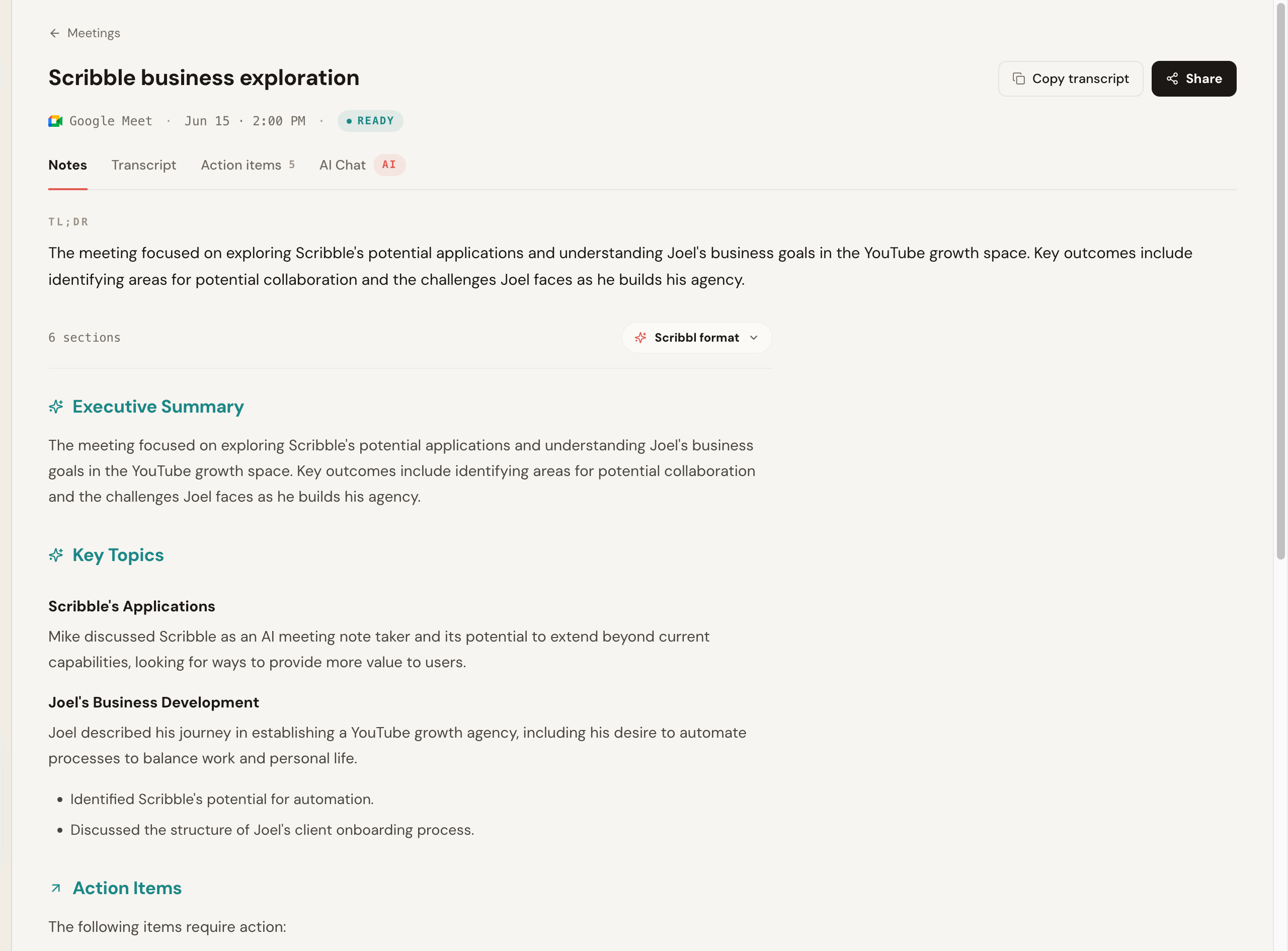
What to know: nothing appears in the attendee list and no one is prompted to admit a recorder, exactly like Bluedot's bot-free behavior. Here is the Scribbl notes view after a Google Meet call: a TL;DR, an executive summary, key topics, and action items. Nothing joined the call.
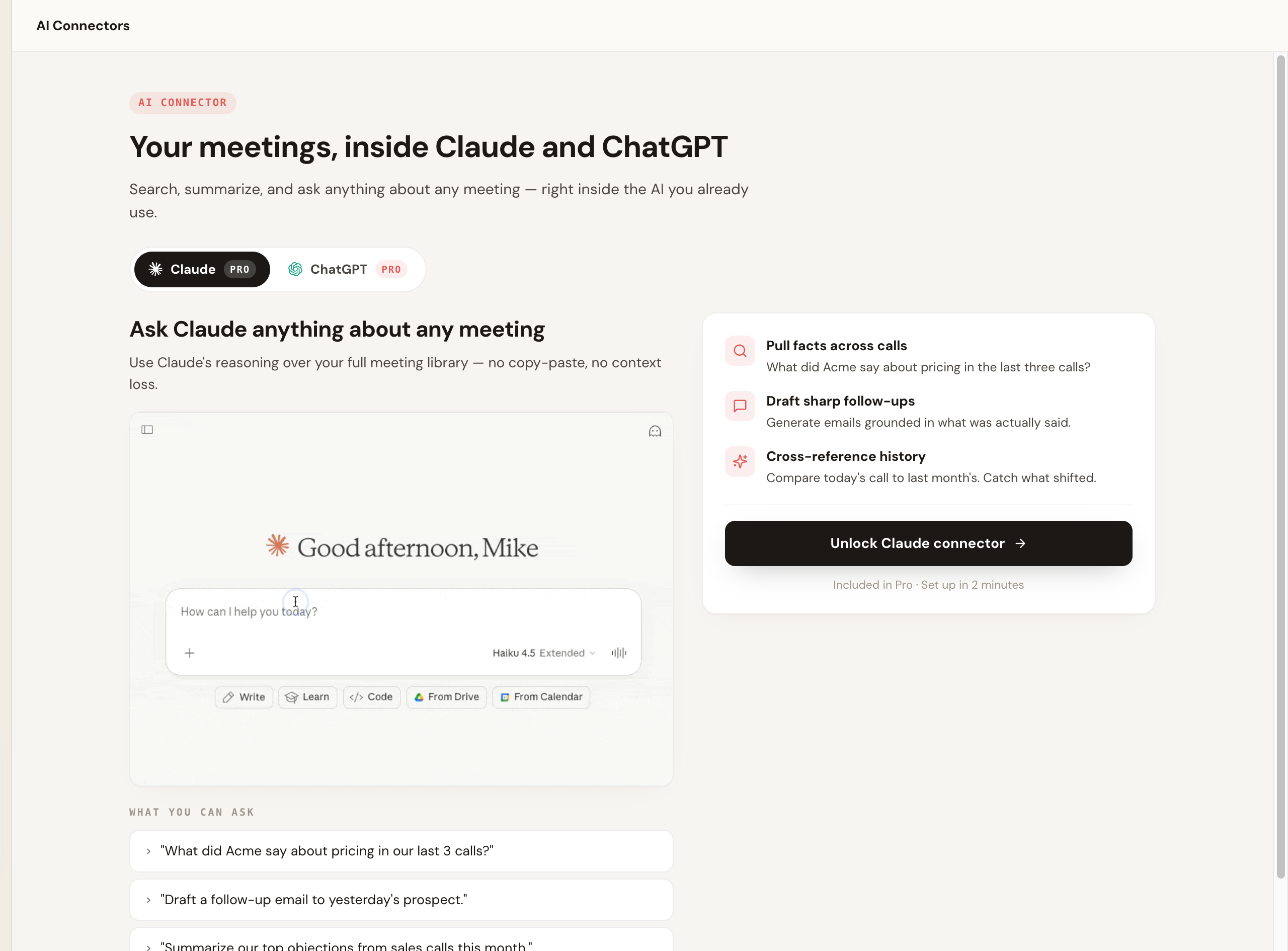
The part that separates Scribbl from Bluedot is what happens after the call. Connect Scribbl once and Claude or ChatGPT can search the transcript and notes of every meeting, or just one Smart Collection, so you can ask "What were the main objections in my sales calls this week?" and get an answer from only those calls. Automations do the follow-up: draft the email, log notes in HubSpot or Pipedrive, post to Slack or Teams, and open Linear, Jira, Asana, or Monday tickets, asking before they change anything by default.
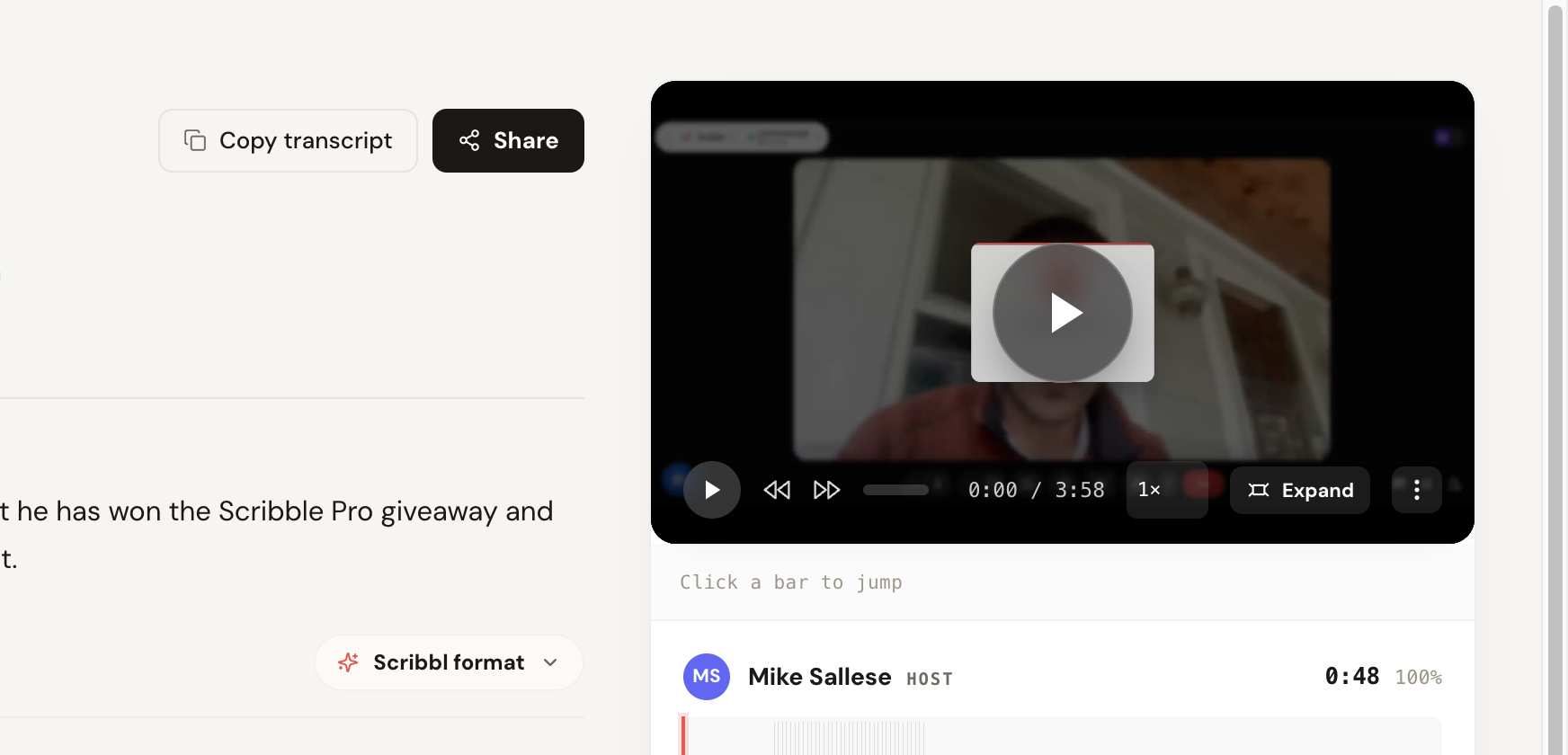
You still get the full recording and a clickable transcript when you want them, with speaker labels and a timeline you can jump around in.
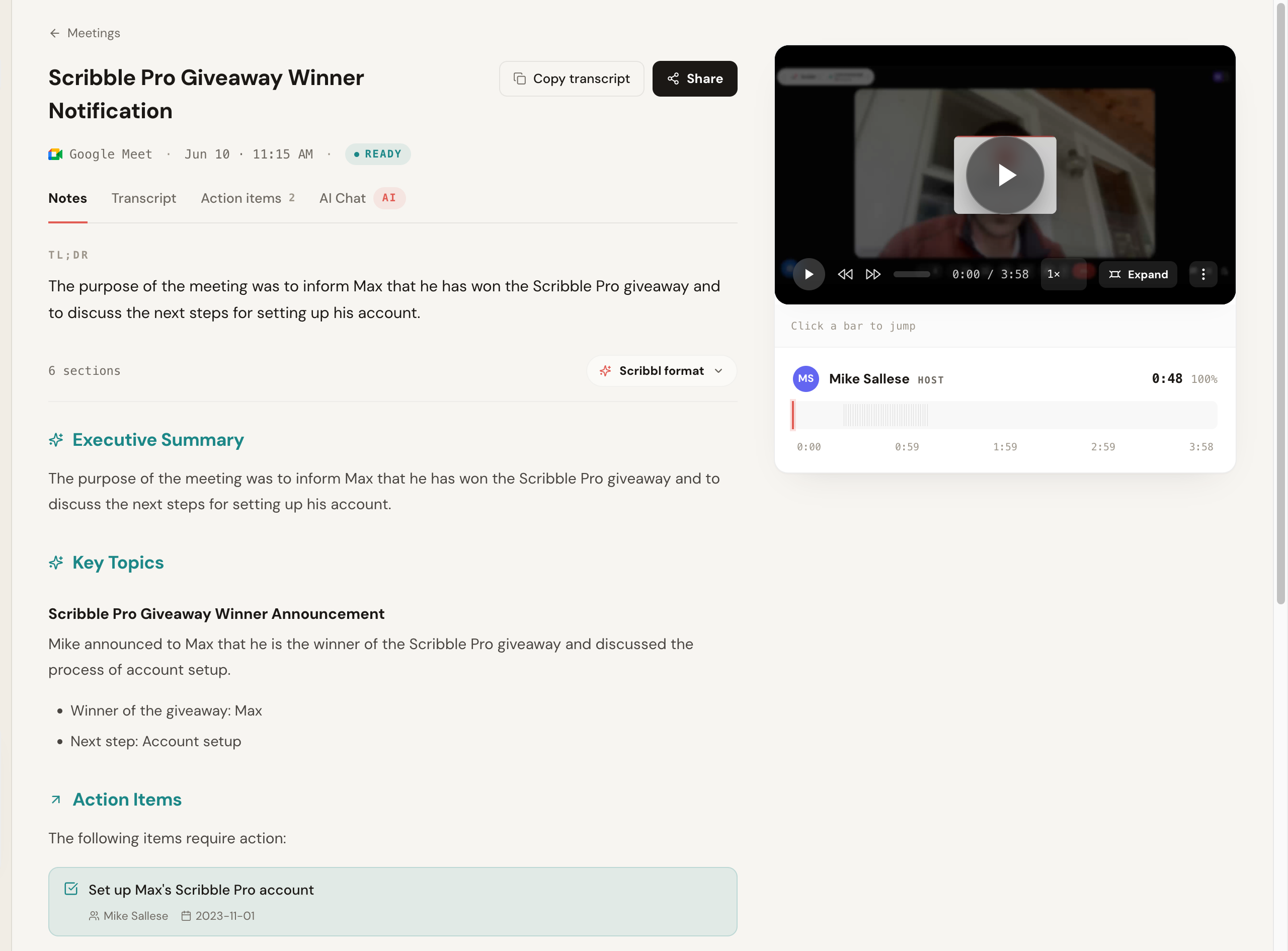
The notes and the recording live side by side, so you can read the AI summary and jump straight to the moment in the video where something was said.
Pros: botless on Meet, Zoom, and Teams, the same nothing-in-the-room feel as Bluedot; Chrome extension for Google Meet and Scribbl Desktop for Zoom and Teams, so Zoom and Teams calls are not browser-only; real free plan, no credit card; Smart Collections and Automations so the follow-up gets done; 5.0 from 3,000 reviews on the Chrome Web Store, used by 10,000+ organizations.
Pricing: free plan with no credit card (10 meetings a month, Google Meet, Zoom, and Teams included); Pro is $13 per user per month billed annually, or $20 monthly. See the pricing page.
Best for: Bluedot users who want to stay bot-free but need a desktop app, multi-platform reach, a free start, and the follow-up done for them. See Scribbl for sales and the broader best botless meeting recorders.
Bluedot (the tool you are leaving)
Bluedot suits people whose calls all happen in one supported browser and who do not need a desktop app or deep CRM writeback. It is commonly cited with a G2 rating around 4.8 out of 5.
What to know: nothing joins the call. The limits are where users report them: capture is anchored to the browser, and the integration set is lighter than the heavier platforms below.
Pros: genuinely bot-free, nothing joins the call; clean, fast summaries; simple browser-based setup; connects to ChatGPT and Claude on paid plans; well-rated by its users.
Cons: browser-and-extension dependency; integration and CRM gaps versus heavier tools; English-leaning; some users report occasional glitches; confirm current platform coverage for your calls.
Pricing: historically a free tier with caps plus paid plans; confirm the current free-tier limits and paid pricing on Bluedot's site, because they change.
Best for: people who mostly take online calls in a supported browser, value bot-free capture, and do not need a desktop app or deep CRM writeback. Check current G2 reviews for the latest sentiment.
Otter.ai (mature live transcription, with a bot on online calls)
Otter is a long-running transcription tool with strong live captions and a large searchable archive. It typically adds an OtterPilot assistant to online calls to capture audio.
What to know: the OtterPilot assistant is visible to the room on online calls, which is the trade versus a bot-free tool.
Pros: mature, strong live transcription; mobile app; large searchable archive; wide language support; connects to ChatGPT and Claude.
Cons: typically adds a visible assistant to online calls, so it is not bot-free like Bluedot; the free plan caps transcription at 300 minutes a month; lighter on deep CRM writeback.
Pricing: free Basic plan with 300 transcription minutes a month; Pro is $8.33 per user per month billed annually, or $16.99 monthly; Business is $19.99 billed annually, or $30 monthly (Otter pricing).
Best for: people who want mature live transcription and accept an assistant on online calls. See our Otter alternative and Scribbl vs Otter.
Fathom (generous free recording, with a bot)
Fathom is a popular notetaker known for its free plan. It typically joins online meetings to record and produces clean summaries. The trade versus Bluedot is the usual one: a participant appears in the call.
What to know: the notetaker is visible in the call, which is fine for internal meetings and the reason it ranks below the bot-free picks for guarded external ones.
Pros: clean, fast summaries; unlimited recordings, transcripts, and storage on the free plan; simple to set up; connects to ChatGPT and Claude on every plan.
Cons: a bot joins the call, so it is not bot-free like Bluedot; less of a fit for guarded external meetings; on the free plan, advanced summaries cover only your first 5 calls each month, and AI action items, AI follow-up emails, and Ask Fathom need Premium.
Pricing: free plan; Premium is $16 per user per month billed annually, or $20 monthly; Team is $15 billed annually, or $19 monthly, per user, with a 2-user minimum (Fathom pricing).
Best for: internal-heavy teams that want a clean, popular notetaker and a strong free tier and are fine with a bot. See our Fathom alternative and Scribbl vs Fathom.
Fireflies.ai (native CRM and an unattended bot)
Fireflies is one of the more established and feature-rich options, with strong search, a wide set of integrations, native CRM writeback, and team analytics. It suits teams that want an unattended bot that can record meetings they are not in. Its standard model sends a notetaker bot, often named Fred, into the meeting.
What to know: the Fred bot is visible in the call, the opposite of Bluedot's bot-free approach.
Pros: deep feature set; broad integrations including Salesforce and HubSpot; strong search and team analytics; wide language support; an unattended bot for meetings you cannot attend; connects to ChatGPT and Claude.
Cons: a visible bot in the call, not bot-free; the breadth can feel heavy for simple needs; free tier caps storage and features.
Pricing: free plan; Pro is $10 per seat per month billed annually, or $18 monthly; Business is $19 billed annually, or $29 monthly (Fireflies pricing).
Best for: teams that want depth, integrations, native CRM, and an unattended bot, and do not need bot-free capture. See our Fireflies alternative and Scribbl vs Fireflies.
Granola (bot-free runner-up for note-takers)
Granola is the closest in spirit to Bluedot on this list: it is notes-forward and avoids the traditional join-the-call bot, leaning on your own typed notes and enhancing them with AI. People who like to take rough notes and have AI clean them up tend to enjoy it, and it keeps the bot-free property you came to Bluedot for.
What to know: there is no participant in the room, but there is also no recording to go back to: Granola transcribes and then deletes the audio. It rewards you typing along, so it is less hands-off than a tool that captures everything on its own.
Pros: no traditional join-the-call bot, so it stays bot-free like Bluedot; great for people who take their own notes; tidy AI-enhanced output; runs on Mac, Windows, iOS, and Android; connects to Claude and ChatGPT.
Cons: keeps no recording, so there is no video to replay; built around you typing notes, not hands-off capture; the free Basic plan only keeps notes from the last 30 days; lighter on CRM writeback.
Pricing: Basic is free (notes from the last 30 days); Business is $14 per user per month, billed monthly; Enterprise starts at $35 per user per month (Granola pricing).
Best for: people who take their own notes and want AI to enhance them without a bot. See our Granola alternative and Scribbl vs Granola.
tldv (a bot for Meet, Zoom, and Teams, with timestamps)
tldv is a popular bot-based recorder for online calls, known for timestamped highlights, clips, and a generous free tier. It is a fit if you do not need bot-free capture and want a polished recording-and-highlights workflow across the big three platforms. It sends a notetaker bot into the meeting.
What to know: the clip-and-timestamp workflow is its strength. The bot is visible in the call, which is the trade versus Bluedot.
Pros: clean highlights, clips, and timestamps; works across Meet, Zoom, and Teams; generous free tier; wide language support; connects to ChatGPT and Claude on Pro or higher.
Cons: a bot joins the call, not bot-free; lighter on deep revenue analytics; integration depth varies by tier.
Pricing: free tier plus paid plans; paid is commonly cited around $18 to $29 per user per month depending on tier and billing. Confirm on tldv's site and read its current G2 and Capterra reviews.
Best for: teams that want a polished bot-based recorder with clips and highlights and do not need bot-free capture. See our Scribbl vs tldv head-to-head.
Read.ai (meeting analytics and engagement signals)
Read.ai layers meeting analytics on top of notes: talk-time, sentiment, engagement, and coaching-style metrics, plus summaries and action items. It suits people who want signals about how meetings went, not just a transcript. It generally joins online calls as a bot.
What to know: the analytics dashboards and engagement metrics are the differentiator. The bot is visible in the call, and the analytics are more than a simple notes user needs.
Pros: meeting analytics, engagement, and sentiment signals; summaries and action items; works across the major platforms; wide language support; mobile app; connects to Claude and ChatGPT.
Cons: a bot joins the call, not bot-free; the analytics can be more than you need for plain notes; free tier caps features.
Pricing: free plan; Pro is $15 per month billed annually, or $19.75 monthly; Enterprise is $22.50 billed annually, or $29.75 monthly (Read AI pricing).
Best for: people who want meeting analytics and engagement signals alongside notes. See our Read.ai vs Otter comparison.
Bot-free is the property to protect
The single thing that drew you to Bluedot, that nothing joins the call, is worth protecting in whatever you switch to. Here is the split: most alternatives send a visible bot, and only a few stay bot-free like Bluedot.
- Capture: a bot joins the meeting as a participant
- Attendees see it: yes, and some remove or block it
- Upside: can record unattended meetings you are not in
- Examples: Fireflies, tldv, Read.ai, Otter (online), Fathom
- Capture: nothing joins the call
- Attendees see it: no bot, nothing announced, no email
- External calls: the meeting stays exactly normal
- Examples: Scribbl (botless, plus a desktop app and Automations), Granola, and Bluedot
Being bot-free also keeps capture resilient on guarded calls: a bot is a participant, which means it can be denied, removed, or blocked by meeting controls, and nothing-in-the-room sidesteps that entirely. If you want bot-free and what Bluedot lacks (a desktop app, Google Meet, Zoom, and Teams in one account, the follow-up done for you), Scribbl is the pick.
Scribbl vs Bluedot: head-to-head feature matrix
If you are specifically weighing the botless free pick against Bluedot, here is the line-by-line comparison. Both are bot-free, so this is not about the bot; it is about the gaps. Where a row depends on plan or changes often, we say confirm.
| Feature | Scribbl | Bluedot |
|---|---|---|
| Bot joins the call | No, botless (nothing joins) | No, bot-free (nothing joins) |
| Announced to attendees | No (nothing announced, no email) | No (nothing announced) |
| How it runs | Chrome extension for Google Meet, Scribbl Desktop for Zoom and Teams | Browser-based (extension); confirm |
| Google Meet / Zoom / Teams | Yes / Yes / Yes | Confirm current coverage |
| Free plan | Yes, no credit card | Free tier historically; confirm |
| Connects to ChatGPT or Claude | Yes, on Pro, and you can ask about just one Smart Collection | Yes, on paid plans (Basic and up) |
| Native CRM writeback | Automations log notes in HubSpot or Pipedrive | Limited; confirm |
| AI summary and action items | Yes | Yes |
| Reliability of capture | Desktop app reduces browser-tab dependency | Browser-anchored; some glitches reported |
| Third-party rating reference | 5.0 from 3,000 reviews on the Chrome Web Store; 4.9 from 725 reviews on G2 | G2 (commonly cited ~4.8; confirm) |
Scribbl's ratings, organization count, and botless behavior are our own verifiable facts. Everything in the Bluedot column reflects commonly documented behavior that you should confirm on Bluedot's site, because plans and features change.
How to choose your Bluedot alternative
You do not need to weigh every feature. Pick based on the handful of things that actually change your week. Because Bluedot is already bot-free, the first question is whether you must stay bot-free or can accept a bot for unattended recording.
- Pick Scribbl if you want to stay bot-free, need a desktop app as well as a browser extension, meet across Google Meet, Zoom, and Teams, and want a real free plan with no credit card. This is the closest upgrade path from Bluedot. See Scribbl for sales.
- Pick Scribbl if a blank CRM after every call is your gap: Automations log notes in HubSpot or Pipedrive, draft the follow-up email, and post to Slack or Teams, and by default they ask before changing anything.
- Pick Scribbl if you want your meetings organized without filing them: Smart Collections sort meetings by themselves into groups you describe in one sentence, and Claude or ChatGPT can answer questions about just that group.
The short rule: if you came to Bluedot for the bot-free feel, protect it. Scribbl keeps nothing in the room and adds the desktop app, the three platforms, and the follow-up that Bluedot lacks. Apart from Bluedot and Granola, every tool on this list usually sends a bot into the call, and Granola keeps no recording. You can compare Scribbl's plans on the pricing page.
How to switch from Bluedot without losing anything
Switching is lower-stakes than it feels, because you can run the new tool alongside Bluedot before you cancel. Here is the clean path, using the botless free pick as the example.
- 1
Export what you want to keep from Bluedot
Pull any transcripts and summaries you still need out of Bluedot first, so nothing is trapped behind a lapsed plan later.
- 2
Install your new tool
For Scribbl, add the Chrome extension for Google Meet or Scribbl Desktop for Zoom and Teams, and sign in with the free plan. No credit card is required to start.
- 3
Run it on one real meeting
Join your next Google Meet, Zoom, or Teams call. Like Bluedot, nothing joins the room, so there is no recorder to announce and no setup the other side has to approve.
- 4
Check the output
Read the transcript and summary, and if you use ChatGPT or Claude, ask it about the meeting and watch the follow-up email or action items get written.
- 5
Cancel Bluedot once you are happy
After a few meetings you trust the new tool, turn off your Bluedot plan so you are not paying for both.
Keep both running for a week if you want a side-by-side before committing. The only step that is not reversible is canceling Bluedot, so do that last.
Bluedot alternatives FAQ
What is the best Bluedot alternative in 2026?
For most people leaving Bluedot, Scribbl is the pick. It keeps what you liked, nothing joins the call, and removes the browser-only dependency: a Chrome extension for Google Meet and Scribbl Desktop for Zoom and Microsoft Teams, all in one account, with a real free plan, no credit card. It connects your meetings to ChatGPT or Claude, Smart Collections sort meetings by themselves into groups you describe in one sentence, and its Automations do the follow-up: draft the email, log notes in HubSpot or Pipedrive, post to Slack or Teams. Disclosure: we make Scribbl, so run your own test call.
Is Bluedot AI the same as the Bluedot EV-charging app?
No. The Bluedot people compare here is the bot-free AI meeting notetaker that records and summarizes calls from your browser. There is a separate, unrelated company called Bluedot that makes an EV-charging and driver-rewards app. If your search results mix the two, the meeting-notes Bluedot is the one this guide is about.
Why do people switch from Bluedot?
The reasons that come up most are browser and extension dependency, integration and CRM gaps, occasional reliability glitches on some calls, an English-leaning experience, and follow-up work that is still manual. Bluedot is bot-free, which many people like, but it largely lives inside the browser, so meetings outside a supported browser tab can fall outside its reach. Confirm Bluedot's current platform coverage and integrations on its site, because products change.
Is there a bot-free Bluedot alternative?
Yes. Bluedot's appeal is that nothing joins the call, so the honest alternatives keep that property. Scribbl is botless, so no bot ever joins, nothing is announced to the room, and no email goes to attendees, and it adds a desktop app alongside the browser extension. Granola is notes-forward and avoids a traditional join-the-call bot, but it keeps no recording: it transcribes and then deletes the audio. Most other notetakers, like Fireflies, tldv, and Read.ai, send a visible bot into the call by default, so if bot-free is your deciding factor, start with Scribbl, which also gives you the video, a transcript with speaker names, AI notes and action items for every meeting on Google Meet, Zoom, and Microsoft Teams in one account.
Is Scribbl free?
Yes. Scribbl has a free plan with no credit card required: 10 meetings a month, and it includes Google Meet, Zoom, and Microsoft Teams. Pro is $13 per user per month billed annually, or $20 monthly. The simplest way to compare against Bluedot is to run one real meeting on Scribbl's free plan first. For what each plan includes, see the Scribbl pricing page.
Does Scribbl put a bot in the meeting like the bot-based alternatives?
No. Scribbl is botless, the same property that drew you to Bluedot. No bot ever joins the call, no participant named after the tool appears in the attendee list, and no email is sent to other attendees. Everyone else sees a normal call. Fireflies, tldv, and Read.ai generally send a visible bot into the meeting instead.
How accurate is Bluedot, and which alternative is most accurate?
Accuracy depends heavily on audio quality, accents, jargon, and crosstalk, so no single tool wins every call. Every tool slips on heavy crosstalk and thick accents. Run one real call with your own product names and judge accuracy yourself.
Which Bluedot alternative supports the most languages?
If your meetings are not all in English, look at tools that lead with language breadth. Otter and Fireflies are commonly cited for wide language coverage, and many notetakers now support dozens of languages, while Bluedot leans English-first. Do not assume a headline language count guarantees clean output. Run a real call in your actual languages and confirm the current supported-language list on each vendor's site before you commit.
Which Bluedot alternative connects to my CRM?
Bluedot offers integrations, but native CRM writeback is a common gap people cite. Scribbl's Automations log your meeting notes in HubSpot or Pipedrive, draft the follow-up email, and post the recap to Slack or Teams, asking before they change anything by default, and nothing joins the call. Fireflies offers native CRM connections, including Salesforce and HubSpot on paid tiers, through a bot that joins the call. Confirm each tool's current integrations against your stack, because supported objects change.
Does Bluedot have a free plan?
Bluedot has historically offered a free tier with caps plus paid plans, but free-tier limits and entry prices change often, so confirm the current numbers on Bluedot's pricing page. Among alternatives, Scribbl has a genuine free plan with no credit card: 10 meetings a month across Google Meet, Zoom, and Microsoft Teams, with nothing joining the call. Otter, Fathom, Fireflies, tldv, Read.ai, and Granola also offer free tiers, each with its own limits. Always check the current cap before you commit.
How do I switch from Bluedot without losing anything?
Export anything you want to keep from Bluedot first, then install your new tool and run it on one real meeting before you cancel. With Scribbl you install the Chrome extension for Google Meet or Scribbl Desktop for Zoom and Teams, sign in with the free plan, no credit card, and join your next call. Nothing joins the meeting, so there is no setup to announce to attendees. Once you have a few meetings you are happy with, cancel your Bluedot plan so you are not paying for both.
Is Scribbl better than Bluedot?
For most Bluedot users, yes. Both are bot-free, so if you like keeping nothing in the room, you already share the core instinct. Scribbl is the stronger fit if you want a desktop app as well as a browser extension, consistent coverage across Google Meet, Zoom, and Microsoft Teams, a real free plan with no credit card, and the follow-up done for you: Smart Collections sort meetings by themselves, you can ask Claude or ChatGPT about just one group of meetings, and Automations draft the email, log notes in HubSpot or Pipedrive, and post to Slack or Teams. Disclosure: we make Scribbl. Run one real call on each before deciding.
Try Scribbl
Let your meetings take their own notes.
Scribbl records, transcribes, and summarizes your Google Meet calls from your browser. No bot joins the call. Free forever for individuals.
Add to Chrome · It's free