
7 Best MeetGeek Alternatives in 2026 (Compared and Ranked)
The best MeetGeek alternatives for 2026, compared head to head: pricing per user, free-tier limits, bot vs botless recording, security and compliance, and the right pick by use case. Starts with why people leave MeetGeek.
Updated October 7, 2026
On this page8 sections
- 01Why people leave MeetGeek
- 02How we picked and compared these alternatives
- 03MeetGeek alternatives compared at a glance
- 04Security and compliance, head to head
- 05The 7 best MeetGeek alternatives
- 06Which MeetGeek alternative should you pick
- 07How to switch from MeetGeek without losing your notes
- 08MeetGeek alternatives FAQ
Scribbl is the best MeetGeek alternative for most people. If you are tired of an analytics-heavy interface and slow processing and just want clean notes with nothing joining the room, Scribbl captures with no bot, has a free plan with no credit card, and connects your meetings to ChatGPT or Claude. Every meeting gets the video, a transcript with speaker names, AI notes and action items, across Google Meet, Zoom, and Microsoft Teams in one account. Most of the other alternatives below, including Fathom, Fireflies, and Otter, send a recording bot into your calls the same way MeetGeek does. The quick-pick table, the per-tool pros and cons, the security matrix, and the decision framework below map each alternative to the precise problem, whether it is the UI overkill, the processing lag, video quality, multilingual accuracy, the price, or where your meeting data lives.
This guide leads with why people actually leave MeetGeek, then covers seven genuine alternatives with current 2026 pricing, free-tier caps, capture model, integrations, and security posture. We do not invent competitor prices or feature claims, because they change, so where a number could drift we say so and point you to the vendor's own page. Last updated October 7, 2026.
Why people leave MeetGeek
MeetGeek is a capable AI meeting assistant. It joins your calls, records and transcribes them, and produces automatic summaries, highlights, and meeting analytics, all filed in a searchable library. For teams that want a hands-off archive of every internal meeting, that works. But there are recurring reasons people go looking for a replacement, and they show up repeatedly in public reviews on G2, Capterra, and Reddit. We summarize the patterns rather than quoting individuals, and you should confirm current behavior on MeetGeek's own site, since products change.
- Analytics-heavy UI that feels like overkill. MeetGeek leans hard into meeting insights, speaker stats, sentiment, and dashboards. If you only wanted clean notes and action items, the analytics surface can feel like a tool built for a different job, and reviewers describe the interface as busy or cluttered for everyday use.
- Slow post-meeting processing. A common complaint is the wait between a call ending and the summary, transcript, or recording actually being ready. When you need the recap right after the meeting, lag is friction.
- Weak video quality. Reviewers report the recorded video can be low resolution or lower quality than expected. If you record demos, training, or anything you intend to reshare, the video matters as much as the transcript.
- Inaccurate multilingual transcription. Accuracy on non-English calls and on heavy accents is a frequent pain point. No tool is perfect here, but it is a dealbreaker for multilingual teams who relied on it.
- Recording that sits outside the security framework. Teams with governance requirements raise concerns about a recording bot from an outside vendor joining their calls. Compliance reviewers want to know exactly where the recording happens and who controls it.
- Billing and support friction. Complaints about plan changes, free-tier caps tightening, and slow or hard-to-reach support recur in reviews. Pricing surprises and downgrade friction are a quiet but real reason people churn.
How we picked and compared these alternatives
We weighted the things that actually change your day to day, in the order MeetGeek switchers tell us they care about. Capture method first, because it is what attendees notice and what decides whether you even get notes on external calls. Then processing speed and output quality, since lag and weak video are top MeetGeek complaints. Then security and privacy, because an outside recorder in the call is a top stated reason for leaving. Then integrations, a real free plan, and price. A tool that joins your meetings is not bad; it is a different trade, and for client or sales calls a botless tool usually wins. Here is the exact weighting, so you can re-rank for your own priorities.
| Criterion | Weight | How we scored it |
|---|---|---|
| Capture method | 25% | Botless and invisible scored highest; a visible join-the-call bot scored lower, weighted for impact on external calls |
| Output speed and quality | 20% | How fast notes, transcript, and video are ready, and the quality of the recorded video and summary |
| Security and privacy | 20% | Whether a bot or outside account enters the call, what attendees are told, and admin controls |
| Integrations | 15% | Depth of CRM, chat, and workflow connections, plus whether output flows into tools you already use |
| Free plan | 10% | Whether a real free tier exists and how usable it is without a credit card |
| Price | 10% | Per-seat cost and the presence of hidden costs like add-on AI credits |
MeetGeek alternatives compared at a glance
Here is the full field in one view. Capture model, price per user, free-tier limit, integrations, security posture, and standout strength are the columns people actually decide on. Specifics like exact prices, language counts, and certifications change, so treat the directional reads below as a shortlist builder and confirm current details on each vendor's own site. Prices are paid entry-tier, per user per month, billed annually where that is the cheaper option.
| Tool | Capture | Price (per user/mo) | Free tier | Key integrations | Security signal | Standout strength |
|---|---|---|---|---|---|---|
| Scribbl | Botless, nothing joins | Free; Pro $13 billed annually or $20 monthly | Yes: 10 meetings a month, no credit card | Meet, Zoom, Teams; ChatGPT, Claude | Botless; no bot or outside account enters the call | No bot on external and client calls |
| MeetGeek (baseline) | Bot joins | Free, then ~$15+; confirm on site | Yes, monthly-minute cap; confirm | Many; CRM, chat, storage | SOC 2 / GDPR cited; confirm on site | Automated analytics and recaps |
| Fathom | Bot joins | Free; Premium $16 billed annually or $20 monthly | Yes; advanced summaries on your first 5 calls a month | Common CRMs and chat; confirm | SOC 2 cited; confirm on site | Polished free notetaker |
| Fireflies.ai | Bot (Fred) joins | Free; Pro $10 billed annually or $18 monthly; AI credits extra | Yes, with caps | Very broad; deep CRM and search | SOC 2 / GDPR / HIPAA cited on tiers | Integrations and team search |
| Otter.ai | Bot (OtterPilot) joins | Free; Pro $8.33 billed annually or $16.99 monthly | Yes, monthly-minute cap | Common tools; Business adds admin | SOC 2 cited; admin on Business | Live notes and US accents |
| tl;dv | Bot joins | Free, then $18 billed annually or $29 monthly (Pro) | Yes, with caps | Common CRMs and chat; confirm | GDPR focus cited; confirm on site | Clips and highlight sharing |
| Granola | Botless; keeps no recording | Free; Business $14 billed monthly | Yes; notes from the last 30 days | Notes tools; Claude and ChatGPT | Transcribes, then deletes the audio | Lightweight typed notes, no bot |
| Read AI | Bot joins | Free; Pro $15 billed annually or $19.75 monthly | Yes, with caps | CRM, chat, calendar; confirm | SOC 2 cited; confirm on site | Meeting metrics and analytics |
The grid below puts the decisions that matter side by side for the most-shortlisted tools in this field. Only Scribbl and Granola keep a bot out of the call. Competitor behavior, tiers, and pricing change, so treat each row as a shortlist read and confirm current details on the vendor's own site.
| Feature | Scribbl | MeetGeek | Fathom | Fireflies | Otter | Granola |
|---|---|---|---|---|---|---|
| No bot joins the call | Yes | No | No | No | No | Yes |
| Nothing announced, no email to attendees | Yes | No | No | No | No | Confirm |
| Google Meet | Yes | Yes | Yes | Yes | Yes | Confirm |
| Zoom | Yes | Yes | Yes | Yes | Yes | Confirm |
| Microsoft Teams | Yes | Yes | Yes | Yes | Yes | Confirm |
| Connects to ChatGPT or Claude | Yes | Yes | Yes | Yes | Yes | Yes |
| Records video with synced transcript | Yes | Yes | Yes | Yes | Confirm | No |
| Meeting search and library | Yes | Yes | Yes | Yes | Yes | Yes |
| Broad CRM and chat integrations | HubSpot, Pipedrive, Slack, Teams | Yes | Yes | Yes | Yes | Limited |
| Free plan, no credit card | Yes | Free tier | Yes | With caps | With caps | Limited |
| Pricing approach | Free, then $13 billed annually or $20 monthly | Paid tiers | Paid tiers | Paid + AI credits | Paid tiers | Free, then $14 monthly |
| Rated 5.0 from 3,000 reviews on the Chrome Web Store | Yes | No | No | No | No | No |
Security and compliance, head to head
This is the part most listicles skim, and it is one of the top stated reasons people leave MeetGeek. There are two separate questions.
Who is in the call, and where does the recording happen? A bot-based tool, MeetGeek included, joins as a participant run from the vendor's own servers, so an outside account sits in every meeting, attendees see a recorder, and the recording is made on the vendor's side. Scribbl is botless: no bot or outside account enters the call, nothing is announced, and no email goes to attendees. For client, sales, and candidate calls, that is usually the deciding difference.
What does each bot-based vendor publish? Certifications change and are often gated to higher tiers, so for the bot-based tools below, check the tier you would actually buy on the vendor's own trust or security page. We do not list certification dates because they go stale.
| Tool | Capture control model | Certifications cited | Admin / governance |
|---|---|---|---|
| Scribbl | Botless, nothing joins the call | No bot or outside account enters the call | No external participant in any call; nothing announced, no email to attendees |
| MeetGeek | Server-side bot | SOC 2 and GDPR cited; confirm all on site | Confirm current admin controls |
| Fireflies | Server-side bot | SOC 2 and GDPR cited; HIPAA cited on higher tiers | Strong admin and org controls cited |
| Otter | Server-side bot | SOC 2 and GDPR cited; confirm HIPAA on site | Admin controls on Business |
| Fathom | Server-side bot | SOC 2 and GDPR cited; confirm HIPAA on site | Confirm current admin controls |
| tl;dv | Server-side bot | GDPR focus cited; confirm SOC 2 and HIPAA on site | Confirm current admin controls |
| Granola | Botless; transcribes, then deletes the audio | Confirm on site | Confirm org controls |
| Read AI | Server-side bot | SOC 2 cited; confirm GDPR and HIPAA on site | Confirm current admin controls |
The 7 best MeetGeek alternatives
1. Scribbl, the botless pick
Scribbl is our top recommendation for most people leaving MeetGeek, because it removes the two things that drive the most churn at once: the bot in the call and the heavy, slow, analytics-first interface. Scribbl is botless. Nothing joins the call, nothing is announced, and no notification goes to the people you are meeting with. It works on Google Meet with its Chrome extension and on Zoom and Microsoft Teams with Scribbl Desktop (Mac with Apple silicon and Windows), and lets you ask ChatGPT or Claude about every meeting. It is rated 5.0 from 3,000 reviews on the Chrome Web Store and 4.9 from 725 reviews on G2, and used by more than 10,000 organizations.
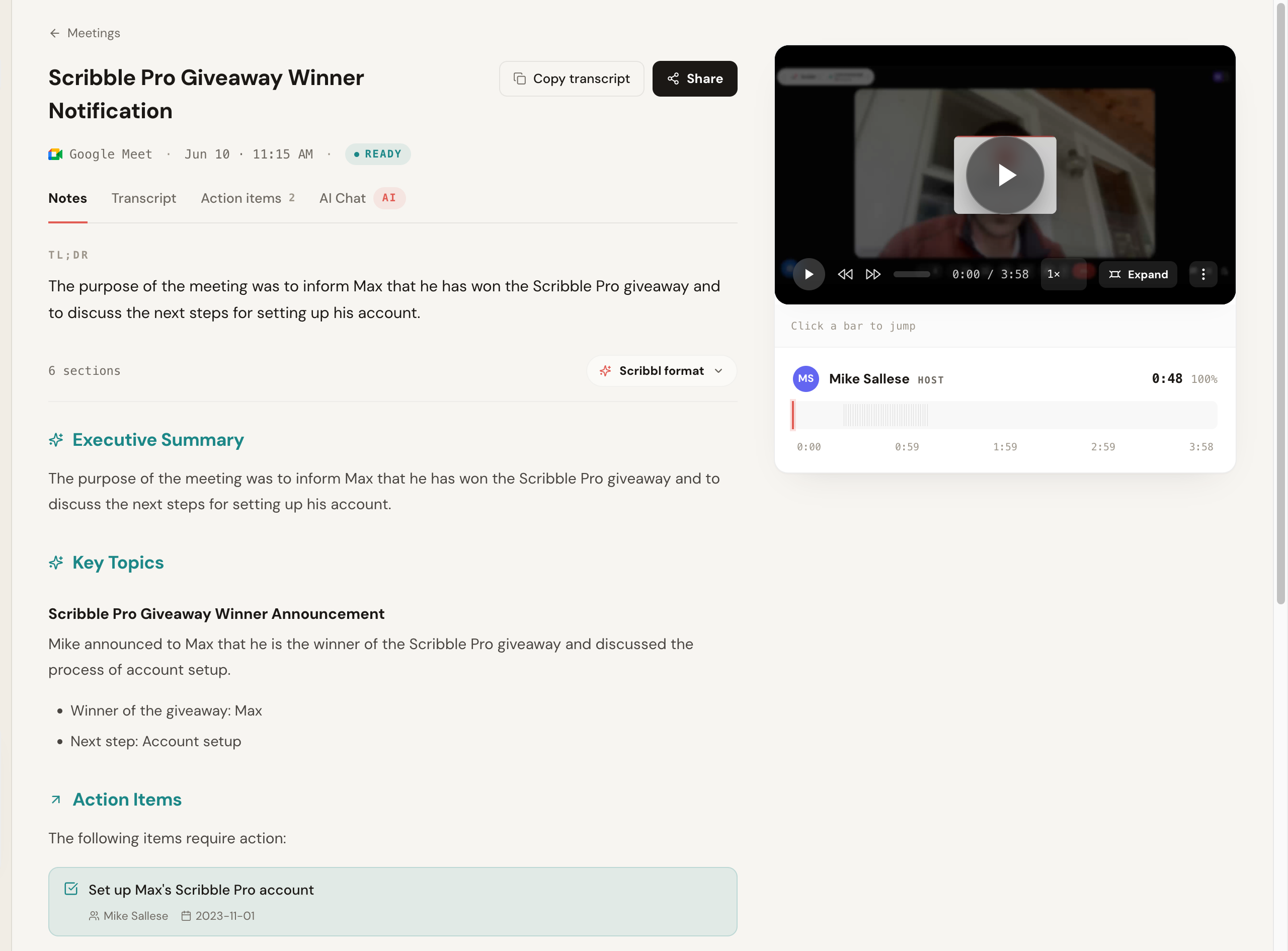
Where MeetGeek files everything into an analytics-heavy library, Scribbl keeps the output focused: a TL;DR, an executive summary, key topics, and action items with owners and due dates, plus the recorded video with a synced transcript so you can click any line and jump to that moment. That synced video-and-transcript view is also the honest answer to the MeetGeek video-quality complaint: you can judge resolution and sync on a real call before you commit.
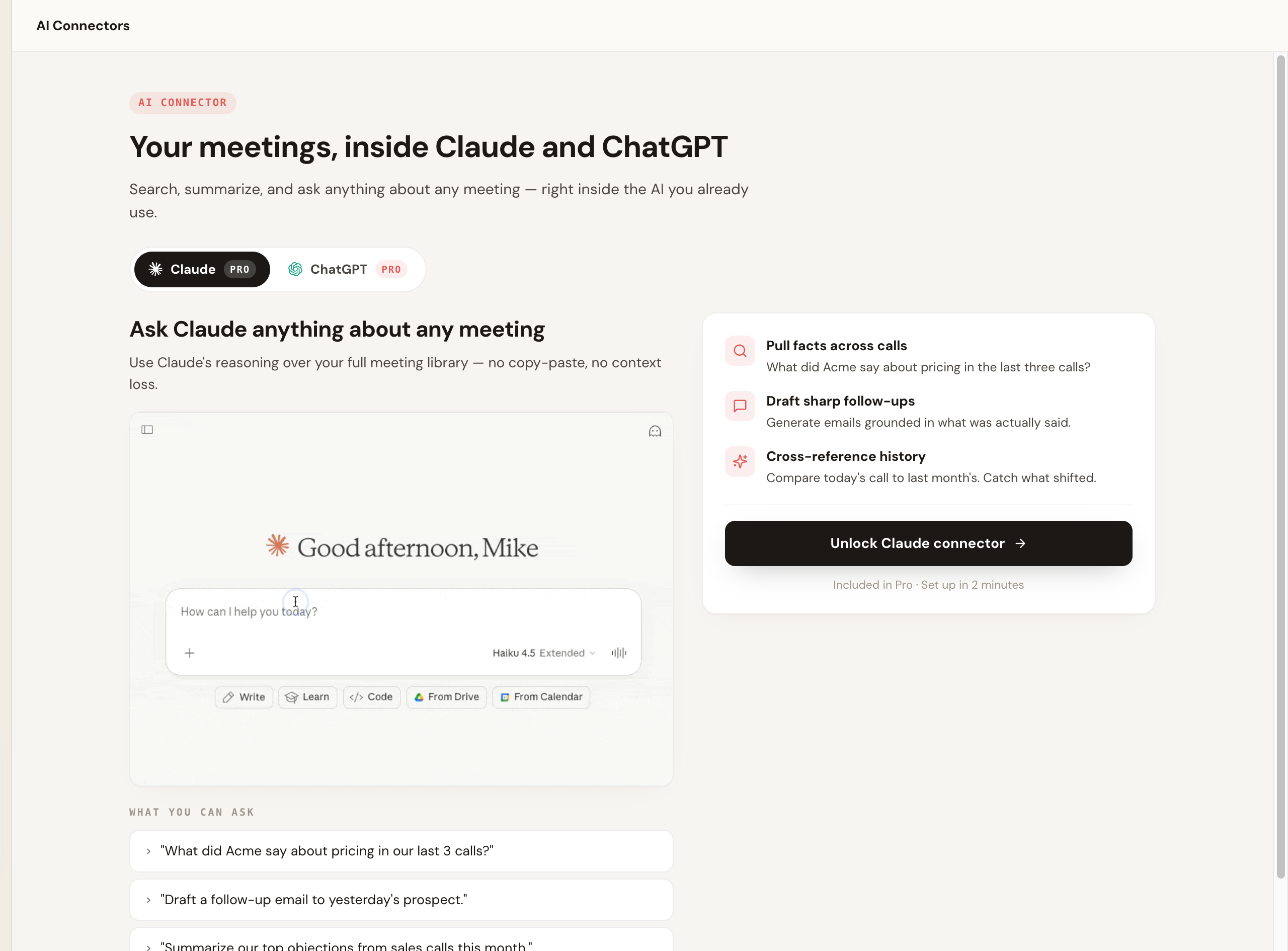
The part that separates Scribbl from a pure transcription tool is what happens after the call. Smart Collections sort each new meeting into groups you describe in one sentence, so you can ask Claude or ChatGPT about just one group, like "What were the main objections in my sales calls this week?" Automations do the follow-up: they draft the email, log notes in HubSpot or Pipedrive, post to Slack or Teams, save to Notion, Google Drive or Confluence, or open Linear, Jira, Asana or Monday tickets, and by default they ask before changing anything.
Pros: no bot ever joins; nothing is announced and no email goes to attendees; works across Meet, Zoom, and Teams; free plan with no credit card; Automations do the follow-up; focused output instead of analytics overkill. Pricing: free plan with 10 meetings a month, no credit card; Pro is $13 per user per month billed annually, or $20 monthly, on the pricing page. Best for: anyone with client, sales, or external calls who wants notes with no bot, a free start, and the follow-up connected to ChatGPT or Claude. More in our botless AI notetaker explainer and the Scribbl vs MeetGeek comparison.
- Capture: a notetaker bot joins the meeting as a participant
- Attendees see it: yes, a recording participant appears
- Interface: analytics-heavy library, dashboards, and insights
- After the call: automated summary, often with processing lag
- Capture: nothing joins the call
- Attendees see it: no bot, nothing announced, no email
- Interface: focused notes, transcript, and synced video
- After the call: Automations do the follow-up, and you can ask ChatGPT or Claude about every meeting
Because MeetGeek is the baseline, here is the head-to-head, using Scribbl as the example alternative. Competitor behavior changes, so confirm MeetGeek's current specifics on its own site.
| Feature | MeetGeek | Scribbl |
|---|---|---|
| Capture method | Sends a notetaker bot into the call | Botless; nothing joins the call |
| Visible to attendees | A recording participant appears | No bot, nothing announced, no email to attendees |
| Platforms | Meet, Zoom, Teams (confirm current support) | Google Meet, Zoom, Microsoft Teams |
| Interface | Analytics-heavy library and dashboards | Focused notes, transcript, synced video |
| Free plan | Free tier with a monthly-minute cap (confirm current limits) | 10 meetings a month, no credit card required |
| Delivery | Web app | Chrome extension (Google Meet) and Scribbl Desktop (Zoom, Teams) |
| AI summary and action items | Yes | Yes, with owners and due dates |
| Connects to ChatGPT or Claude | Yes, including on the free plan | Yes, on Pro; Smart Collections let you ask about one group of meetings |
| Rating | Verify current rating on review sites | 5.0 from 3,000 reviews on the Chrome Web Store; 4.9 from 725 reviews on G2 |
| Used by | Verify on MeetGeek | More than 10,000 organizations |
For the full breakdown, see our dedicated Scribbl vs MeetGeek comparison.
2. Fathom
Fathom is a polished, popular bot-based notetaker with a lighter interface than MeetGeek's. It typically joins the meeting to record, then produces clean summaries quickly. On the free plan every call gets an AI summary, but advanced summaries cover only your first 5 calls each month, and AI action items and follow-up emails need Premium. Processing is usually fast, which directly addresses the MeetGeek lag complaint, and the output is among the tightest of the bot-based tools. The trade is the usual one for a bot: a participant appears in the call, so on external or client meetings the room is no longer fully private.
Pros: free plan; clean, fast summaries; lightweight, well-supported interface; SOC 2 cited. Cons: a bot joins and is visible to attendees; lighter on the deep analytics and meeting library that MeetGeek built its identity on. Pricing: free plan; Premium is $16 per user per month billed annually, or $20 monthly (Fathom pricing). Best for: teams that want a clean, fast, popular notetaker for mostly internal meetings and are fine with a bot. See our Fathom alternative breakdown.
3. Fireflies.ai
Fireflies is one of the most established and feature-rich options, and it suits people leaving MeetGeek for more integrations and search depth, not less. Its standard model sends a notetaker bot, often called Fred, into the meeting. The searchable archive, broad CRM and chat connections, and team analytics are the draw, and it commonly cites SOC 2, GDPR, and HIPAA support on higher tiers, which makes it a frequent enterprise shortlist entry. The catch is cost structure: Fireflies has historically used an AI-credit or AI-action model, so heavy use of the AI features can run above the headline per-seat price.
Pros: very broad integrations; strong search and team analytics; SOC 2, GDPR, and HIPAA cited on tiers; strong admin and org controls. Cons: a visible bot joins; the feature surface can feel as heavy as MeetGeek's; watch the AI-credit costs, which are the hidden line item. Pricing: free plan with caps; Pro is $10 per seat per month billed annually or $18 monthly, and Business is $19 billed annually or $29 monthly, with AI credits metered separately (Fireflies pricing). Best for: teams that want a deep feature set and broad integrations, and do not mind a visible bot. See our Fireflies alternative breakdown.
4. Otter.ai
Otter is a mature transcription product and a natural MeetGeek alternative if live, in-meeting notes and strong English transcription are what you want. OtterPilot joins the call to record and transcribe, and the Business tier adds admin controls. Otter is strong on US-accented English and live note-taking, which is its lane. The common friction points are language coverage that is narrower than dedicated multilingual tools, auto-join behavior that can record meetings you did not intend to, and free-tier minute caps, so if multilingual accuracy was your MeetGeek complaint, Otter may not be the fix.
Pros: strong live notes and US-English accuracy; admin controls on Business; SOC 2 cited; widely supported. Cons: a bot joins; language coverage is narrower than rivals; auto-join can surprise you; free-tier minute caps. Pricing: free Basic plan with 300 monthly transcription minutes; Pro is $8.33 per user per month billed annually or $16.99 monthly, and Business is $19.99 billed annually or $30 monthly (Otter pricing). Best for: English-first teams that want live notes and, on Business, admin governance. See our Otter alternative roundup and MeetGeek vs Otter.
5. tl;dv
tl;dv focuses on recording and highlighting meetings, with clipping and sharing features that teams use to spread context. It generally captures by joining the call. If your MeetGeek workflow was really about cutting and sharing moments, tl;dv does that better, with a strong free tier and a clear emphasis on clips over dense analytics. It also leans into a GDPR-conscious posture, which European teams cite. The notes and summary are solid but secondary to the recording-and-clip workflow, so it is a fit when sharing video moments is the point.
Pros: excellent clipping and highlight sharing; good free tier; GDPR focus cited; lighter than MeetGeek's analytics. Cons: a bot joins; notes are secondary to clips for some teams; confirm current SOC 2 and admin posture. Pricing: free tier with caps plus paid plans from roughly $18 per user per month; confirm on tl;dv's site. Best for: teams that share meeting clips and want recording-first features. See our tl;dv alternative breakdown.
6. Granola
Granola is a lightweight notetaker that runs on your device and leans on your own editing, without a traditional join-the-call bot. It is the opposite of MeetGeek's heaviness: rather than dashboards and a recording bot, it produces clean, editable notes from what it hears on your machine. The trade is that it transcribes and then deletes the audio, so there is no recording or video to go back to, and if MeetGeek's weak video was your complaint, Granola gives you none at all.
Pros: no traditional join-the-call bot; lightweight and fast; clean, editable notes. Cons: keeps no recording or video; the free plan only reaches notes from the last 30 days; lighter on integrations and team features than the bot-based platforms. Pricing: Basic is free (notes from the last 30 days); Business is $14 per user per month, billed monthly (Granola pricing). Best for: solo users and small teams who want minimal, no-bot notes and do not need the recording. See our Granola alternative breakdown.
7. Read AI
Read AI leans into meeting metrics and analytics, layering engagement, sentiment, and speaker-balance readouts on top of transcription and summaries, capturing via a notetaker that joins the call. If your relationship with MeetGeek was actually about the analytics, but you found MeetGeek's particular dashboards lacking, Read AI is the most analytics-forward alternative here and reaches beyond the meeting into email and messaging context for some workflows. It is more than most people leaving MeetGeek want, since UI overkill is a common reason for the switch, so weigh whether you want more analytics or less.
Pros: meeting analytics, engagement and sentiment metrics; broad reach across meetings and messaging; SOC 2 cited. Cons: a bot joins; the metrics layer is more than many notetaker buyers need, and it is the opposite direction from "less UI." Pricing: free plan; Pro is $15 per month billed annually or $19.75 monthly (Read AI pricing). Best for: teams that specifically want meeting metrics and analytics alongside notes and accept a bot. See our Read AI alternative breakdown.
Which MeetGeek alternative should you pick
For most people leaving MeetGeek, pick Scribbl. If your calls include clients, prospects, candidates, or partners, you want notes with nothing joining the room, plus a free start, fast focused output instead of analytics overkill, and your meetings connected to ChatGPT or Claude. That is the lane Scribbl owns: no bot, across Google Meet, Zoom, and Microsoft Teams in one account.
The rest of the field each suits a narrower job, and every tool below except Granola sends a bot into your calls the way MeetGeek does:
- Fathom suits mostly internal meetings where a visible bot is fine.
- Fireflies suits teams that want deep integrations and will watch the AI-credit costs.
- Otter suits English-first teams that want live notes.
- tl;dv suits clip-and-highlight workflows.
- Granola suits solo users who want minimal typed notes and no recording.
- Read AI suits teams that want even more meeting metrics, the wrong direction if UI overkill was your complaint.
For sales teams specifically, the bot is usually decisive; see Scribbl for sales. For larger orgs weighing governance, see Scribbl for teams. If you want a free, no-bot start, our free AI notetaker with no bot guide is the shortest path, and our full best Otter.ai alternatives roundup compares this field head to head.
How to switch from MeetGeek without losing your notes
Switching is lower effort than people expect, and you do not have to do it all at once. Here is the order that avoids the two things people regret, losing old transcripts and being stuck mid-call without notes.
- Export anything you want to keep from MeetGeek. Transcripts and summaries typically export as text or PDF, and stored recordings can usually be downloaded. Confirm the current export options in MeetGeek, and treat this export as your archive, because transcripts do not migrate between tools.
- Install your replacement and run one real meeting through it. Pick the messiest call you reasonably can, since that is where tools separate, and time how fast the notes and video are ready so you can compare against the MeetGeek lag that may have sent you looking. With a botless tool like Scribbl you can do this on the free plan with no credit card, so there is no commitment to test it.
- Compare the output against what was actually said. Check names, numbers, multilingual segments, the summary quality, and the recorded video resolution and sync. If it holds up, you have your answer.
- Cancel or downgrade MeetGeek from your account settings once you are confident. Keep the export. Start fresh notes in the new tool.
MeetGeek alternatives FAQ
What is the best MeetGeek alternative in 2026? Scribbl is our top pick for most people leaving MeetGeek. Nothing joins the call: no bot, nothing announced, and no email to attendees. Every meeting gets the video, a transcript with speaker names, AI notes and action items, across Google Meet, Zoom, and Microsoft Teams in one account, and Scribbl connects your meetings to ChatGPT or Claude. The free plan needs no credit card. Most other alternatives, including Fathom, Fireflies, and Otter, send a recording bot into your calls the same way MeetGeek does.
Why do people leave MeetGeek? The recurring reasons we see in public reviews on G2, Capterra, and Reddit are an analytics-heavy interface that feels like overkill if you only want notes, slower post-meeting processing than rivals, weaker video quality, transcription accuracy that drops on accents and other languages, and billing or support friction around plan changes and the free-tier caps. Many switchers also want recording that does not sit outside their company security framework. Always verify current behavior on MeetGeek's own site, since products change.
Is there a MeetGeek alternative that does not use a bot? Yes. Scribbl is botless: no participant joins the call, nothing is announced, and no email is sent to attendees. It works across Google Meet, Zoom, and Microsoft Teams, records the video, and has a free plan with no credit card. Granola also avoids the traditional join-the-call bot, but it transcribes and then deletes the audio, so there is no recording to go back to. If invisible capture on external calls is your priority, start with Scribbl.
Are there free MeetGeek alternatives? Yes. Scribbl has a free plan with no credit card required: 10 meetings a month, including Google Meet, Zoom, and Microsoft Teams, and nothing joins the call. Fathom, Fireflies, tl;dv, Otter, and Granola also publish free tiers with their own usage caps, such as monthly transcription minutes or stored-meeting limits. Confirm current limits on each tool's own pricing page, since free-tier caps change often.
Which MeetGeek alternative is best for security and compliance? Start with who is in the call. MeetGeek, Fathom, Fireflies, Otter, and most other alternatives send a recording bot into every meeting, so an outside vendor's participant sits in your client and internal calls. Scribbl is botless: no bot or outside account enters the call, nothing is announced, and no email goes to attendees, on Google Meet, Zoom, and Microsoft Teams. The bot-based vendors publish their certifications and admin controls on their own trust pages, often gated to higher tiers, so check the tier you would actually buy.
Which MeetGeek alternative is best for multilingual meetings? Inaccurate multilingual transcription is a common reason people leave MeetGeek. If non-English calls are your norm, shortlist on the supported-language count and on whether the tool transcribes in the spoken language versus translating to English, and confirm the current list on each vendor's site. Accuracy varies a lot by language, so run one real call in your main language through your top pick before you commit.
How is MeetGeek's video quality compared to alternatives? Weak or low-resolution video is a recurring MeetGeek complaint in reviews. If the recorded video matters, such as for sharing demos or training, judge it directly: record one real call and check resolution, sync, and whether the player lets you jump to moments. Scribbl records the call with a synced transcript so you can click any line to jump to that moment in the video. Confirm current video resolution and export options on any vendor's own site, because they change.
Does Scribbl train AI on my meetings? No. Scribbl doesn't use your meetings to train AI for anyone other than you, and recordings are private by default. Training and data policies differ across the other tools on this list and change over time, so read each vendor's current privacy policy and data-processing terms before you record sensitive calls.
Do these MeetGeek alternatives work with Microsoft Teams and Zoom? Many do, but coverage varies, so confirm on each vendor's site. Scribbl works on Google Meet with its Chrome extension and on Zoom and Microsoft Teams with Scribbl Desktop (Mac with Apple silicon and Windows), and it is botless on all three. Bot-based tools like Fathom, Fireflies, tl;dv, and Otter generally support Meet, Zoom, and Teams by sending a notetaker into the call. If you mostly meet on Teams, verify Teams support specifically, since some tools support it on higher tiers only.
How do I switch from MeetGeek to an alternative? Switching is mostly low effort. First, export anything you want to keep from MeetGeek, since transcripts and summaries usually export as text or PDF and your stored recordings can be downloaded (confirm current export options in MeetGeek). Second, install your replacement and run one real meeting through it, ideally a messy one, to confirm accuracy, processing speed, and the in-call experience. Third, once you are happy, cancel or downgrade MeetGeek from your account settings. Transcripts do not migrate between tools, so treat the export as your archive and start fresh. With a botless tool like Scribbl you can run that first test call on the free plan with no credit card.
Try Scribbl
Let your meetings take their own notes.
Scribbl records, transcribes, and summarizes your Google Meet calls from your browser. No bot joins the call. Free forever for individuals.
Add to Chrome · It's free