How to Write Meeting Minutes: Steps, Template and Example (2026)
How to write meeting minutes: what to do before, during and after the meeting, what to leave out, a copy-paste template, filled-in examples and approval.
Updated October 7, 2026
To write meeting minutes, list who attended, then for each agenda item write down what was decided and who will do what by when. Leave out the back-and-forth, send the draft within a day so people can correct it, and in formal meetings have the group approve it at the next meeting.
That's the whole job. Minutes are the shared record of a meeting, not a transcript, so good minutes are short: most team meetings fit on one page. Below are the steps for before, during and after the meeting, what changes for a board, committee or club, a template to copy, two filled-in examples, and how an AI note taker such as Scribbl now writes most of it for you.
What are meeting minutes?
Meeting minutes are the written record of a meeting: when it happened, who was there, what the group decided, and who agreed to do what. "Minutes of meeting," often shortened to MoM, means the same thing.
People often mix minutes up with two other things:
- Meeting notes are anyone's personal notes. They can be rough, partial and in shorthand. Minutes are the one version the group agrees is accurate.
- A transcript is every word, in order. Minutes keep the outcome and drop the conversation. A transcript is useful to write minutes from, but it isn't minutes.
Who takes them: in a board, committee or club, usually the secretary. In a team meeting, whoever the organizer asks. It works better when that isn't the person running the meeting.
How to write meeting minutes, step by step
Before the meeting
- Get the agenda. The agenda is the outline of your minutes. Each item becomes a heading, so you fill in blanks instead of starting from a blank page.
- Set up the template. Paste the template below into a doc and fill in the meeting name, date, place or video link, and the invite list. During the meeting you then only mark who showed up.
- Learn the names and terms. Know how to spell everyone's name and what they do, and look up project names and acronyms you don't know. It's hard to write down a decision about something you can't spell.
- Ask how much detail is wanted. A weekly team check-in needs decisions and action items. A board may have bylaws or legal rules about what its minutes must show. Ask the chair before the meeting, not after.
- Decide whether you'll record. A recording, or an AI note taker, means you don't have to catch every word. If you use one, tell everyone at the start that you're recording.
During the meeting
- Write the start time and who's there. List who's present, who's absent, and anyone who joins late or leaves early. Formal meetings also note that a quorum was present and the time the chair called the meeting to order.
- Follow the agenda. Under each item, add a sentence or two of context only if a reader would be lost without it.
- Write every decision as a decision. "Decision: the launch moves to November 3." Not "There was a discussion about timing."
- Write every action item with one owner and a due date. If either is missing, ask before the meeting moves on: "Who's taking that, and by when?"
- In formal meetings, write each motion word for word. Note who made it and the result. If the votes were counted, write the count.
- Note what's left open. Items pushed to a later meeting, questions nobody could answer, and the date of the next meeting. Then write the end time.
After the meeting
- Write them up the same day. Notes that made sense at 10 a.m. are hard to read by Friday. If you recorded, use the recording or transcript to fill gaps.
- Check names, numbers and dates. These are the details people act on, and the ones that cause trouble when they're wrong.
- Have the chair read them before they go out, for formal meetings or anything sensitive.
- Send them to everyone who was invited, including people who didn't make it. Put the decisions and action items near the top.
- Get them approved and file them. Formal minutes are approved at the next meeting (how that works). Keep them where the group can find them, and copy the action items into whatever your team uses to track work.
What to include in meeting minutes, and what to leave out
- Meeting name, date, start and end time, and where it was held
- Who was present, who was absent, and who took the minutes
- Each agenda item, with a sentence of context only where needed
- Every decision, stated plainly
- Every action item, with one owner and a due date
- Formal meetings: each motion word for word, who made it, and whether it passed
- Open questions and items moved to a later meeting
- The date of the next meeting
- Word-for-word quotes, and who said what in a debate
- Your opinion of the discussion, such as 'a heated exchange' or 'a great idea'
- Side conversations, jokes and small talk
- Ideas that were floated but not agreed, unless someone owns a follow-up
- Confidential details your group hasn't agreed to put in writing
- Anything you're not sure was said, until you've checked it
Team meetings vs formal meetings
A weekly team meeting and a board meeting need different minutes.
| Team meeting | Formal meeting (board, committee, club, council) | |
|---|---|---|
| What matters most | Decisions and action items | Motions, votes and decisions |
| Discussion | A sentence of context where it helps | Usually none, unless your group asks for it |
| Names | Attendees and the owner of each action item | Attendees, the chair, the secretary, and who made each motion |
| Opening lines | Date, time, who's there | Also: quorum, time called to order, approval of the last minutes |
| Closing lines | Date of the next meeting | Time adjourned, and the secretary's name, often after "Respectfully submitted" |
| Approval | None; people reply with fixes | Approved by the group at its next meeting |
| When to send | The same day | A draft within a few days, after the chair has read it |
Two Robert's Rules details catch people out. First, the official Robert's Rules site says it isn't just unnecessary to summarize the debate in formal minutes, it's improper (Source: Robert's Rules FAQ 15, citing RONR 12th edition 48:2, as of October 2026). Second, the minutes name the person who made a motion, but not the person who seconded it, unless your organization's own rules ask for that (Source: parliamentarian Sarah E. Merkle, Civility).
Many groups add their own rules. Eastern Connecticut State University's sample minutes for student clubs, for example, number every motion, name who made and seconded it, and ask for a short paragraph on each topic (Source: Eastern Connecticut State University). If your bylaws or your organization say how minutes should look, follow them first.
How to write decisions, action items and motions
The difference between minutes people use and minutes nobody opens is mostly in how these lines are written.
| Vague | Clear | |
|---|---|---|
| Decision | Discussed the launch date. | Decision: the launch moves from October 20 to November 3. |
| Action item | Look into venues. | Ben: get two venue quotes under $5,000, by Friday, October 16. |
| Action item | Marketing to follow up ASAP. | Ana: send the new launch date to sales and support, by Wednesday, October 7. |
| Motion | Everyone agreed on the book budget. | M. Ortiz moved to spend up to $1,200 on library books from the fall fundraiser. Motion carried, 5 in favor, 0 opposed, 0 abstentions. |
| Open item | Free plan TBD. | Not decided: whether the pricing page shows a free plan. Back on the agenda October 13. |
For action items, three rules do most of the work: one owner (a person, not "the team"), a task that starts with a verb, and a real date instead of "soon." There's more on this in meeting minutes format with action items.
Meeting minutes template (copy and paste)
Paste this into Google Docs, Word or your team's wiki. For a team meeting, delete the lines marked "formal meetings only."
[TEAM OR ORGANIZATION]: MEETING MINUTES

Meeting:      [name, e.g. Weekly product check-in]
Date and time: [day, date, start to end time, time zone]
Where:        [room, or Google Meet / Zoom / Teams]
Chair:        [name]
Minutes by:   [name]
Present:      [names]
Absent:       [names]

[Formal meetings only]
Quorum:            [present / not present]
Called to order:   [time]
Previous minutes:  [approved as presented / approved as corrected]

1. [AGENDA ITEM]
   Context:   [one or two sentences, only if needed]
   Decision:  [what was decided, or "Not decided. Back on (date)."]
   Motion:    [formal meetings only: exact wording. Moved by (name).
               Carried or failed, (number) in favor, (number) opposed,
               (number) abstentions]

2. [AGENDA ITEM]
   Context:
   Decision:

ACTION ITEMS
   Owner     Task (start with a verb)                    Due
   [name]    [task]                                      [date]
   [name]    [task]                                      [date]

OPEN ITEMS
   [question or topic, and when it comes back]

NEXT MEETING
   [date, time, place or link]

Adjourned: [time]
Approved on: [date]  [formal meetings only]
For more layouts, including a version with a status column, see the meeting minutes example post. For board minutes and their legal side, see the guide to board meeting minutes.
Meeting minutes example
Team meeting minutes example
A 30-minute weekly check-in for a website relaunch, written from the template above.
WEBSITE RELAUNCH CHECK-IN: MEETING MINUTES

Date and time: Tuesday, October 6, 2026, 10:00 to 10:30 AM ET
Where:         Zoom
Chair:         Ana Ortiz
Minutes by:    Sam Reed
Present:       Ana Ortiz, Ben Clarke, Chloe Park, Sam Reed
Absent:        Dev Patel

1. LAUNCH DATE
   Context:   Testing found 12 open bugs, 3 of them blockers.
   Decision:  The launch moves from October 20 to November 3.

2. PRICING PAGE
   Decision:  Show annual prices first, with monthly prices behind a toggle.
   Not decided: whether the page shows a free plan. Back on October 13.

3. HELP CENTER
   Chloe has moved 40 of 65 articles to the new site. No decision needed.

ACTION ITEMS
   Owner   Task                                           Due
   Ben     Fix the 3 blocker bugs                         Fri, Oct 16
   Ana     Send the new launch date to sales and support  Wed, Oct 7
   Chloe   Move the last 25 help articles                 Fri, Oct 23
   Sam     Draft both free-plan options for October 13    Mon, Oct 12

NEXT MEETING
   Tuesday, October 13, 2026, 10:00 AM ET, Zoom

Corrections to Sam by Thursday, October 8.
What to notice: there's one line of context in the whole thing, and only where the decision would look odd without it. The item nobody decided is written down as not decided, with a date, so it doesn't vanish. Every action item has one person and one date.
Formal meeting minutes example (with motions)
A parent-teacher association board meeting, following Robert's Rules.
RIVERSIDE PTA BOARD: MINUTES OF THE REGULAR MEETING

Date:     Thursday, October 1, 2026
Where:    Riverside Elementary library
Present:  J. Lee (president, chair), M. Ortiz, R. Shah (treasurer),
          T. Brown, K. Nguyen, A. Wright (secretary)
Absent:   P. Hall

A quorum was present. The chair called the meeting to order at 7:02 PM.

The minutes of the September 3 meeting were approved as corrected.

Treasurer's report: R. Shah reported a balance of $6,420.

Library books: M. Ortiz moved to spend up to $1,200 on library books
from the fall fundraiser. Motion carried, 5 in favor, 0 opposed,
0 abstentions.

Spring carnival: T. Brown moved to hold the spring carnival on
Saturday, May 8, 2027. Motion failed, 2 in favor, 3 opposed,
0 abstentions.

Action items:
  R. Shah     Order the library books                       Oct 30
  K. Nguyen   Bring two other carnival dates to the board   Nov 5

Next meeting: Thursday, November 5, 2026, 7:00 PM, school library.

The meeting adjourned at 8:05 PM.

Respectfully submitted,
A. Wright, Secretary
What to notice: no summary of the debate, just what the board did. Each motion names who made it but not who seconded it. The correction to the last minutes isn't spelled out; "approved as corrected" is enough (Source: Robert's Rules FAQ 16, as of October 2026). If your bylaws ask for the seconder's name or a summary of each topic, add them.
How to send and approve meeting minutes
Team meetings. Send the minutes the same day, by email or in the team's chat, with a link to the full doc. Put the decisions and action items in the message itself, because many people won't open the link. Give a date for corrections.
Subject: Minutes: Website relaunch check-in, Tuesday, October 6

Hi all,

Here are the minutes from today's check-in. The full minutes are here: [link]

Decisions
- The launch moves from October 20 to November 3.
- The pricing page shows annual prices first.

Action items
- Ben: fix the 3 blocker bugs, by Friday, October 16
- Ana: send the new launch date to sales and support, by Wednesday, October 7
- Chloe: move the last 25 help articles, by Friday, October 23
- Sam: draft both free-plan options, by Monday, October 12

Next meeting: Tuesday, October 13, 10:00 AM ET

Please reply with any corrections by Thursday, October 8.

Sam
For more on the wording of the email itself, see how to write a follow-up email.
Formal meetings. Minutes only become the official record once the group approves them.
- 1
Write the draft
The secretary writes the minutes from their notes, within a few days of the meeting.
- 2
The chair reads it
The chair checks names, numbers and the wording of each motion before anyone else sees it.
- 3
Send the draft
Send it to members, marked as a draft, so they can read it before the next meeting.
- 4
Approve at the next meeting
Early in the next meeting, the chair asks for corrections. With none, the minutes are approved as presented. With changes made on the spot, they are approved as corrected, without listing what changed.
- 5
File the approved minutes
Keep the approved minutes where members can find them. They are now the official record of that meeting.
If someone finds a mistake after the minutes were approved, Robert's Rules says the secretary doesn't rewrite the original. The group votes to change it, and the secretary can add a note in the margin pointing to the change (Source: Robert's Rules FAQ 16).
How to take minutes when you're also in the meeting
If you're expected to take part and take the minutes, you can't listen, talk and write all at once. A few ways to make it easier:
- Write less. Only decisions and action items during the meeting. Add context afterward.
- Use the agenda as your page, so you never have to work out where you are.
- Ask the chair to say decisions and owners out loud at the end of each item.
- Hand it off when you're running the meeting. It's hard to lead a discussion and write it down at the same time.
- Let an AI note taker such as Scribbl take the notes, and write the minutes from them afterward. Tell everyone at the start that you're recording. In some places everyone has to agree; see do you have to tell people you're recording.
For your own notes (as opposed to the group's minutes), see how to take better meeting notes.
Common meeting minutes mistakes
- Writing a transcript. Nobody reads three pages to find one decision.
- Action items with no single owner. "Marketing" or "the team" means nobody. Put one name on each.
- "ASAP" instead of a date. Without a date, nobody can tell whether the task is late.
- Decisions hidden in paragraphs. Label them "Decision:" so people can find them at a glance.
- Opinions and tone. "John strongly disagreed" or "a lively debate" doesn't belong in the record.
- Leaving out who was absent. Later, people need to know who was there when a decision was made.
- Sending them days later. By then people have acted on their own memory of the meeting.
- Quietly editing approved minutes. Change them only through the group, as above.
- Sending an AI draft without reading it. AI notes are a draft. Check every owner, date and decision.
How AI note takers write meeting minutes
An AI note taker records the meeting, writes a transcript with speaker names, and then turns it into notes: a summary, the decisions and the action items. That covers the "during" part of the job, so the person who usually takes minutes can join in instead. What's left is the "after" part: check the draft and send it.
Your meeting app may have one built in, but only on paid plans:
- Google Meet: "Take notes for me" needs an eligible Google Workspace edition or Google AI plan, and the notes are saved in the meeting organizer's Google Drive (Source: Google Meet Help, as of October 2026).
- Zoom: Meeting Summary with AI Companion needs a paid Zoom Workplace license, Pro or higher (Source: Zoom Support, as of October 2026).
- Microsoft Teams: intelligent recap, with AI meeting notes and recommended tasks, needs a Teams Premium or Microsoft Copilot license (Source: Microsoft Learn, as of October 2026).
Scribbl does it on all three, on its free plan, with the video to check the minutes against.
Scribbl: the minutes drafted and sent for you
Scribbl is an AI note taker for Google Meet, Zoom and Microsoft Teams, and we make it. Nothing joins the call. Google Meet works from a Chrome extension, and Zoom and Teams from the Scribbl desktop app for Mac (Apple silicon) and Windows.
After each meeting you get:
- The video recording.
- A transcript with speaker names.
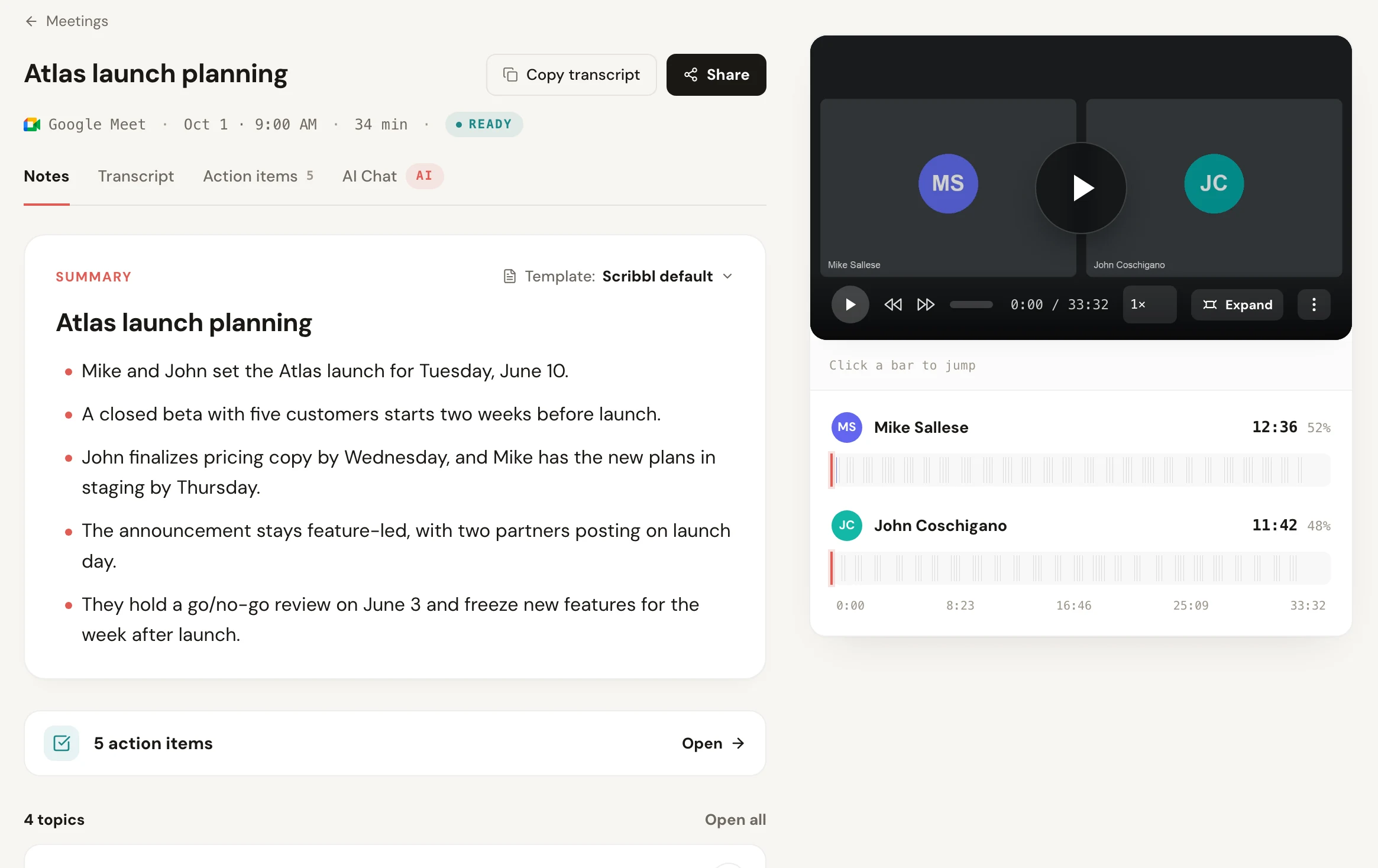
- AI notes and action items. In the screenshot at the top of this page, the summary of Scribbl's sample meeting already reads like the decisions in a set of minutes: the launch date, the beta, who finishes what by which day, and the date of the go/no-go review.
- A first draft of your minutes. Copy the notes and action items into your template, add anything a formal meeting needs (quorum, motion wording, vote counts), and send it.
Then it does the "after" part too:
- Sending the minutes. Automations draft the follow-up email with the decisions and action items, post the minutes to Slack or Teams, or save them to Notion or Confluence. They ask before changing anything by default.
- Tracking the action items. Automations can open a Linear, Jira, Asana or Monday ticket for each one, or add a row to a Google Sheet.
- Finding a past decision. Smart Collections keep each group's meetings together, like every board meeting, and you can connect Scribbl to ChatGPT or Claude and ask what you decided about the launch date last month.
What it costs: the free plan includes Google Meet, Zoom and Microsoft Teams, with 10 meetings a month. Pro is $13 per user per month billed annually, or $20 monthly (pricing).
Whichever tool you use, tell everyone at the start of the meeting that you're recording.
Try Scribbl freeTo turn AI notes into minutes a board can approve, see meeting minutes AI. To do it with ChatGPT and a prompt, see ChatGPT meeting notes.
FAQ
What are meeting minutes?
Meeting minutes are the written record of a meeting: who attended, what was decided, and who agreed to do what by when. They are not a transcript. Minutes of meeting, often shortened to MoM, means the same thing.
What are the four things meeting minutes should include?
The basics (meeting name, date, time and who attended), the decisions, the action items with an owner and a due date, and the date of the next meeting. Formal meetings also record each motion, who made it, and whether it passed.
What should not be included in meeting minutes?
Leave out word-for-word quotes, who said what in a debate, personal opinions, side conversations, jokes and heated remarks. For formal meetings, Robert's Rules says minutes record what was done at the meeting, not what was said. Keep confidential details out unless your group has agreed how to record them.
How soon should meeting minutes be sent?
Within a day for team meetings, while people still remember what happened. Some groups set a deadline: Eastern Connecticut State University asks its student clubs to send minutes within 48 hours. Formal minutes go out as a draft first and are approved at the next meeting.
Who approves meeting minutes?
For formal meetings, the group does, usually early in its next meeting. If nobody has changes, the minutes are approved as presented. If changes are made at that point, they are approved as corrected. Team meeting minutes usually need no vote; people reply with corrections instead.
How do you take minutes and take part in the meeting at the same time?
Write less during the meeting. Keep the agenda open, write down only decisions and action items, and ask the chair to say each decision out loud before moving on. Or let an AI note taker such as Scribbl, which makes this page, write the notes and action items, after telling everyone you're recording, and write the minutes from them afterward.
Should meeting minutes say who said what?
Usually not. Name people where it matters: who attended, who owns each action item and, in formal meetings, who made each motion. Under Robert's Rules, the person who seconded a motion is not named unless your organization's own rules ask for it.
What is the difference between meeting minutes and meeting notes?
Meeting notes are anyone's personal notes and can be as rough as you like. Minutes are the shared, official record that the group agrees is accurate. Notes are often what you write the minutes from.
Can ChatGPT write meeting minutes?
Yes, from notes or a transcript you paste in. Ask for fixed headings (attendees, decisions, action items with owner and due date) and tell it to write 'not recorded' where the notes don't say, instead of guessing. Check names, numbers and decisions before you send them.
Can AI write meeting minutes automatically?
Mostly. An AI note taker records the meeting and writes the notes and action items for you, and you check them and send them. Scribbl, which makes this page, does this on Google Meet, Zoom and Microsoft Teams with nothing joining the call, and its Automations can send the minutes on, like drafting the follow-up email or posting them to Slack. The free plan includes Google Meet, Zoom and Microsoft Teams, with 10 meetings a month.
Sources
Every rule, plan and limit above was checked on these pages on October 6, 2026.
- Robert's Rules of Order, official site: Frequently asked questions, FAQ 15 (what minutes contain, citing RONR 12th edition 48:2) and FAQ 16 (corrections and "approved as corrected," citing 48:4(5) and 48:15)
- Sarah E. Merkle, PRP, Civility: 4 Things Most People Get Wrong About Seconds (July 13, 2017)
- Eastern Connecticut State University, Student Activities: Sample minutes and instructions (PDF)
- Google Meet Help: Take notes for me in Google Meet
- Zoom Support: Using Meeting Summary with AI
- Microsoft Learn: Intelligent recap for Teams calls, meetings, and events
- Scribbl: pricing
Try Scribbl
Let your meetings take their own notes.
Scribbl records, transcribes, and summarizes your Google Meet calls from your browser. No bot joins the call. Free forever for individuals.
Add to Chrome · It's free